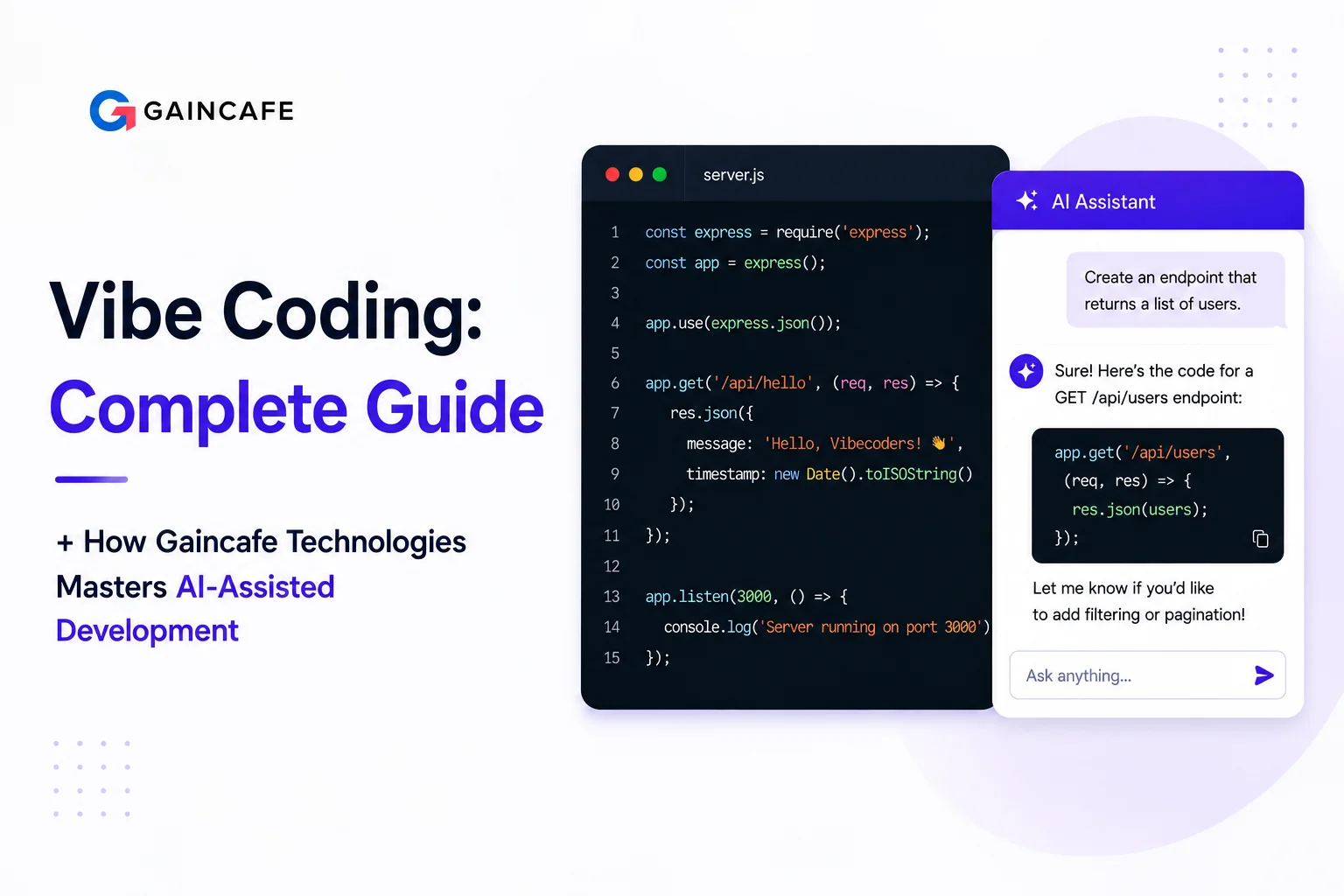
A couple of years ago, "just describe what you want and let the AI build it" sounded like a sales pitch. In 2026 it is how a growing share of real software actually gets made. That shift has a name, vibe coding, and it went mainstream fast enough that Collins Dictionary named it the Word of the Year for 2025. This guide explains what vibe coding really is, how it works, where it genuinely helps, where it quietly fails, and how teams use it to ship faster without shipping junk.
Whether you are a founder trying to get a product out the door, a developer curious about the workflow, or a business leader weighing the risks, this is the practical picture, not the hype.
What Is Vibe Coding?
Vibe coding is a way of building software where you describe what you want in plain language and an AI model writes the code, while you guide, review, and refine. The term was coined by AI researcher Andrej Karpathy in early 2025, and it captured something that was already happening: developers increasingly working alongside large language models like a pair programmer, rather than typing every line themselves.
The idea is simple. Instead of translating your intent into syntax manually, you express the intent, "build a booking form that saves to the database and emails a confirmation," and the AI produces a working first version. You then nudge it, correct it, and shape it until it does what you need. The developer stays in the creative, decision-making seat; the AI handles the mechanical typing.
That accessibility is the big deal. Vibe coding lowers the barrier to building software, so a solo founder or a small team can produce things that used to need a full engineering department. It does not remove the need for real engineering judgment, as we will get to, but it changes who can start and how fast.
Vibe Coding vs Traditional Programming
The clearest way to understand vibe coding is to put it next to the traditional approach. Here is an honest comparison.
| Aspect | Traditional coding | Vibe coding |
|---|---|---|
| How you build | Manual, line by line | Natural-language instructions |
| Speed to a working version | Days to weeks | Hours to days |
| Barrier to entry | High, needs deep syntax knowledge | Low, accessible to non-specialists |
| Developer focus | Syntax and implementation details | Logic, product, and creativity |
| Process | Linear and planned | Iterative and experimental |
| Risk | Slow but predictable | Fast, but needs review to stay safe |
Notice the last row, because it is the one most guides skip. Vibe coding trades some predictability for speed, which is a great deal early on and a dangerous one if you ship AI-generated code to production without a human checking it.
How Vibe Coding Works
Under the surface, vibe coding is a loop between you and an AI model, usually inside a tool built for it. It runs something like this.
You start by describing your vision in plain language, as specifically as you can. The AI generates an initial version, the structure, the screens, the basic logic. You look at what it built, then refine it with feedback: fix this, add that, change how this behaves. You go around that loop a few times until the thing works. Then comes the step that separates a demo from a product: a real review, where an experienced developer checks the code for security, performance, and architecture before it goes live.
That last step matters more than the marketing admits. The AI gets you to "it works on my screen" remarkably fast. Getting to "it works safely for ten thousand users" still needs human engineering. The teams that win with vibe coding are the ones that respect that line.
Popular Vibe Coding Tools in 2026
The tooling has matured a lot since the term was coined. These are the tools doing the heavy lifting in 2026, each suited to a slightly different job.
- Lovable is a full-stack AI app builder that turns a prompt into a working web app, frontend, backend, and database, and is popular for fast prototypes and MVPs.
- Cursor is an AI-first code editor whose agent can plan and make changes across a whole codebase, now a daily tool for many professional developers.
- Claude Code is a terminal-based coding agent that has become a favorite for working on larger, real codebases rather than greenfield demos.
- GitHub Copilot remains the widely used in-editor assistant for suggestions and completions.
- Replit Agent offers a browser-native environment where you can build and run without local setup.
Most serious teams do not pick one. They validate quickly in a builder like Lovable, then move into Cursor or Claude Code for the deeper engineering, and pair it all with a backend like Supabase. If you want help choosing, our comparison of the best AI app builders of 2026 breaks down which tool fits which job.
Not sure which vibe coding tools fit your stack?
Tell us your stack, team size, and goals, and Gaincafe will recommend the right tools for prompting, building, reviewing, and shipping faster, without breaking your workflow.
Why Vibe Coding Took Off
Vibe coding did not go mainstream because it is trendy. It spread because it solves a real problem: software has always been slow and expensive to build, and this makes a large chunk of it fast and cheap. A few forces pushed it from experiment to everyday practice.
- Speed: Ideas that took weeks to prototype now take days or hours, which changes how quickly a business can test and learn.
- Access: People who could never build software before can now ship a working first version, which has opened the door to a wave of founders and small teams.
- Cost: Less time means less money for an early build, freeing budget for the parts that actually need senior engineering.
- Model quality: The AI models behind these tools got dramatically better through 2025 and 2026, so the code they produce is far more usable than it once was.
The scale of the shift is real. Y Combinator reported that roughly a quarter of its early-2025 startup batch had codebases that were around 95% AI-generated, a number that would have sounded absurd a year earlier. Vibe coding is no longer a novelty at the edges; it is moving into the mainstream of how products get built.
The question for most teams is no longer whether to use AI to build, but how to use it without shipping something fragile.
Where Vibe Coding Genuinely Helps
It is at its best when speed and iteration matter more than deep complexity. The strongest fits are:
- Prototypes and MVPs, where the goal is to test an idea quickly and cheaply before investing heavily.
- Internal tools and dashboards, where a small team needs something functional without a long build.
- Standard web apps, booking tools, simple marketplaces, and content sites, where the patterns are well understood.
- Early-stage startups, who need to move fast on a tight budget and validate before scaling.
In these cases, spending months hand-coding a first version is the expensive mistake, not the safe choice. Vibe coding lets you learn what to build before you pour real money into building it properly. For founders, this pairs naturally with lean MVP development: prove the idea fast, then invest in what the evidence supports.
Where Vibe Coding Still Needs Human Experts
Here is the honest counterweight, and it is the part that matters most if you plan to run real software on this. AI models are brilliant at producing something that works and surprisingly weak at the things that keep it working safely at scale.
- Security. AI-generated code can carry real vulnerabilities, and the model will not always flag them. Human audits catch what the AI misses.
- Architecture. A model optimizes for "make it work now," not "make it scale for two years." Scalable structure still needs human design.
- Performance. Making an app fast under real load is engineering work the AI rarely does well on its own.
- Complex integrations. Wiring into messy, real-world business systems needs domain knowledge and careful handling.
- Maintainability. Fast-generated code can become a tangle that is expensive to change later, which is its own kind of debt.
This is exactly why the trust picture is nuanced. Even as developer use of AI tools has climbed sharply, surveys show their trust in the output has actually fallen, because experienced engineers keep finding the gaps. The lesson is not to avoid vibe coding. It is to use it for speed and keep humans in charge of safety. When a vibe-coded prototype proves itself, the smart move is to take that vibe-coded app to production-ready with proper engineering, rather than shipping the demo as-is.
Vibe coding gets you to "it works" fast. Getting to "it works safely at scale" is still a human job, and pretending otherwise is how teams end up with an expensive rebuild.
How Gaincafe Technologies Uses Vibe Coding
At Gaincafe, vibe coding is not a shortcut, it is a first gear. The team uses AI-assisted development to move fast in the early, exploratory phase, then applies senior engineering where it counts: security, architecture, performance, and scale. The result is startup speed with production discipline.
In practice, that means prototyping quickly in tools like Lovable, developing in Cursor and Claude Code, and building on a solid backend with Supabase for real-time data and authentication, all reviewed by experienced developers before anything ships. The supporting stack, Vercel for deployment, React and Next.js on the frontend, TypeScript for safety, and Tailwind for styling, is deliberately boring and dependable, because the goal is software that lasts, not just software that demos well.
What makes this work is the balance. Teams that lean entirely on AI ship fast and break at scale. Teams that refuse AI move slowly and overspend on early builds. Gaincafe's approach, AI for speed and humans for judgment, is the middle path that most successful products actually follow, and it is available through its broader AI development and automation work.
Real Examples: What Vibe Coding Has Built
The clearest way to understand the value is to look at real products, not demos, and there are plenty of real apps built with Lovable that show what is possible. Here are projects built with AI-assisted development and human oversight.
1. Ritu IVF, a Healthcare Platform
A fertility clinic website built with emotional storytelling at its core, delivered in about two weeks rather than the three months a traditional build would have taken. It pairs a clean Next.js and Supabase foundation with thoughtful design: an interactive IVF journey, smart appointment booking, and a cost calculator. The result speaks for itself in search, where the site now ranks at the top of Google for its core terms, including "best IVF doctor" and "IVF centre in Jaipur," driving steady patient enquiries. It is a good example of vibe coding handling the build speed while design and strategy did the heavy lifting.
Ilios Health, a Medical Consultation Platform
A second-opinion medical platform built in roughly three weeks instead of four months. It includes real-time dashboards, doctor matching, HIPAA-aware video consultations, encrypted file sharing, and multilingual support, the kind of workflow-heavy product where AI accelerated the build and senior engineering ensured the security and compliance were done right.
Other Builds
The same approach has powered a range of products, from ROI calculators for a clean-energy company to a freight-forwarding platform with live tracking and an automated tax-compliance tool. In each case, the pattern held: AI for speed in the early build, humans for the parts that carry real risk.
Have an idea you want built fast, and built right?
Gaincafe combines vibe coding speed with senior engineering, so you ship quickly without the hidden rebuild later.
How to Vibe Code Well: Practical Tips
If you are going to try it, a few habits separate useful results from frustrating ones.
- Be specific. Vague prompts get vague code. Describe the behaviour, the data, and the edge cases you care about.
- Work in small steps. Build one feature at a time and check it before moving on, rather than asking for the whole app at once.
- Review everything that matters. Treat AI output as a first draft, not a final answer, especially anything touching data, payments, or security.
- Keep the code yours. Use tools that let you export or sync the code to a version control system, so a developer can take over later.
- Know when to switch gears. When you hit real complexity, security, scale, or deep integrations, bring in engineering help rather than fighting the tool.
The founders who get the most from vibe coding treat it as a way to learn fast and cheaply, then invest properly once they know what they are building. If you reach that point, it often makes sense to hire a specialist to take the build the rest of the way.
The Future of AI-Assisted Development
Where is this heading? A few directions are already clear enough to plan around, without pretending anyone can predict the field precisely.
- From suggestions to agents. Tools are shifting from completing lines to carrying out whole tasks across a codebase, with the developer directing rather than typing.
- Smarter, domain-aware models. Models are getting better at specific domains, so the code they produce needs less correction.
- AI in testing and quality. Beyond writing code, AI is increasingly used to test it, catch bugs, and check compliance.
- A higher bar on originality. As building gets easier, a distinct, well-made product matters more than one shipped fast, which keeps human judgment central.
The practical takeaway is not that developers disappear. It is that the job shifts further toward judgment, architecture, and product thinking, while the mechanical typing gets handed to the machine. The teams that thrive will be the ones that use AI for speed and keep humans firmly in charge of what good actually means.
Conclusion
Vibe coding is one of the most significant shifts in how software gets made, and in 2026 it is no longer an experiment, it is part of the mainstream toolkit. Used well, it compresses the slow, expensive early phase of building into something fast and cheap, which is a genuine advantage for founders and teams.
But the speed is only half the story. The products that last are the ones where AI handled the building and experienced humans handled the judgment: the security, the architecture, the scale. Get that balance right, as the strongest teams do, and vibe coding stops being a gimmick and becomes a real competitive edge.
If you want to move at vibe coding speed without inheriting a fragile product, Gaincafe Technologies builds with AI for speed and senior engineering for everything that has to hold up. Start with a conversation about what you want to build.
Ready to build at vibe coding speed, the right way?
From fast prototypes to production-grade products, Gaincafe pairs AI-assisted development with senior engineering and full code ownership. Get an honest roadmap today.