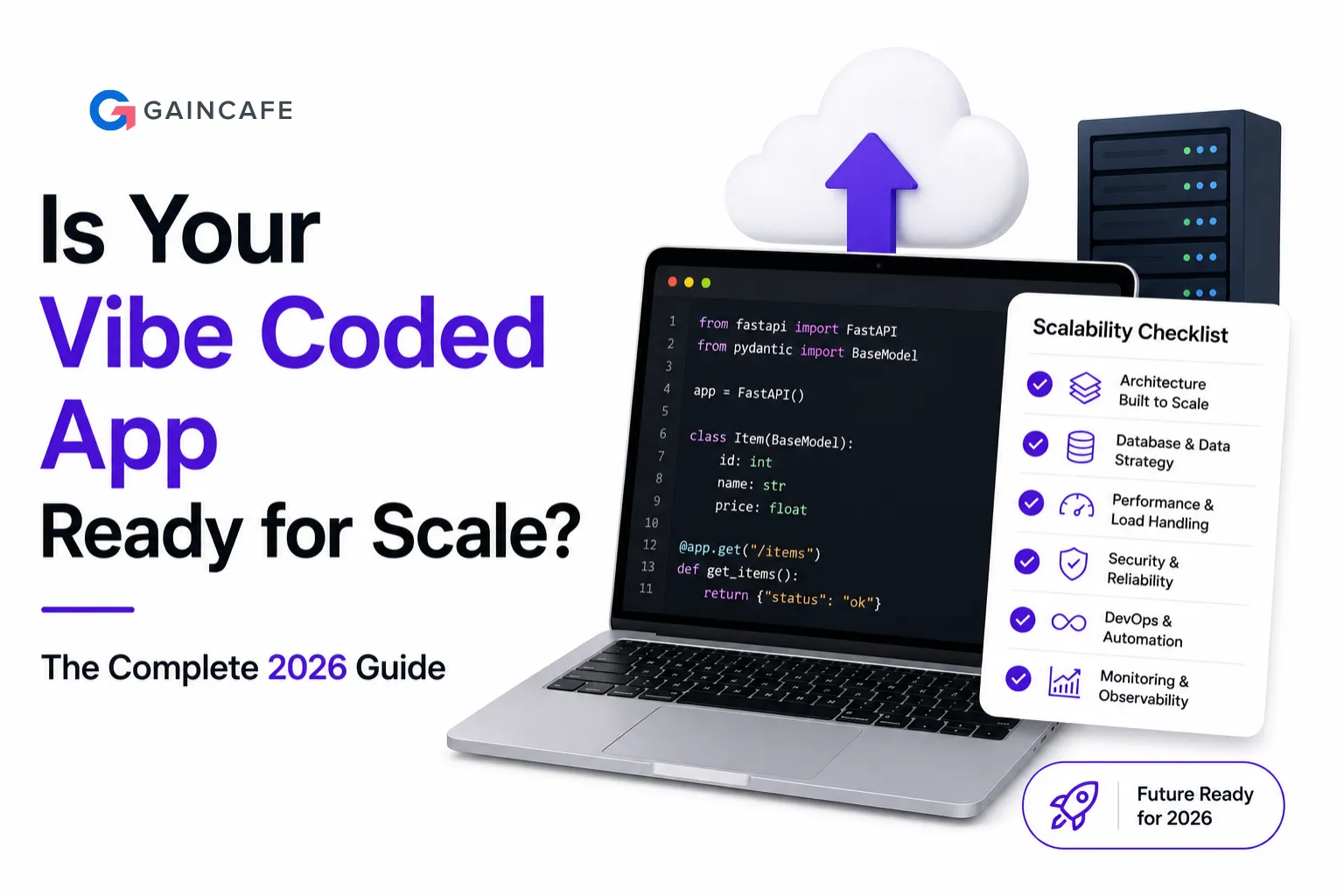
You shipped fast. Lovable, Bolt, or Replit gave you a working product in days, not months. Real users started signing up. Then something cracked.
A login broke. An API key leaked. The database slowed to a crawl when twenty users hit it at once. You opened the codebase to fix it and found code you do not fully understand.
This is the moment every founder reaches when they try to scale vibe coded app projects beyond the MVP stage. The speed that got you here will not take you forward. What got you to 100 users will not get you to 10,000.
This guide walks through exactly what production readiness means in 2026, the seven failure points hiding in every AI-built codebase, the audit you should run before next week, and the four-phase path from prototype to production-grade reliability.
The Vibe Coding Reality Check: Why Most AI-Built Apps Break at Scale
Vibe coding is no longer experimental. It is mainstream. GitHub's 2026 data shows 46% of all new code shipped this year is AI-generated. Roughly 92% of US developers now use AI coding tools daily. The vibe coding market itself reached $4.7 billion in 2026 and is growing at 38% annually.
Adoption inside startups is even more aggressive. 25% of Y Combinator's Winter 2025 cohort had codebases that were 95% AI-generated. Lovable alone reports 100,000 new projects created on its platform every day, with a user base nearing 8 million by late 2025. Gartner forecasts that 60% of all new software code will be AI-generated by the end of 2026.
Here is the part nobody mentions at the launch party. AI tools optimise for working code, not for production resilience. They will write a function. They will not add rate limiting. They will scaffold an auth flow. They will leave the API key hardcoded in the frontend.
A vibe coded app is a prototype with the appearance of a finished product. Treating it like the second is the most expensive mistake a founder can make in 2026.
📊 Stat Callout: Veracode's 2025 GenAI Code Security Report tested over 100 large language models across Java, JavaScript, Python, and C#. 45% of AI-generated code samples contained OWASP Top 10 vulnerabilities. AppSec Santa's 2026 study, testing 534 samples across six leading models including GPT-5.2, Claude Opus 4.6, and Gemini 2.5 Pro, confirmed the figure independently at 25.1% with confirmed exploitable defects. Aikido Security now attributes 1 in 5 enterprise security breaches directly to AI-generated code.
What Does "Production Ready" Actually Mean in 2026?
Quick answer: A production ready app handles real users, real traffic, real data, and real failure modes without breaking. It enforces security at the API level, recovers gracefully from errors, scales under load, and tells you when something goes wrong before your users do. A vibe coded MVP rarely does any of this by default.
The phrase "production ready" gets thrown around loosely. Founders use it to mean "the demo works." Engineers use it to mean something far stricter. The gap between those two definitions is where startups quietly die.
The Gap Between "Works on Localhost" and "Works for 10,000 Users"
Localhost is a controlled environment. One user. One request at a time. No malicious inputs. No network failures. No concurrent writes to the same record.
Production is the opposite. Hundreds or thousands of users hitting the system simultaneously. Some entering bad data on purpose. Some on slow mobile connections. Some triggering edge cases your AI tool never anticipated because you never described them.
Even the largest tech companies are not immune. Amazon's March 2026 outage lasted six hours and affected 6.3 million orders, with internal post-mortems linking root causes to AI-generated code shipped under aggressive AI-coding mandates. If Amazon can break under AI-generated code at scale, your seed-stage MVP is not magically protected.
The 5 Pillars of a Truly Scalable App
A genuinely production-grade application stands on five technical pillars. Miss any one, and the system becomes brittle at scale.
- Security: Secrets in environment variables, row-level access controls, sanitised inputs, rate limiting, and locked-down endpoints
- Reliability: Graceful error handling, retries with backoff, idempotent operations, and zero silent failures
- Performance: Database indexes, query optimisation, caching layers, and architecture that does not collapse beyond a few hundred concurrent sessions
- Observability: Structured logs, real-time monitoring, alerts that fire before users complain, and traces that show exactly where time is being spent
- Maintainability: Clean, readable code, automated tests, CI/CD pipelines, and documentation that lets a new engineer ship a fix without reverse-engineering the entire system
Every founder running a serious scale AI generated app project should be able to point to evidence for each of these five pillars. If you cannot, you do not have a production system. You have a prototype with traffic.
Need to harden your AI-built MVP before scaling?
We help founders secure, optimise, and productionise Lovable, Bolt, Replit, and Cursor-built applications.
Book a Production Readiness Audit7 Hidden Failure Points of Every Vibe Coded App
Patterns matter more than individual bugs. After auditing dozens of AI-built codebases at Gaincafe, the same seven failures show up in nearly every one. The Veracode finding that AI-generated code carries 2.74x more vulnerabilities than human-written equivalents is not a statistical curiosity. It is the lived experience of every founder who tries to scale without a hardening sprint.
Exposed API Keys and Hardcoded Secrets
AI coding agents are remarkably good at writing functional code. They are also indifferent to credential hygiene. When the agent writes a database connection or an OpenAI API call, the value often goes directly into the source so the example "just works."
The Moltbook incident in early 2026 is the cautionary case study. Wiz Research disclosed that the platform leaked 1.5 million authentication tokens and 35,000 user email addresses because API endpoints returned sensitive data without checking authorisation, all on top of a fully vibe-coded backend. Six commits later, hardcoded secrets live in your Git history forever, even if you move them to environment variables afterwards.
Missing Row-Level Security and Database Vulnerabilities
If your app uses Supabase or any Postgres-backed system, Row-Level Security (RLS) is the difference between safe and catastrophic. CVE-2025-48757 disclosed that 170 of 1,645 Lovable-generated production applications were shipping with missing or misconfigured RLS, exposing real user data to the public internet. That is roughly 1 in 10 deployments leaking data without the founder knowing.
Most vibe coded apps either ship with RLS disabled entirely or with policies set to "allow all" because that is what makes the demo work. The result: any logged-in user can query any other user's data with a slightly modified API call. This is not theoretical. This is the most common vulnerability we find when conducting a vibe coded app security audit.
Zero Input Validation and Error Handling
Try entering a 10,000 character string into your app's email field. Try uploading a 4GB file. Try submitting the same form twice in 200 milliseconds. Vibe coded apps almost never handle these cases because the AI was never asked to.
Escape.tech's 2026 audit of 5,600 publicly accessible vibe-coded applications uncovered over 2,000 vulnerabilities, 400+ exposed secrets, and 175 instances of personally identifiable information sitting in the open. Without validation, attackers find the edge cases for you. Without error handling, one bad input can crash the entire request handler for every user.
Architecture That Collapses Beyond 1,000 Concurrent Users
AI tools generate code that works for one user. They do not optimise database queries. They do not add caching. They write N+1 query patterns that load fine with five test records and grind to a halt with fifty thousand real ones.
A 2026 industry analysis found that 41% of AI-generated backend code includes overly broad permission settings, and 60% of developers fail to adjust permission scopes before deployment. The first time your app gets featured on Product Hunt or LinkedIn, you will discover this the hard way.
No CI/CD or Automated Testing
Most vibe coded apps deploy by clicking a button. There is no test that runs first. There is no build check. Every new feature is a regression risk because nothing is automatically verifying that the old features still work.
Production incidents per pull request rose 23.5% between December 2025 and early 2026 as AI code volume accelerated faster than testing discipline. A founder shipping new features on Friday at 6 PM with no test coverage is one prompt away from breaking production.
Missing Observability, Logs, and Monitoring
When something breaks in production, you need three things: structured logs to see what happened, monitoring to know when it happened, and alerts to find out before your users do. Vibe coded apps usually have none of these.
You discover the outage through an angry email from a paying customer.
Technical Debt and Unmaintainable AI-Generated Code
Different prompts produced different conventions. One file uses async/await. The next uses promises. One has TypeScript. The next has plain JavaScript. Variable names are inconsistent. Comments are missing or wrong.
GitClear's longitudinal analysis of 211 million lines of code shows the structural damage. Code churn is up 41%. Code duplication has increased 4x. Refactoring collapsed from 25% of changed lines in 2021 to under 10% by 2024. Black Duck's 2026 OSSRA report adds that mean vulnerabilities per codebase jumped 107% year over year.
This is vibe coding technical debt, and it compounds. 63% of developers in 2026 surveys now report spending more time debugging AI-generated code than writing the original would have taken. Eventually, hiring a new engineer costs more than rebuilding from scratch.
For a deeper breakdown of how each major AI app builder handles these failure points differently, our comparison of Lovable vs Emergent vs Replit is a useful reference.
Worried about hidden vulnerabilities in your AI-generated code?
Get a senior engineering audit covering security, architecture, scalability, and production readiness.
Request a Security AuditThe Production Readiness Audit: A 12-Point Checklist Every Founder Should Run
Before you spend another rupee on user acquisition, run this audit. If you cannot tick at least 10 of the 12, your app is not ready for paid traffic.
| No | Audit Point | Pass Criteria |
|---|---|---|
| 1 | Secrets management | All API keys in environment variables, none in source control |
| 2 | Authentication | Sessions expire, passwords hashed, MFA available for admin |
| 3 | Authorisation | RLS or equivalent enforced at the database level |
| 4 | Input validation | All user inputs validated server-side, not just frontend |
| 5 | SQL injection protection | Parameterised queries throughout, no string concatenation |
| 6 | Error handling | All external calls wrapped in try/catch with fallback paths |
| 7 | Rate limiting | API routes have per-IP and per-user rate limits |
| 8 | Database indexes | All frequently queried columns indexed, slow query log reviewed |
| 9 | CI/CD pipeline | Automated build, lint, and smoke test on every push |
| 10 | Observability | Structured logs, error tracking (Sentry or similar), uptime monitoring |
| 11 | Backup and recovery | Database backed up daily, restore process tested |
| 12 | Documentation | New engineer can deploy and ship a fix within 1 day of joining |
Three or fewer ticked? You have a prototype. Plan a hardening sprint before any further launch activity. The data backs the urgency: 96% of developers in 2026 surveys say they do not fully trust that AI-generated code is functionally correct, yet only 48% always review it before committing.
💡 Expert Insight (Senior Engineer, Gaincafe) "We see the same mistake repeated across every Lovable, Bolt, and Replit project that comes to us. Founders try to scale vibe coded app systems by adding more features. The fix is the opposite. Stop building features. Spend two weeks fixing the foundation. Every week you delay this work, the cost of doing it later doubles. Gartner's own forecast says AI-generated code will drive a 2,500% increase in software defects by 2028 without proper governance. That number is the cost of skipping this audit."
How to Scale a Vibe Coded App: Build vs Rewrite vs Harden Decision Matrix
Once you have run the audit, the next question is structural. Do you keep the AI-built codebase, rebuild it from scratch, or harden what you have? Most founders assume rewrite. Most are wrong.
| Approach | Cost | Time | Risk | When to Choose |
|---|---|---|---|---|
| Harden existing app | Low ($5K-$15K) | 2-4 weeks | Low | App logic works, you have paying users, only foundation needs fixing |
| Selective rewrite | Medium ($15K-$40K) | 4-8 weeks | Medium | Core flows are solid but specific modules (auth, payments, data layer) need replacement |
| Full rewrite | High ($40K-$150K+) | 3-6 months | High | Tech debt has crossed a threshold where every fix breaks two things, OR product-market fit has shifted significantly |
The vast majority of teams that come to us thinking they need a full rewrite actually need targeted hardening. We have taken Lovable app scalability issues that founders described as "unfixable" and resolved them in three weeks by replacing the auth layer, adding RLS, and introducing proper error handling. The product on the surface was untouched.
The published MVP Development Cost 2026 breakdown gives a fuller picture of what each path actually requires in budget terms.
Not sure whether to rewrite or harden your app?
Our engineers can review your codebase and recommend the fastest path to production-grade stability.
Talk to Senior EngineersStep-by-Step Path to Make Your Vibe Coded App Production Ready
A focused four-phase sprint takes a typical vibe coded MVP from "demo works" to "ready for real users" in three to six weeks. Each phase has concrete deliverables and verifiable outcomes.
Phase 1: Security and Secrets Hardening (Week 1)
Move every secret out of source code into environment variables. Rotate any keys that touched the codebase or Git history, even if you removed them later. Audit your Git history for accidental commits using a tool like truffleHog.
Lock down all admin routes behind proper authentication. Confirm that no privileged endpoint trusts a frontend flag for authorisation. Every permission check belongs on the server. Wiz Research's 2026 finding that 1 in 5 organisations using vibe-coding platforms face systemic security risks tells you this work is not optional.
Phase 2: Database, Auth, and Validation Layer (Week 2)
Enable Row-Level Security on every table that holds user data. Write explicit policies for select, insert, update, and delete actions. Test each policy by logging in as different test users and confirming isolation.
Add server-side validation to every input. Sanitise anything that might end up in a database query, an HTML render, or an external API call. Replace any string-concatenated SQL with parameterised queries.
Phase 3: Performance, Caching, and Architecture Review (Weeks 3-4)
Identify your application's "critical path", the three to five functions that get called most often. Profile them. Anything taking longer than 400 milliseconds gets optimised, cached, or moved to a background job.
Add database indexes on every column used in WHERE, JOIN, or ORDER BY clauses. Introduce a caching layer (Redis or equivalent) for expensive read operations. Review architecture for obvious bottlenecks: synchronous calls that should be async, monolithic functions that should be split.
Phase 4: CI/CD, Testing, and Observability (Weeks 5-6)
Set up GitHub Actions or equivalent. The minimum pipeline: build check, lint, and a smoke test confirming the app starts and the critical route returns 200. Eight lines of YAML, deployed before the next feature ships.
Add error tracking (Sentry, Bugsnag, or similar). Add structured logging with request IDs. Add uptime monitoring with alerts to your phone. By the end of this phase, you should know about a production issue before any user does.
This is the same hardening sprint our Hire Lovable Experts team runs for clients who want to keep their AI-generated foundation but need senior engineers to make it production-grade.
Need help productionising your AI-generated MVP?
We harden authentication, databases, APIs, CI/CD pipelines, and infrastructure for scaling startups.
Start a Hardening SprintReal Case Study: How Gaincafe Scaled an AI-Built MVP for Real Users
Creator Solutions AI came to us in 2026 with a working OnlyFans agency platform. The MVP had been built rapidly using AI-first tools. The product idea was strong. The infrastructure was not.
The platform had to handle multi-tenant data isolation across creators, agencies, and managers. Sensitive financial information flowed through the system. Real users were already onboarding, which meant a full rewrite was off the table. Every fix had to be deployed without downtime.
Our team ran the 12-point audit, identified critical gaps in RLS policies and authentication boundaries, and executed a phased hardening plan. We replaced the auth layer with a properly scoped role-based system, added RLS across every tenant-aware table, introduced rate limiting on financial endpoints, and stood up a full CI/CD pipeline with automated tests covering the most-called functions.
The product surface stayed identical for end users. Behind the scenes, the platform went from a fragile prototype to a system handling concurrent agency workflows reliably. Full details in our published Creator Solutions AI case study.
This is the model. Keep what works. Harden what is fragile. Ship without breaking the user experience.
When You Should Hire Senior Engineers to Harden Your Vibe Coded App
There is a specific moment when DIY stops being efficient. If you are a non-technical founder, that moment usually arrives right after your first 100 paying users.
The signs are consistent. Bug reports start coming in faster than you can fix them. Adding a new feature breaks something old. Your AI tool starts generating fixes that contradict each other. You spend more time debugging than building. The 63% of developers who report spending more time debugging AI code than writing the original would have taken are the canary in this mine.
This is the threshold at which professional harden AI generated code work pays for itself within weeks. The cost of one senior engineer for a month is less than the cost of one publicly visible data breach, one customer churn cycle from outages, or one founder burning out trying to ship features and fix infrastructure simultaneously. With 1 in 5 enterprise breaches in 2026 already attributed to AI-generated code, the math has fundamentally shifted.
Outside help becomes essential when the codebase you built is generating compounding cost rather than compounding value.
💡 Pro Tip (Gaincafe Engineering Lead) "The cheapest hardening sprint is the one you run before launch. The most expensive is the one you run after a breach. We have helped clients save lakhs by spending two weeks on production readiness before they hit growth, and we have helped others recover from incidents that could have been prevented for the same investment. The math always favours acting early."
Why Choose Gaincafe Technologies for Vibe Coded App Scaling
Gaincafe Technologies sits at the exact intersection of AI-first speed and senior engineering rigour. Our team has been building with Lovable, Cursor, Bolt, Replit, and Emergent since each of these tools shipped. We know exactly where they cut corners and exactly how to fix what they leave behind.
What we do for founders looking to scale vibe coded app projects:
- 12-point production readiness audit with prioritised fix list and effort estimates
- Targeted hardening sprints that keep your existing codebase intact while fixing the foundation
- Full architecture reviews for teams ready to invest in long-term scalability
- Ongoing maintenance partnerships so you ship features without breaking what already works
500+ projects delivered. 12 years of senior engineering experience. A 5.0 rating on Upwork. Teams across Australia, UAE, USA, and the UK trust us to make their AI-built products bulletproof.
Explore our full MVP Development Services for the complete scope of what we deliver from prototype to production.
Ready to scale your vibe coded app safely?
Work with senior engineers who specialise in hardening Lovable, Bolt, Replit, Cursor, and AI-generated applications.
Conclusion: Speed Got You Here, Engineering Will Take You Forward
Vibe coding solved the speed problem. It did not solve the scale problem.
The 2026 numbers are unambiguous. 46% of new code is AI-generated. 45% of that code carries OWASP Top 10 vulnerabilities. 1 in 5 enterprise breaches now traces back to AI-generated source. Adoption won. Quality is the open question for every founder shipping in this market.
The founders who win in 2026 are the ones who recognise that production readiness is a separate discipline from prototyping. They use AI to ship in days. They bring in senior engineers to make sure what shipped stays shipped under real-world conditions.
If you have a working vibe coded app and real users, the next step is not another feature. It is the audit, the hardening sprint, and the foundation that lets you scale vibe coded app projects from 100 users to 100,000 without rewriting from scratch every six months.
Speed and engineering are not opposites. They are partners. The teams that figure this out first are the ones still standing when the rest of the SaaSpocalypse plays out. For more on the tools landscape, our roundup of the Top 10 Vibe Coding Tools gives you the full picture for 2026.
Ready to make your AI-built product production-grade? Talk to the Gaincafe team and run your 12-point audit this week.