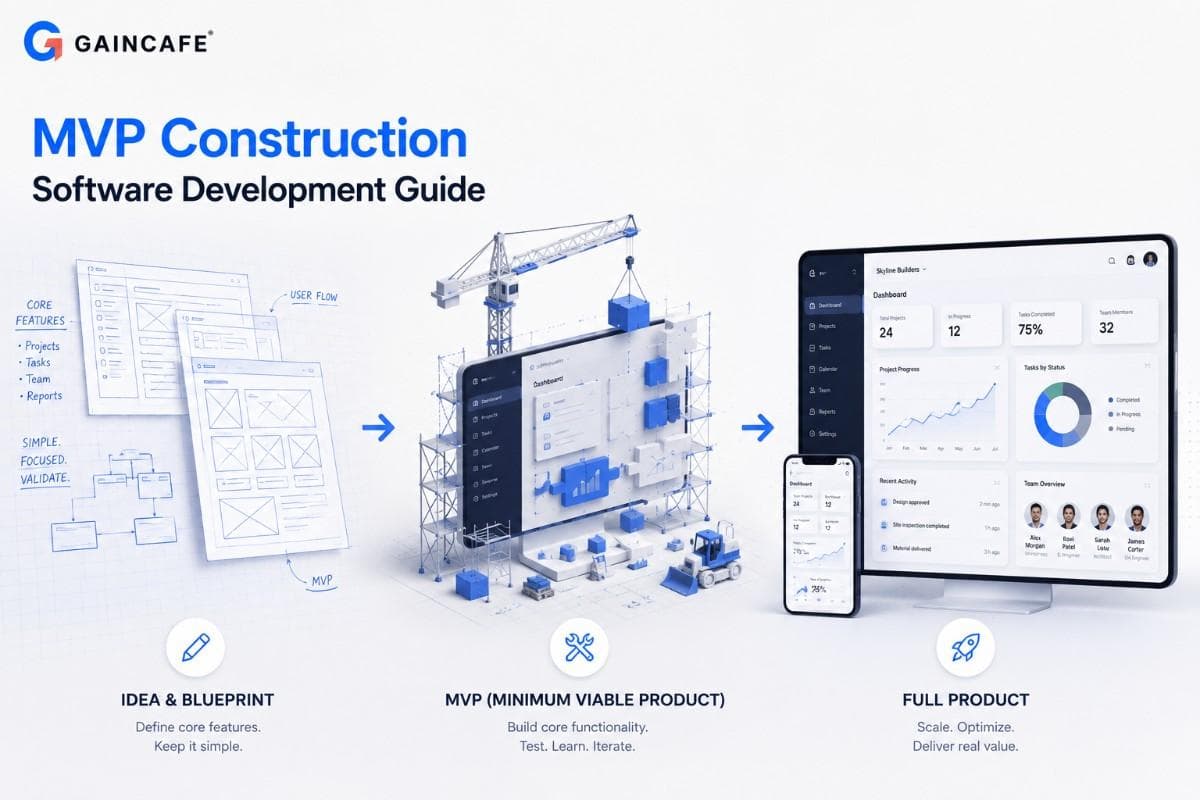
The MVP Construction Software Development Cost is the first number every construction founder and CTO wants pinned down before a single line of code is written. An MVP, or minimum viable product, is the leanest working version of your software that still delivers real value to site teams, project managers, and finance.
Instead of spending eighteen months and a fortune building every feature you can imagine, an MVP ships the core workflows that matter most. You launch, you watch how real users behave, and you let actual usage data guide what gets built next.
This approach has reshaped how serious construction companies invest in technology. The goal is no longer a giant first release. The goal is a smart, affordable build that proves the idea works on real job sites.
Construction is one of the least digitized major industries, which means the opportunity for purpose-built software is enormous. A well-scoped MVP is the fastest, lowest-risk way to claim that opportunity without betting the entire budget on day one.
If you are weighing the broader economics of building lean, our breakdown of MVP development cost in 2026 is a useful companion to this guide.
Key Takeaways
- The MVP Construction Software Development Cost in 2026 typically falls between $40,000 and $80,000 for a focused first build, with mid-level platforms reaching $90,000 to $200,000 and full enterprise suites running $250,000 and above.
- Building an MVP first lets construction firms validate the product with real site teams before committing to a six-figure enterprise rollout.
- Cost is driven by four levers: feature scope, team type, software complexity, and development region.
- AI has moved from pilot to production: 38% of contractors now report measurable business impact from AI in 2026, up from 17% a year earlier.
- The smartest 2026 strategy is MVP first, scale later, backed by a partner who understands both construction workflows and modern software delivery.
Why Do Construction Companies Need Construction Management Software?
Construction runs on coordination, and coordination is exactly where most projects bleed money. Spreadsheets, paper forms, and disconnected apps create gaps that quietly turn into delays, disputes, and rework.
The financial damage is staggering. Industry analysis attributes roughly $31 billion lost every year to rework in the US construction sector alone, with a large share traced back to communication breakdowns and bad project data.
Modern construction management software closes those gaps. It centralizes schedules, budgets, documents, and field updates into one source of truth that every stakeholder can trust.
Here is what pushes construction companies toward custom software:
- Margin protection: Catching a budget overrun in week three is far cheaper than discovering it at handover.
- Labor shortage pressure: With skilled workers in short supply, software helps existing teams do more with less.
- Client expectations: Owners and developers increasingly expect real-time visibility into their projects.
- Compliance and safety: Digital records make audits, inspections, and safety reporting faster and cleaner.
For most firms, the question is no longer whether to invest in software. It is how to do it without overspending, which is exactly where an MVP-first strategy earns its place.
Key Features of Construction Management Software
A strong MVP includes only the features that deliver immediate value. Everything else waits for version two. Below are the core modules that define a credible first build in 2026.
Project Planning and Construction Scheduling Software
Interactive Gantt charts, task dependencies, and live timeline updates sit at the heart of any platform. Project planning and construction scheduling software keeps every trade aligned and flags slippage before it spreads.
Workflow Automation Services
Manual handoffs are where time disappears. Workflow automation services handle approvals, alerts, and routine status changes automatically, so managers spend less time chasing updates.
Centralized ERP Management Platforms
For larger firms, centralized ERP management platforms connect finance, procurement, and project operations. This removes the double entry that plagues teams juggling separate accounting and project tools.
Field Service Management Software
Work does not happen at a desk. Field service management software lets crews log progress, raise issues, and access drawings directly from the site.
Analytics Dashboards
Decision makers need clarity, not raw data. Analytics dashboards turn project activity into visual insight on cost, schedule health, and productivity.
Mobile Accessibility for On-Site Teams
Finally, mobile accessibility for on-site teams is non-negotiable. If the foreman cannot use it on a phone in the field, adoption collapses.
Benefits of Custom Construction Management Software
Off-the-shelf tools rarely fit the way a specific construction business actually operates. Custom software solves the problem that you have, not the average problem the market has.
The benefits compound over time:
- Workflow fit: The software mirrors your real processes instead of forcing your team into someone else's template.
- Scalability: A custom build grows with you, adding sites, users, and modules without painful platform migrations.
- Integration freedom: You connect the accounting, CRM, and field tools you already use rather than accepting whatever a vendor allows.
- Data ownership: Your project data stays yours, which matters more every year as security and privacy expectations rise.
- Competitive edge: When your workflow is faster and cleaner than your competitor's, you win more bids and protect more margin.
A custom MVP captures these benefits early, at a fraction of the cost of a full enterprise software solutions rollout. You prove the value, then reinvest with confidence.
Types of Construction Management Software
Not every construction business needs the same tool. Understanding the categories helps you scope an MVP that targets your specific pain point.
- Project management platforms: Focused on scheduling, task tracking, and team collaboration across the build.
- Estimating and bidding tools: Built to speed up cost estimation and win more accurate bids.
- ERP and financial systems: Connecting budgets, procurement, payroll, and reporting in one place.
- Field and safety apps: Designed for on-site reporting, inspections, and compliance.
- Document and BIM management: Handling drawings, models, contracts, and version control.
Most successful MVPs pick one category, nail it, and expand. Trying to be all five at launch is the fastest way to inflate your construction software development cost without improving validation.
Real-World Use Cases of Construction Management Software
Theory is useful, but construction leaders buy software to solve concrete problems. Here is how purpose-built platforms earn their keep on real projects.
- Pre-construction estimating: AI-assisted tools now reach 85% to 90% accuracy on automated estimates, cutting a task that once took half a day down to minutes.
- Live schedule control: Project managers spot a delayed trade instantly and reshuffle resources before the critical path is hit.
- Field issue reporting: A site supervisor photographs a defect, tags it, and routes it to the right subcontractor in seconds.
- Budget tracking: Finance sees committed costs against budget in real time, not weeks later in a reconciled spreadsheet.
- Owner reporting: Clients log in to a clean dashboard instead of waiting for a monthly PDF.
The same MVP discipline that powers these construction use cases also drives results in other verticals. Our work on grocery delivery app MVP development shows how a tightly scoped first build wins in a very different market.
AI in Construction Management Software
Artificial intelligence is no longer a future promise in construction. It is a present-day driver of measurable results, and 2026 is the year the numbers became impossible to ignore.
Industry surveys show 38% of contractors now report measurable business impact from AI, up sharply from 17% just a year earlier. The most common applications target the highest-cost decisions in pre-construction, with around a quarter of firms using AI for cost estimation and a fifth for bid management.
The productivity case is equally strong. Research suggests AI could lift construction productivity by roughly 31% by 2030 and reduce typical project costs by close to 20%, largely by eliminating rework and catching errors early.
Where AI fits inside an MVP:
- Predictive scheduling: Flagging likely delays before they happen.
- Automated estimating: Generating fast, accurate cost projections from historical data.
- Risk and safety alerts: Surfacing jobsite hazards and document conflicts earlier.
- Document intelligence: Reading drawings and specs to find clashes a human might miss in a 2,000-page set.
The honest takeaway is that AI rewards focus. You do not need every model at launch. You need one or two AI features that solve a painful, expensive problem, and an MVP is the ideal vehicle to prove them.
Tech Stack for Construction Management Software Development
The right tech stack balances speed of delivery, scalability, and long-term maintenance cost. For a 2026 MVP, modern, well-supported tools matter more than chasing the newest trend.
A typical, dependable stack looks like this:
- Frontend: React or Next.js for web, with React Native or Flutter for cross-platform mobile.
- Backend: Node.js or Python for core logic and APIs.
- Database: PostgreSQL for reliable, relational project data.
- Cloud and infrastructure: AWS, Google Cloud, or Azure for scalable hosting.
- AI layer: Established model providers and vector databases for estimating, search, and predictive features.
Choosing a scalable architecture from day one prevents expensive rewrites later. A cheaper stack that cannot grow often costs far more once you outgrow it.
Speed of build matters too. Modern AI app builders and low-code tools can compress timelines dramatically, and our guide on how to build an MVP in 7 days with AI app builders shows just how far that compression can go for the right project.
MVP Construction Software Development Process
A clean process keeps the MVP Construction Software Development Cost predictable and protects you from scope creep, the single biggest reason budgets balloon.
Here is the proven sequence:
- Discovery and validation. Define the core problem, the target users, and the one workflow your MVP must nail. This phase prevents building the wrong thing.
- Scope and prioritization. Ruthlessly cut features. Every nice-to-have can raise cost by 20% to 40%, so you keep only what validates the idea.
- UI and UX design. Map clean, mobile-first flows that field teams will actually adopt.
- Development. Build the front end, back end, database, and core integrations in focused sprints.
- Quality assurance. Test on real devices and real site conditions, not just in a clean office network.
- Launch and feedback. Ship to a pilot group, watch behavior, and capture data.
- Iterate. Use evidence, not opinions, to decide what gets built next.
This loop is why MVPs win. You spend money on what users prove they need, not on what a planning document guessed they might want.
Cost of Construction Project Management Software Development
Now to the number everyone scrolled for. The cost of construction project management software development depends on scope, but 2026 benchmarks give a clear, reliable picture.
| Build Tier | What It Includes | Typical Cost (2026) |
|---|---|---|
| MVP | Core scheduling, budgeting, user management | $40,000 to $80,000 |
| Mid-Level Platform | Analytics, integrations, mobile app | $90,000 to $200,000 |
| Enterprise Suite | AI-driven insights, multi-site collaboration, compliance modules | $250,000 to $500,000+ |
These figures cover the main project phases: development, testing, UI and UX design, and initial deployment. After launch, plan for maintenance, hosting, and updates that typically add 15% to 20% of the build cost per year.
The lesson is simple. An MVP is not a cheaper version of the enterprise suite. It is a smarter sequence. You start at the $40,000 to $80,000 tier, validate, then reinvest the savings into the features the market actually rewards.
For a wider view of lean budgeting across product types, our MVP development cost in 2026 breakdown is worth a read alongside these construction-specific numbers.
Not sure what your MVP should cost?
Book a free scoping call and get a clear, fixed cost range for your construction build.
Get My Free Cost EstimateDevelopment Phase-Wise Cost Breakdown
Understanding where the money goes makes every budgeting conversation easier. Here is a realistic development phase-wise cost breakdown for a construction MVP in the $40,000 to $80,000 range.
| Development Phase | What Happens | Share of Budget |
|---|---|---|
| Discovery and Planning | Research, scoping, requirements, architecture | 10% to 15% |
| UI and UX Design | Wireframes, mobile-first flows, prototypes | 15% to 20% |
| Core Development | Frontend, backend, database, integrations | 40% to 50% |
| Quality Assurance | Testing across devices and site conditions | 10% to 15% |
| Deployment and Launch | Setup, release, pilot onboarding | 5% to 10% |
| Post-Launch Support | Bug fixes, early iterations, maintenance | 15% to 25% per year |
Teams that skip discovery to save money often spend 30% to 50% more later, fixing problems that proper planning would have prevented. The cheapest phase to fix a mistake is always the first one.
Cost Estimation by Development Team
Who builds your MVP has a direct, sometimes dramatic, effect on the final bill. Each engagement model carries its own trade-offs.
| Team Type | Strengths | Trade-offs | Cost Profile |
|---|---|---|---|
| Freelancers | Low upfront rate, flexible | Quality varies, limited continuity | Lowest, but riskiest |
| In-House Team | Full control, deep product knowledge | Salaries, benefits, overhead, slow to staff | Highest fixed cost |
| Offshore Agency | Strong cost efficiency, full-stack delivery | Requires clear communication and overlap | Balanced and scalable |
For most construction firms, a dedicated agency partner offers the best blend of expertise, speed, and cost control. You get a complete team without the long, expensive process of hiring one yourself.
This is also why so many founders choose a specialist MVP development company in India, where senior engineering talent delivers enterprise-grade work at a fraction of Western build costs.
Development Cost by Software Complexity
Complexity is the strongest single driver of your MVP Construction Software Development Cost. The more advanced the logic, integrations, and AI, the higher the number climbs.
| Complexity Level | Typical Features | Cost Range (2026) |
|---|---|---|
| Simple MVP | Single core workflow, basic dashboard, one platform | $15,000 to $40,000 |
| Moderate MVP | Multiple modules, integrations, mobile app | $40,000 to $90,000 |
| Complex MVP | AI features, multi-site, compliance, advanced analytics | $90,000 to $200,000+ |
Notice how a single decision, such as adding AI-driven estimating or strict compliance handling, can move you from one tier to the next. This is precisely why scope discipline protects your budget. Build the core, prove it, then add complexity when the data justifies it.
Cost Based on Development Region
Where your developers sit shapes the rate card more than almost any other factor. The talent quality can be comparable across regions, but the pricing is not.
| Region | Typical Senior Hourly Rate (2026) |
|---|---|
| United States and Canada | $150 to $280 |
| Western Europe | $100 to $200 |
| Eastern Europe | $50 to $100 |
| India and South Asia | $25 to $60 |
A word of caution: the lowest hourly rate is not always the lowest total cost. A poorly run cheap project can take far longer and need a rewrite, ending up more expensive than a well-run team from the start.
The goal is value, not just rate. A senior, well-managed offshore team often delivers the strongest return, combining quality engineering with genuinely competitive pricing.
Build the right thing first, not the expensive thing.
Launch a validated construction MVP from $40k instead of gambling six figures on day one.
Start My MVP BuildChallenges in MVP Construction Software Development
Building for construction has its own difficulties, and knowing them upfront keeps your project on track and on budget.
- Field adoption: Site teams resist tools that are slow or clunky. Mobile-first design is essential, not optional.
- Scope creep: Stakeholders keep adding features. Without firm prioritization, the MVP quietly becomes a full enterprise build.
- Data fragmentation: Construction data lives in many disconnected systems, making integration genuinely hard.
- Offline reality: Job sites often have poor connectivity, so the software must work gracefully when the signal drops.
- Security and privacy: Project, financial, and personal data must be protected to modern standards from day one.
None of these are reasons to avoid building. They are reasons to choose an experienced partner who has solved them before, rather than learning on your budget.
Future Trends in Construction Management Software
The direction of travel in 2026 is clear, and it shapes what a forward-looking MVP should anticipate.
- AI everywhere: Adoption is accelerating fast, with the vast majority of current AI users planning to increase usage this year.
- Cloud-based construction ERP software: Firms are consolidating fragmented tools into unified, cloud-native platforms.
- Construction SaaS development solutions: Subscription products are replacing one-off custom installs, giving smaller firms enterprise-grade capability.
- Digital transformation in construction: The whole sector is moving from paper and spreadsheets to connected digital workflows.
- Predictive everything: From schedules to safety, the value is shifting toward forecasting problems before they occur.
A well-built MVP positions you to ride these trends rather than retrofit them later. You design clean foundations now, then layer advanced capability as the market matures.
Why Invest in Custom Construction Management Software in 2026?
The business case has rarely been stronger. Construction firms face rising wages, material costs, and persistent labor shortages, all of which squeeze margin.
Custom software answers that squeeze directly. It helps existing teams do more, reduces costly rework, and gives leadership the real-time visibility needed to protect profitability.
The competitive angle matters too. Early movers are already pulling ahead, bidding more work, catching more risks, and submitting cleaner scope packages. The gap between digital-first firms and the rest is widening every quarter.
Investing through an MVP keeps the entry cost reasonable while capturing these gains early. You are not gambling a fortune on an unproven idea. You are making a measured, validated investment that compounds as you scale.
In a market where margins are tight and expectations are rising, custom construction software is shifting from a luxury to a basic requirement for staying competitive.
Why Choose Gaincafe Technologies for MVP Construction Software Development?
Choosing the right partner is the difference between a clean, predictable MVP Construction Software Development Cost and a project that drifts over budget and behind schedule. Gaincafe Technologies is built to deliver the former.
Here is what sets our team apart:
- MVP-first discipline: We scope ruthlessly, build the core that validates your idea, and protect you from the feature bloat that wrecks budgets.
- Senior engineering at competitive rates: Our developers deliver enterprise-grade quality without enterprise-grade overhead, giving you exceptional value per dollar.
- Construction-aware delivery: We design for the field, with mobile-first interfaces, offline resilience, and workflows that real site teams actually adopt.
- Modern, AI-ready stacks: From estimating to predictive scheduling, we build foundations that are ready for the AI features defining 2026.
- Security by default: Your project, financial, and personal data is protected to modern standards from the first sprint.
We also move fast. By combining proven frameworks with modern AI-assisted build methods, we compress timelines that traditional teams stretch across months. If your roadmap includes rapid, AI-accelerated delivery, you can hire a Lovable expert from our pre-vetted pool and start building sooner.
Ready to scope your build? Book a free consultation with Gaincafe Technologies, and we will map your fastest, most cost-effective path from idea to launched product.
Get senior engineers without the enterprise overhead.
Partner with Gaincafe's pre-vetted team and ship your construction software faster.
Talk to Our ExpertsFinal Thoughts
The MVP Construction Software Development Cost in 2026 is not a single scary number. It is a range you control through smart scoping, the right team, and disciplined execution.
Start lean. A focused MVP in the $40,000 to $80,000 band lets you prove your concept on real job sites before committing to a six-figure enterprise platform. That sequence protects your capital and sharpens your product.
The construction firms winning in 2026 are not the ones who spent the most. They are the ones who built the right thing first, learned fast, and reinvested with confidence.
With the correct partner, custom construction software stops being a risk and becomes one of the best returns your business can make. The opportunity is open, the tools are ready, and the cost to start has never been more reachable.
FAQs
How much does MVP construction software development cost in 2026?
The MVP Construction Software Development Cost generally ranges from $40,000 to $80,000 for a focused first build covering core scheduling, budgeting, and user management. Mid-level platforms with analytics and mobile apps run $90,000 to $200,000, while full enterprise suites with AI and compliance modules can reach $250,000 or more. Your final figure depends on scope, complexity, team type, and region.
How long does it take to build a construction MVP?
A simple construction MVP usually takes around 8 to 12 weeks, while more complex builds with AI features or multiple integrations can run 16 to 20 weeks. Speed depends on scope and team size, since adding developers in parallel can compress the timeline at a higher cost. Modern AI-assisted development is shortening these timelines considerably in 2026.
Is it cheaper to build an MVP or a full enterprise platform first?
Building an MVP first is almost always the smarter financial choice. You validate the core idea for $40,000 to $80,000 before risking the $250,000 plus required for a full enterprise suite. This sequence reduces the chance of spending heavily on features that real users do not need, which is the most common cause of wasted software budgets.
How is construction software secured and kept compliant?
Strong construction software protects data through encryption, role-based access control, and secure cloud infrastructure from the first sprint. A capable partner also designs for relevant privacy and industry standards based on where you operate. Because construction software handles sensitive project, financial, and personal data, security should be a launch requirement, not an afterthought.
Does AI increase the MVP construction software development cost?
Adding AI features such as predictive scheduling or automated estimating does raise the build cost, often moving a project into a higher complexity tier. However, the return can be substantial, with AI shown to reduce project costs by close to 20% and lift productivity meaningfully. The best approach is to launch with one or two high-value AI features and expand once they prove their worth.