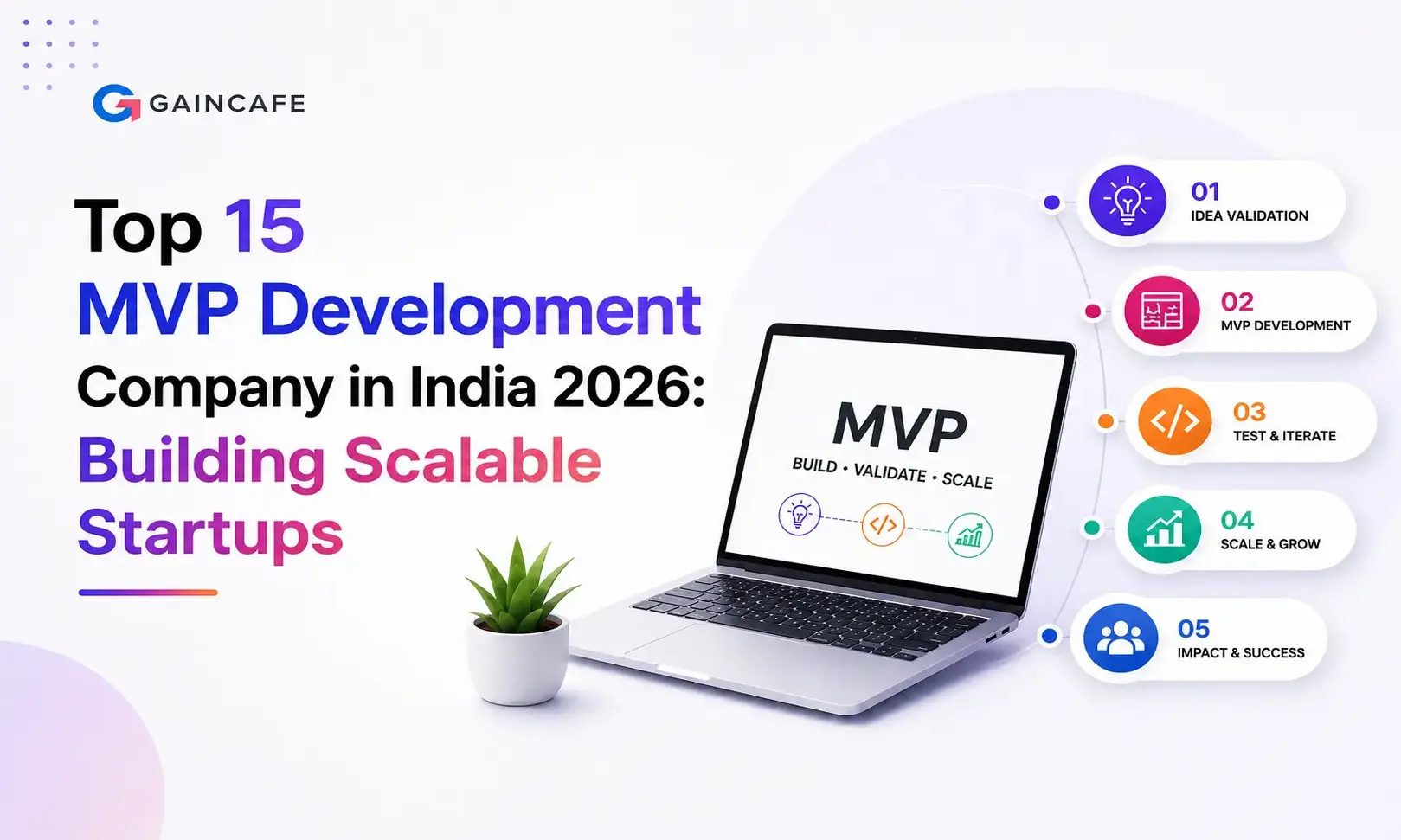
India has quietly become the world's most trusted destination for startup product development, and in 2026, that reputation is stronger than ever. If you are searching for the top 15 MVP development companies in India 2026, you are already thinking the right way. Validating your idea with a lean, functional product before committing to a full build is the single smartest move any founder can make.
India offers a rare combination of world-class engineering talent, Agile-first development culture, and cost structures that make serious product development accessible to bootstrapped founders and funded startups alike.
This guide ranks the top 15 MVP development companies in India based on technical depth, client outcomes, domain expertise, and their ability to function as a true product partner, not just a vendor.
Best MVP Development Companies in India 2026
If you are short on time, here is the fast version. The top MVP development companies in India in 2026 are Gaincafe Technologies for AI-powered MVPs and founder-CTO partnerships, EnactOn and Simform for SaaS builds, Appinventiv and RipenApps for mobile-first products, Hidden Brains and Net Solutions for enterprise-grade scale, and Aalpha, F22 Labs, and ValueCoders for lean, budget-conscious builds.
Each of these firms has shipped real products for real founders. The rest of this guide breaks down exactly who fits which stage, budget, and product type, so you can shortlist with confidence.
The best MVP partner is not the biggest name on this list. It is the one whose strengths match your product, your stage, and your runway.
Why India Is the Global Hub for MVP Development in 2026
India produces over 1.5 million engineering graduates every year. Thousands of these engineers now work inside product-first development firms that have delivered MVPs for startups across the US, UK, Europe, the Middle East, and Southeast Asia.
What makes India particularly powerful for MVP development in 2026 is the maturity of its ecosystem. Indian firms are no longer just offering cost advantages. The best companies combine product thinking, AI-augmented development workflows, and real startup experience in every engagement.
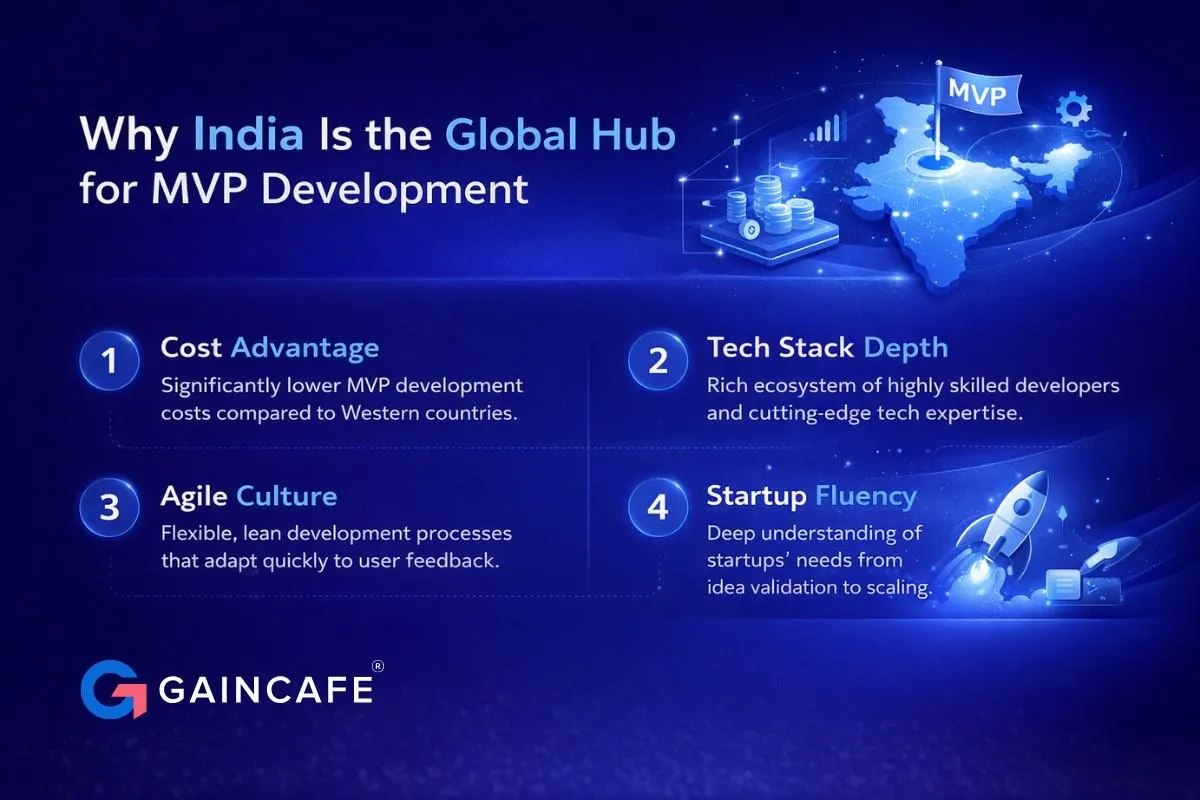
Key Reasons Founders Choose India
- Cost advantage: MVP development costs are 40–70% lower compared to the US or UK.
- Time zone flexibility: Teams work across US and European time zones with structured overlap hours.
- Tech stack depth: Strong expertise in React, Node.js, Flutter, Python, AWS, and AI/ML frameworks.
- Agile culture: Most firms operate on two-week sprint cycles with transparent progress tracking.
- Startup fluency: Many teams have firsthand startup experience and understand founder challenges.
Build your MVP with India’s top product teams
Get a clear roadmap, timeline, and cost estimate tailored to your idea.
How to Identify the Best MVP Development Company in India?
Choosing the right MVP development partner is one of the most consequential decisions a founder will make in the early stage of their startup journey.
A wrong choice costs you time, money, and momentum. A right choice gives you a product, a process, and a partner who genuinely understands what you are trying to build.
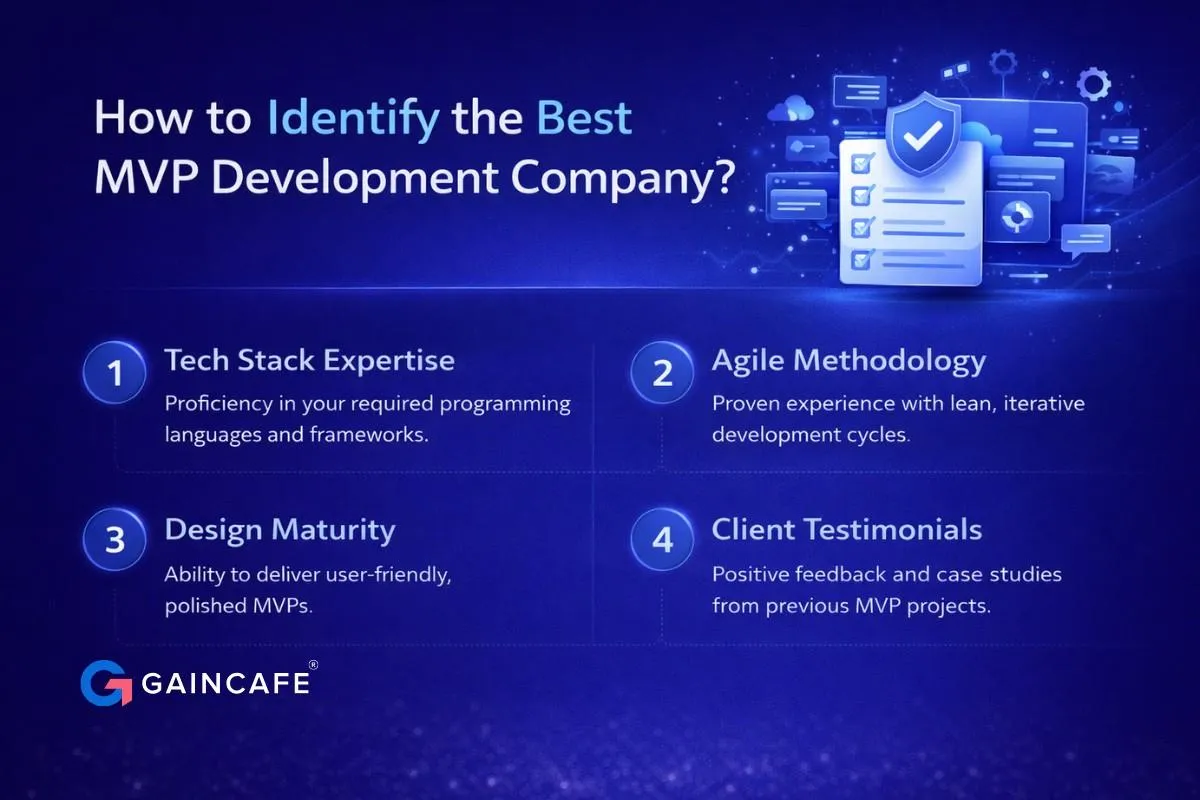
This list was not based on Google rankings or paid placements. Every company was evaluated using a strict, founder-centric framework built around four non-negotiable criteria.
1. Tech Stack Expertise
An MVP must be built on a scalable technical foundation. Evaluate whether the company can handle modern, production-grade architecture including cloud infrastructure, API design, mobile development, and AI integration.
Companies that rely on outdated frameworks or lack deep engineering capability should be excluded.
2. Agile Methodology and Sprint Discipline
Speed and transparency are critical in MVP development. Assess how the company structures Agile sprints, how frequently they deliver working demos, and how clearly they communicate progress.
Firms with unclear timelines or waterfall-heavy processes are not suited for fast-moving startup environments.
3. UI/UX Focus and Design Maturity
Your MVP is the first real interaction users have with your product. Poor design can distort feedback and reduce retention.
Look for companies with strong UI/UX capability, user research processes, and a proven track record of delivering clean, intuitive interfaces.
4. Client Testimonials and Verifiable Outcomes
Portfolio screenshots alone are not enough. Focus on verified client reviews, repeat engagement rates, and measurable outcomes.
Companies that demonstrate real results for startups, especially in validating product-market fit, should rank significantly higher.
Only companies that perform well across all four criteria should be considered for your MVP development.
Not sure how to evaluate an MVP partner?
We’ll review your idea and guide you on what actually matters before you hire.
What Is an MVP Development Company?
Before you compare firms, it helps to be clear on what an MVP development company actually does. An MVP development company is a team that turns your idea into a lean, working product designed to validate one thing: will real users actually use this?
They handle the full journey, from scoping and design to building and launching your first version, so you can test your idea in the market before committing to a full build. A good one does not just write code. They think like a product partner, challenge weak assumptions, and help you build only what is necessary to learn fast.
MVP vs Full Product Development
The difference is scope and intent. A full product is built to serve every user and every feature you imagine. An MVP is built to answer a single question with the smallest possible investment.
Full product development often takes six to twelve months and a large budget. An MVP focuses only on your core assumption, ships in weeks, and gathers real user data before you scale. One is a bet. The other is an experiment designed to make that bet safer.
Building a full product before validation is how founders spend their entire runway learning something an MVP could have told them in six weeks.
Why Startups Need an MVP Before Full Development
Every founder believes in their idea. That belief is necessary. But belief alone has killed more startups than bad code ever has.
The graveyard of failed startups is full of products that were technically well-built, visually polished, and completely unwanted by the market. These founders were not incompetent. They were building without validation.
An MVP exists to solve that exact problem.
Validate the Idea Before You Fund the Build
A Minimum Viable Product is the leanest version of your product that delivers real value to users. It is not a demo or a wireframe. It is a working product designed to answer one critical question: will people actually use this?
Founders who build an MVP first are not cutting corners. They are making a rational decision to spend a small fraction of time and cost to gather real-world validation before committing to a full build.
The Real Cost of Skipping the MVP Stage
Full product development often takes six to twelve months with a team of developers, designers, and infrastructure costs.
42% of startups fail due to lack of market need. That is not a technical failure, it is a validation failure.
An MVP provides real behavioral data from users: what they click, where they drop off, and what they actually value. This insight is more valuable than months of assumptions.
Build for Learning, Not for Launching
An MVP is not a soft launch. It is a structured experiment designed to test a specific hypothesis about your product and users.
Build only what is necessary for validation. Launch fast, observe real user behavior, and iterate based on actual data.
This process leads directly to product-market fit and reduces risk before scaling development.
What a Well-Executed MVP Actually Delivers
- Validated core assumption before significant investment
- Real user feedback to guide future development
- A working product for investors and early customers
- Faster path to product-market fit through iteration
- Scalable architecture for long-term growth
The fastest founders are not the ones who build the most. They are the ones who learn the fastest. An MVP is how you learn fastest.
Don’t waste months building the wrong product
Validate your idea in 4–6 weeks with a focused MVP strategy.
Top 15 MVP Development Companies in India 2026
Finding the right development partner is not about picking the biggest agency or the cheapest quote. It is about finding a team that understands the founder mindset, respects your runway, and builds with speed and intention.
Here are the top 15 MVP development companies in India in 2026 that meet that standard.
1. Gaincafe Technologies (Jaipur, India)
There are development agencies, and then there are product partners. And then there is Gaincafe Technologies, a category of one.
While most MVP firms focus on traditional builds, Gaincafe specializes in AI-powered MVP development. They build intelligent products with automation, AI decision-making, and smart workflows embedded from day one.
Their core approach: Structured discovery and scoping before development to ensure the product solves the right problem.
Technical expertise:
- SaaS platform development (B2B and B2C)
- AI-powered apps and automation
- Mobile MVPs (iOS and Android)
- No-code and Lovable-based rapid prototyping
- Scalable architecture design
- WhatsApp AI chatbot integration
- Legacy system modernization
Delivery model: Two-week Agile sprints, weekly demos, full transparency.
Industries: Healthcare, Fintech, Edtech, eCommerce, Logistics, Enterprise SaaS
Best for: Founders needing a CTO partner and fast execution.
Website: gaincafe.com
2. Appinventiv (Noida, India)
Appinventiv is one of India's most established development companies with over 1,000 delivered products globally.
Key strengths: Mobile-first development, strong UI/UX, large team
Best for: Consumer mobile apps with scale requirements
3. EnactOn Technologies (Surat, India)
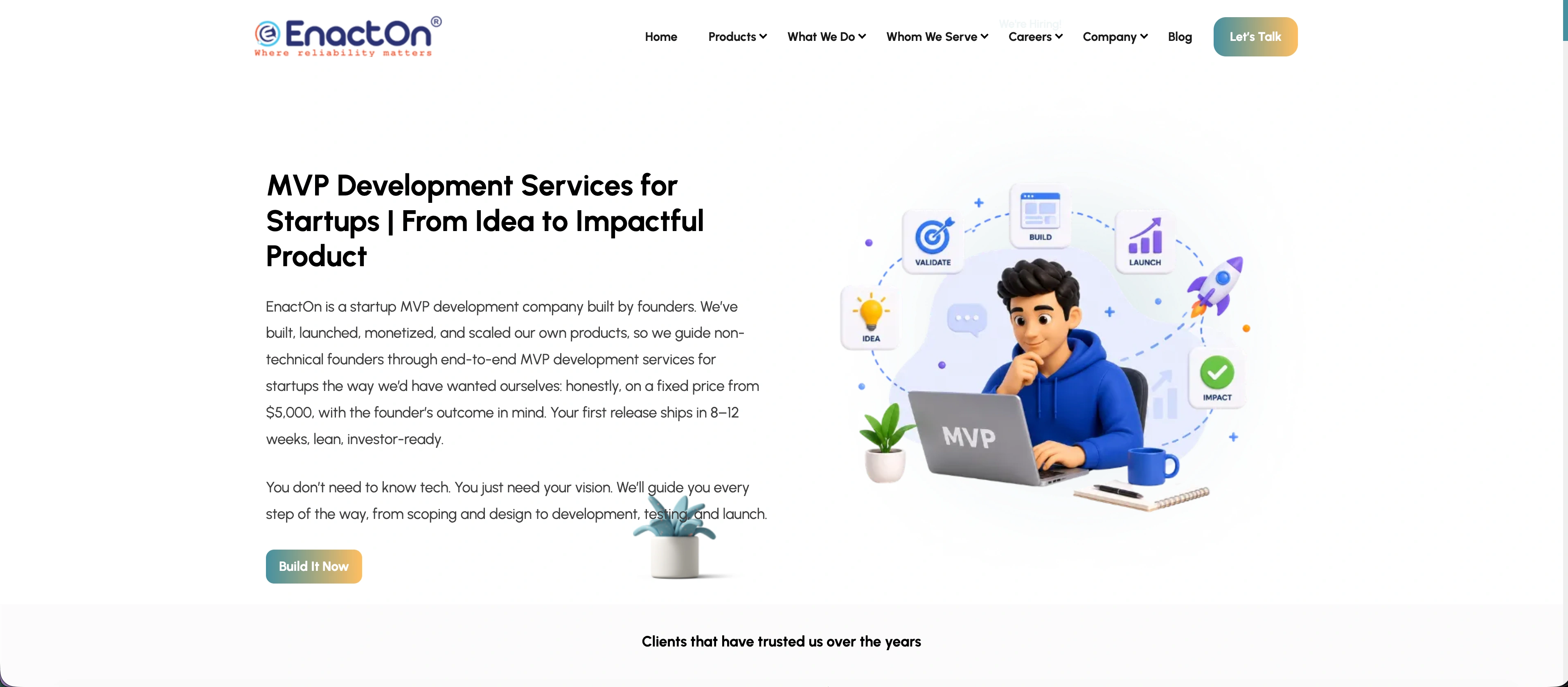
EnactOn Technologies is an AI-first product engineering company that has built 500+ products for clients across 65+ countries since 2013. Before writing any code, the team follows a structured process to remove non-essential features, helping founders avoid spending their budget on functionality users may not need in the first version.
Key strengths: MVP and SaaS development, AI prototype rescue
Best for: Non-technical, early-stage SaaS and AI founders
4. Simform (Ahmedabad, India)
Simform specializes in cloud-native SaaS MVPs with strong expertise in AWS, GCP, and microservices.
Key strengths: B2B SaaS, cloud architecture
Best for: SaaS startups targeting global markets
5. Bacancy Technology (Ahmedabad, India)
Bacancy offers a disciplined Agile delivery model with strong full-stack expertise.
Key strengths: Dedicated teams, sprint execution
Best for: Founders needing consistent long-term teams
6. ValueCoders (Noida, India)
ValueCoders brings 18+ years of experience with flexible pricing and scalable team structures.
Key strengths: Multi-industry experience, flexible engagement
Best for: Cost-conscious founders needing reliable execution
7. Successive Technologies (Noida, India)
Successive focuses on design thinking and structured user research before development.
Key strengths: User research, compliance-heavy industries
Best for: Healthcare and enterprise SaaS founders
8. Concetto Labs (Ahmedabad, India)
Concetto Labs is known for transparent scope management and affordable MVP delivery.
Key strengths: Marketplace and eCommerce expertise
Best for: On-demand and marketplace startups
9. OpenXcell (Ahmedabad, India)
OpenXcell combines strong design capability with structured product discovery.
Key strengths: UI/UX quality, fintech and healthtech
Best for: Investor-facing MVPs
10. Thinksys (Noida, India)
Thinksys focuses on engineering depth and robust QA processes for stable MVPs.
Key strengths: API-heavy systems, integrations
Best for: Fintech and B2B platforms
11. Aalpha Information Systems (Bangalore, India)
Aalpha is one of India's longer-standing development firms, known for structured, lean MVP builds with strong engineering discipline. It helps founders validate ideas quickly through clear scoping and reliable delivery.
Key strengths:SaaS and API-first product engineering, entry-level budgets
Best for:Early-stage founders wanting structured lean builds
12. F22 Labs (Chennai, India)
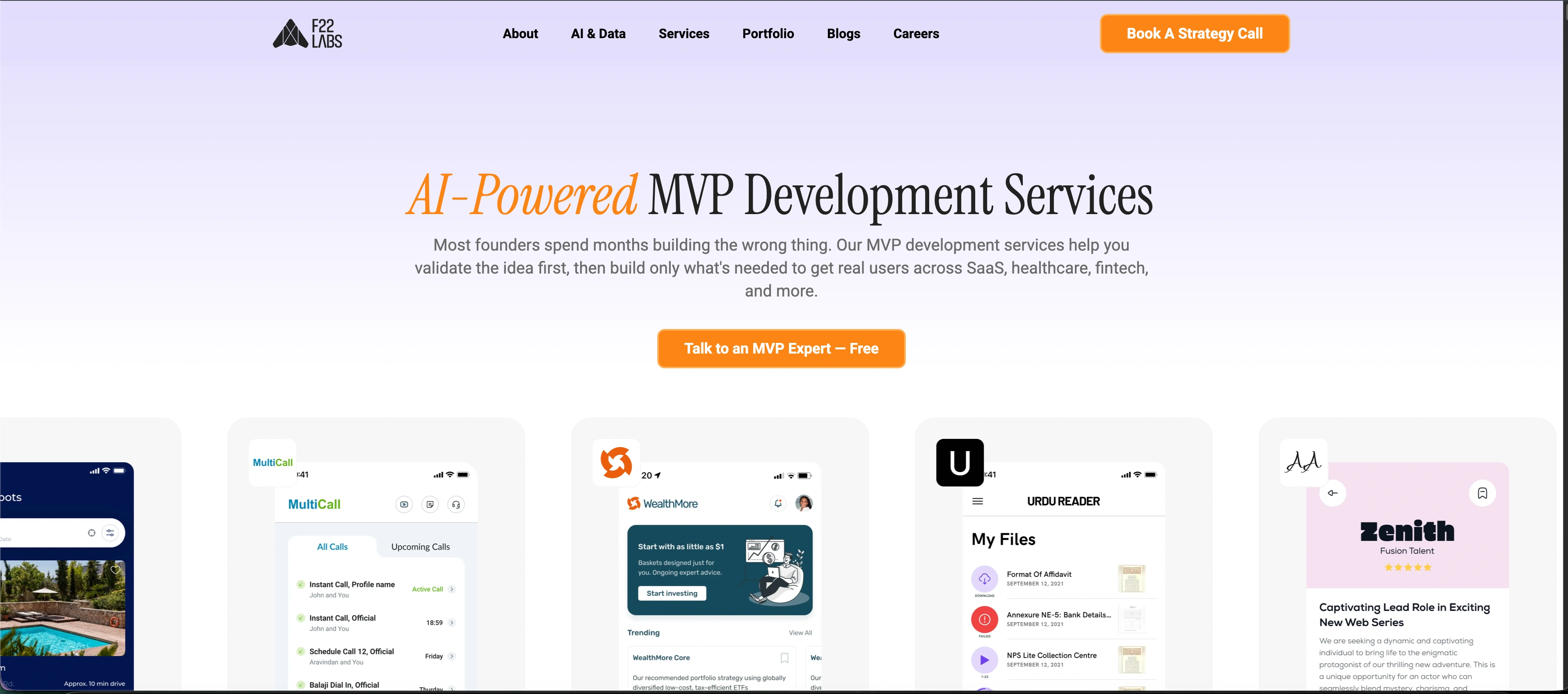
F22 Labs is a startup-focused product studio that builds web, mobile, and AI-powered MVPs with a process tuned for speed and lean budgets. Its founder-level product thinking suits early-stage teams.
Key strengths:Startup-native web, mobile, and AI MVPs
Best for:Early-stage founders needing fast, iterative builds
13. Net Solutions (Chandigarh, India)
Net Solutions is a seasoned digital product company with over two decades of experience and delivery presence across India, the US, Canada, and the UK. It suits founders who need cross-border collaboration without enterprise pricing.
Key strengths:SaaS, eCommerce, and healthcare product engineering
Best for:Founders needing global delivery at startup budgets
14. Hidden Brains InfoTech (Ahmedabad, India)
Hidden Brains is one of India's most established firms, combining enterprise-grade engineering with startup agility across AI/ML, IoT, and cloud. It builds scalable MVPs that balance innovation with solid business logic.
Key strengths:Enterprise-grade engineering, AI/ML, IoT, cloud
Best for:Founders building complex, scalable MVPs
15. Matellio (Jodhpur, India)
Matellio builds data-centric MVPs powered by AI and IoT, blending technical depth with product analytics to deliver measurable outcomes. Its rapid development cycles suit data-heavy products.
Key strengths:AI/ML and IoT-driven product development
Best for:Data-heavy and AI/IoT MVPs
Still comparing MVP companies?
Tell us your idea,we’ll suggest the best approach for your startup.
Comparison Table: Top 15 MVP Companies in India 2026
| Company | Location | Founded | Specialization | Best For |
|---|---|---|---|---|
| Gaincafe Technologies | Jaipur | 2019 | AI, SaaS, Mobile | CTO partner for founders |
| Appinventiv | Noida | 2015 | Mobile, Web | Mobile-first MVPs |
| EnactOn Technologies | Surat | 2013 | MVP, SaaS, AI | Early-stage SaaS and AI |
| Simform | Ahmedabad | 2010 | Cloud, SaaS | B2B SaaS startups |
| Bacancy Technology | Ahmedabad | 2011 | Full stack | Dedicated teams |
| ValueCoders | Gurugram | 2004 | Multi-industry | Flexible pricing |
| Successive Technologies | Noida | 2012 | User research | Healthcare and enterprise |
| Concetto Labs | Ahmedabad | 2013 | Marketplace, eCommerce | On-demand startups |
| OpenXcell | Ahmedabad | 2009 | UI/UX, fintech | Investor-facing MVPs |
| Thinksys | Delhi / Sunnyvale | 2012 | QA, API, integrations | Fintech and B2B platforms |
| Aalpha Information Systems | Bangalore | 2008 | SaaS, API-first | Lean entry-budget builds |
| F22 Labs | Chennai | 2014 | Web, mobile, AI | Early-stage founders |
| Net Solutions | Chandigarh | 2000 | SaaS, eCommerce | Global delivery |
| Hidden Brains InfoTech | Ahmedabad | 2003 | Enterprise, AI/ML, IoT | Complex scalable MVPs |
| Matellio | Jodhpur, Rajasthan | 2014 | AI, IoT, data | Data-heavy MVPs |
Which MVP Development Company Wins for Each Use Case
Not every company on this list is right for every founder. The best choice depends on what you are building. Here is a quick breakdown by use case, so you can match your product to the right partner.
- Best for AI-Powered MVPs: Gaincafe Technologies, which builds automation and AI decision-making into products from day one.
- Best for B2B SaaS MVPs: Simform and EnactOn, with strong cloud-native and SaaS architecture experience.
- Best for Fintech MVPs: Thinksys and Hidden Brains, built for compliance-heavy, integration-heavy platforms.
- Best for Mobile App MVPs: Appinventiv and RipenApps, with deep mobile-first design and delivery.
- Best for Fast-Turnaround MVPs: Gaincafe Technologies and F22 Labs, shipping validated MVPs in weeks with lean scope.
- Best for Design-First MVPs: OpenXcell and Successive Technologies, where UI/UX and user research lead the build.
- Best for Budget-Conscious Founders: Aalpha, ValueCoders, and Net Solutions, delivering solid engineering at entry-level budgets.
The fastest founders do not pick the most famous agency. They pick the one that has already solved their exact type of problem.
Choosing the wrong partner is expensive
Get a second opinion before you commit to any development team.
How to Choose the Right MVP Development Partner in India
India has hundreds of software development firms that claim to specialize in MVP development. Most of them are not intentionally misleading, but many have never truly understood what MVP development requires at a strategic level.
Building an MVP is fundamentally different from building a full product. It requires a team that can think in constraints, move fast without creating chaos, and make smart architectural decisions under time and budget pressure. That combination is rarer than most agencies admit.
Here is exactly what to evaluate before you sign a contract with any development partner.
Look for Product Thinking, Not Just Technical Skill
The first conversation with any development partner should not be about technology. It should focus on your user, your problem, and your core assumption.
A capable MVP partner will ask hard questions before discussing tech stacks:
- Who is your target user?
- What is the one thing your product must do well?
- What does failure look like for this MVP?
If a firm jumps straight to frameworks, timelines, and pricing without understanding your vision, they are a development shop, not a product partner.
Evaluate Their Agile Sprint Structure
Time is your most valuable resource as a founder. Any development firm that cannot clearly explain how they manage Agile sprints should not be on your shortlist.
Ask these specific questions:
- How long are your sprints?
- What gets delivered at the end of each sprint?
- How often are live demos conducted?
- Who is the primary point of contact?
Vague answers often lead to missed deadlines, poor communication, and scope creep. Strong teams answer these questions clearly and confidently.
Assess Their UI/UX Capability Separately
Many firms treat design as an add-on. For an MVP, that is a critical mistake.
Your MVP is the first version users interact with. Poor design can invalidate your product feedback because users abandon the experience before engaging with your core idea.
Ask for:
- Recent UI/UX work (not just final screenshots)
- Evidence of user research and wireframing
- Examples of iterative design improvements
The best partners treat design and development as one integrated process.
Dig Into Their Track Record With Real Founders
Portfolio pages are marketing. Client conversations are truth.
Ask for introductions to recent founders they have worked with. Then ask:
- How did they handle scope changes?
- Was communication consistent?
- How was post-launch support?
- Would you hire them again?
A confident firm will connect you directly. Hesitation is a signal.
Understand Their Post-Launch Support Model
Launching your MVP is not the finish line. It is the start of the learning phase.
You need a partner who can support rapid iterations based on real user feedback.
Ask clearly:
- What does post-launch support include?
- Is there a retainer model?
- How fast are change requests handled?
Strong partners have structured answers and ongoing engagement models.
Match the Partner to Your Stage and Budget
Not every MVP development firm fits every startup stage.
A pre-revenue founder validating an idea needs a different partner than a funded startup racing to launch.
Be clear about:
- Your current stage
- Your budget ceiling
- Your success criteria
The right partner will work within your constraints. The wrong one will expand scope, extend timelines, and burn your runway.
Choose a firm that treats your budget like it is their own.
Want an exact MVP cost for your idea?
Get a personalized cost breakdown based on your features and timeline.
MVP Development Cost in India 2026
One of the most common questions founders ask is: how much does MVP development actually cost in India?
The honest answer is that it depends on scope, but here are realistic ranges for 2026:
| MVP Type | Estimated Cost (INR) | Estimated Cost (USD) | Timeline |
|---|---|---|---|
| Simple Web App MVP | INR 2L to 5L | USD 2,500 to 6,000 | 4 to 6 weeks |
| Mobile App MVP (Single Platform) | INR 4L to 8L | USD 5,000 to 10,000 | 6 to 10 weeks |
| SaaS Platform MVP | INR 6L to 15L | USD 7,500 to 18,000 | 8 to 14 weeks |
| AI-Powered MVP | INR 10L to 25L | USD 12,000 to 30,000 | 10 to 16 weeks |
| Marketplace or On-Demand MVP | INR 8L to 20L | USD 10,000 to 25,000 | 10 to 16 weeks |
These ranges assume a lean scope focused on core features only. Companies that help you scope tightly, like Gaincafe Technologies, will keep you at the lower end of these ranges while still delivering a product ready for real user testing.
Factors That Affect MVP Cost
- Number of user roles and flows
- Third-party API integrations
- Custom design requirements
- Platform choice (web only vs. web + mobile)
- AI or machine learning components
Ready to Build Your MVP? Start with a Free Strategy Call
Gaincafe Technologies offers a free 30-minute MVP Strategy Call where their team will review your idea, help you define the right scope, and give you an honest assessment of what it will take to build, launch, and validate your product.