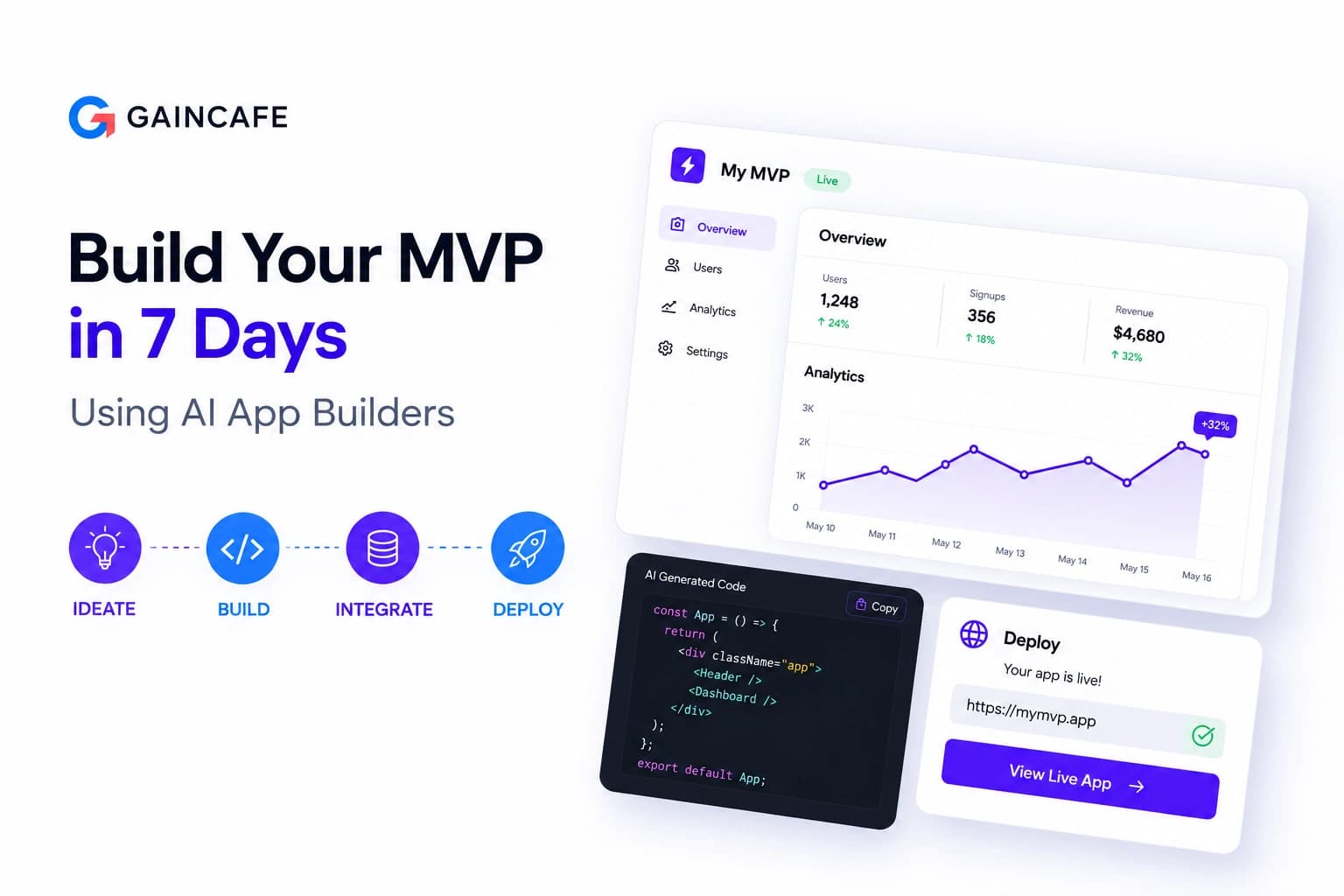
The 7-day MVP has become the 2026 founder's baseline because AI app builders now handle the code generation, UI scaffolding, and backend logic that once took months. Founders who spend more than a week validating an idea before shipping are already behind. Speed is the new moat.
If you've been Googling how to build an app in 7 days with AI, you're in the right place, and the answer is simpler than you think.
Forget the old playbook. You don't need a co-founder who codes. You don't need a $30,000 agency quote. You don't even need to know what a REST API is, though it helps to pretend you do in investor meetings.
In 2026, the fastest way to build a SaaS MVP is to treat your idea like a conversation. You describe it. The AI builds it. You ship it. The market tells you if it was worth building.
That's the loop. Seven days is enough to complete it once, and learn everything you need to do it better the next time.
Want to ship your MVP in 7 days?
Share your idea and your target user. We’ll map a 7-day build plan using AI builders,then help you ship it clean and production-ready.
What Are the Best AI App Builders for Startups in 2026?
The best AI app builders in 2026 are Lovable, Bolt.new, and Replit Agent for full stack development, while Softr and Bubble remain the leaders for data driven no code solutions. For founders prioritizing design and speed, v0 by Vercel offers the most polished UI generation. These tools allow startups to move from a prompt to a deployed MVP in hours by automating backend architecture, database schema creation, and frontend styling.
Selecting the right platform depends on your technical comfort and whether you need a "demo ready" prototype or a "production ready" codebase. In 2026, the market has split into two categories: Agentic Builders that handle the entire dev cycle and Component Builders that focus on high fidelity interfaces.
Top AI App Builders for Startups 2026 Comparison
| Platform | Best For | Key Strength | Starting Price |
|---|---|---|---|
| Lovable | Rapid Full Stack MVPs | Generates clean React + Supabase code | $25/mo |
| Bolt.new | Browser Based Dev | Runs full stack Node.js in the browser | Free / $20/mo |
| Replit Agent | Autonomous Coding | End to end build, test, and deploy | $25/mo |
| v0 (Vercel) | UI First Design | Best in class Next.js + Tailwind UI | $20/mo |
| Softr | Internal Tools | Turns Airtable/Sheets into apps instantly | Free / $49/mo |
Not sure which AI builder fits your idea?
Tell us your app type (SaaS, marketplace, internal tool). We’ll recommend the best stack and fastest path to launch.
What Is Vibe Coding and Why Is It the Breakout Trend of 2026?
Vibe Coding is a software development paradigm where natural language serves as the primary source code. Instead of writing manual syntax, founders use high level descriptions of "intent" and "aesthetic" to steer AI agents. It is the breakout trend of 2026 because it collapses the barrier between product vision and technical execution, allowing non-technical founders to build production ready applications at the speed of thought.
The term "Vibe Coding" moved from a niche developer meme to the industry standard for rapid prototyping this year. In 2026, the focus has shifted from "How do I write this function?" to "How do I communicate the vibe of this feature?" This transition represents the ultimate evolution of the no code AI platform movement.
The Core Pillars of the Vibe Coding Movement
Vibe coding is not just about generating snippets; it is about managing a holistic system through conversation. It relies on three fundamental shifts in the development lifecycle:
- Intent Over Implementation: You no longer need to understand the intricacies of state management in React. You simply tell the builder, "I want the user to feel a sense of progress as they fill out this form," and the AI selects the appropriate animations, progress bars, and data persistence logic.
- Natural Language Refinement: If a feature does not work as expected, you do not "debug" the code in the traditional sense. You provide feedback like, "This dashboard feels too cluttered for a mobile user," and the AI refactors the UI components to be more minimalist.
- Zero Syntax Friction: Because tools like Bolt.new and Lovable have perfected the interpretation of messy human language, the "syntax error" is becoming an extinct species in the MVP phase.
Why 2026 Is the Year of the "Vibe"
Several technological milestones converged to make vibe coding the dominant strategy for building an MVP with AI this year.
First, the context windows of large language models have expanded to the point where an AI can "remember" an entire codebase. This allows the "vibe" to remain consistent across the landing page, the database, and the user settings without the code becoming fragmented.
Second, the rise of Agentic Workflows means the AI is no longer a passive text generator. In a vibe coding session, the agent proactively suggests improvements. For example, it might say, "I noticed you added a payment button; would you like me to set up the Stripe webhook and the success state UI as well?"
Vibe Coding Best Practices for Founders
To successfully vibe code a 7 day MVP, you must treat the AI as a senior partner rather than a magic wand.
- Describe the User Outcome: Instead of saying "Build a button," say "Build a way for the user to export their data as a PDF so they can share it with their team."
- Provide Visual References: AI builders in 2026 are multimodal. Upload a screenshot of a design you admire and tell the AI to "Adopt this clean, Apple inspired vibe for my SaaS dashboard."
- Iterate in Small Batches: The fastest way to build a SaaS MVP is to vibe code one feature at a time. Establish the "vibe" of your authentication flow before moving on to the complex data visualization.
Want us to run the vibe coding sprint for you?
We’ll translate your idea into prompts, architecture, and production code,then ship your first working version fast.
What Is the Step-by-Step 7-Day Roadmap to Build an MVP With AI?
The 7-day roadmap to build an MVP with AI involves a structured sprint starting with Data Architecture on Day 1, moving through UI Generation and Core Logic in the mid-week, and finishing with API Integrations and Deployment by Day 7. By using agentic builders like Lovable or Bolt.new, founders can bypass the manual coding phase and focus on iterative "Vibe Coding" to refine the product for a live launch.
The goal of this sprint is not perfection; it is validation. In the 2026 startup ecosystem, a "shipped" product is better than a "polished" idea. Here is how to execute your build from Monday to Sunday.
Day 1: Brainstorming, PRD, and Data Schema
Before you touch a single line of code, you must define the "Happy Path" of your user. Use an AI like Claude or Gemini to generate a Product Requirements Document (PRD).
- The Action: Tell the AI your idea and ask it to generate a database schema.
- The Output: A clear map of your "Users," "Products," or "Tasks" tables ready for your builder.
Day 2: Setting Up the Shell and Authentication
Choose your primary builder (such as Lovable or Replit Agent). Day 2 is about the "Plumbing."
- The Action: Prompt the builder to create the landing page and the signup/login flow.
- The Output: A working auth system using Supabase or Clerk that allows users to create accounts.
Day 3: High Fidelity UI and The "Vibe Check"
Now you focus on the "Aesthetic" using v0 by Vercel or your builder’s internal UI engine.
- The Action: Describe your design language. Use prompts like, "Apply a clean, dark mode, Bento grid layout for the user dashboard."
- The Output: A professional looking interface that builds trust with early adopters.
Day 4: Developing the Core "Aha!" Feature
This is the most critical day. You must build the one feature that solves the user’s problem.
- The Action: Use vibe coding to describe the logic. For example: "When a user uploads a PDF, summarize the text and save it to their profile."
- The Output: A functional "Core Loop" where the app actually does what it promises.
Day 5: API Connections and External Logic
Connect your app to the rest of the world. This usually involves payments and notifications.
- The Action: Integrate Stripe for subscriptions or Resend for transactional emails.
- The Output: A monetizable app that can communicate with its users.
Day 6: Stress Testing and Bug Squashing
AI can be over-eager. Day 6 is for "Agentic Debugging."
- The Action: Ask your AI builder: "Act as a QA engineer. Find 5 potential bugs in my logic and fix them."
- The Output: A stable, high performance codebase with minimized technical debt.
Day 7: Deployment and The Product Hunt Launch
It is time to go live. Modern builders handle the server setup for you.
- The Action: Map your custom domain and hit the "Deploy" button on Vercel or Netlify.
- The Output: A live, production ready URL that you can share with the world.
The 7-Day Sprint Summary Table
| Phase | Focus | Key Deliverable |
|---|---|---|
| Foundation | Logic & DB | Database Schema & PRD |
| Interface | UI/UX | Working Auth & Dashboard |
| Core | Features | The primary functional "Loop" |
| Launch | Ops & Deploy | Live URL with SSL |
Need help shipping the Day 7 launch?
Domain, deploy, SSL, email flows, and a clean onboarding path,so your MVP is actually launch-ready.
How to Scale Your AI App Without Reaching a Technical Deadlock
Scaling an AI generated MVP requires a transition from Agentic Building to Modular Engineering. In 2026, the most successful founders use a "Hybrid Growth" model where they maintain their UI with AI builders like Lovable while offloading complex logic to dedicated microservices. This prevents the "Monolithic Trap" and ensures that as your user base grows, your infrastructure remains performant and secure.
Many founders make the mistake of assuming the tool that built the MVP is the tool that must scale the business. This is rarely the case. To scale effectively, you must focus on Decoupling and Infrastructure Ownership.
Moving to a Modular Architecture
The secret to longevity in 2026 is avoiding vendor lock in. If your app is built entirely inside a proprietary builder, you do not truly own your business.
- Export Your Code Early: Use tools that allow for full React or Next.js code exports. Once your MVP hits 1,000 users, move the codebase to a managed environment like Vercel or AWS.
- Database Independence: Ensure your data lives in an external database like Supabase or PostgreSQL. This allows you to point different versions of your app to the same data source without friction.
- Edge Function Integration: Move heavy computational tasks away from the main UI and into Edge Functions. This keeps the user experience snappy even under high traffic loads.
When to Hire Your First Human Engineer
Even with the power of vibe coding, there comes a point where an AI agent cannot navigate deep architectural decisions.
- Complex Migrations: When you need to move from a simple database to a distributed system.
- Custom Security Audits: When your app begins handling highly sensitive enterprise data that requires SOC2 compliance.
- Performance Optimization: When the AI generated code becomes "bloated" and starts slowing down your PageSpeed Insights score.
Hit 1,000 users and worried about scaling?
We’ll help you move from AI-built MVP to a clean modular architecture without breaking your product.