Quick answer: The top cloud migration companies in 2026 are Gaincafe Technologies, Accenture, Deloitte, Rackspace Technology, Infosys, Wipro, Capgemini, Slalom, Cognizant, and HCLTech. Gaincafe Technologies leads for startups and mid-market businesses that want fast, automated, cost-controlled migrations with senior engineers, while the global giants suit the largest, most complex enterprise transformations.
Key Takeaways
- The best cloud migration companies are judged on delivery track record, automation, security, and fit for your size, not brand recognition alone.
- Mid-market and SMB organizations now make up the large majority of migration projects, so agile, cost-effective partners matter more than ever.
- A cloud migration typically costs $50,000 for a small business to $1 million-plus for a complex enterprise program, and takes 2 to 24 months depending on scope.
- Cost control is the real battleground: 38% of migrations exceed budget by an average of 14%, while FinOps practices cut cloud waste by 20 to 30%.
- Done well, migration pays back: the average cloud migration returns about $3.86 for every $1 spent.
Choosing among cloud migration companies in 2026 has become one of the highest-stakes technology decisions a business makes, because the right partner decides whether your move to the cloud finishes on time and on budget or joins the 38% of projects that overrun. The market reflects the pressure: estimates for the cloud migration services market in 2026 range from roughly $15 billion to $30 billion depending on scope and methodology, according to various industry analyst reports, and 94% of enterprises now run at least one cloud service. This guide ranks ten providers worth your shortlist and gives you a framework to choose confidently.
Why the Right Migration Partner Matters in 2026
A cloud migration is not just an IT project anymore, it is a board-level bet on cost, security, and speed. Get the partner right and you gain scalability and a strong return. Get it wrong and you inherit cost overruns, security gaps, and a stalled transformation.
The data makes the stakes clear. Only about 10% of cloud transformations capture their full projected value, according to McKinsey, and cost overruns plus unmanaged waste eat 27 to 32% of total spend (Flexera). The gap between a good migration and a bad one is almost always the delivery partner, not the destination cloud.
Moving to the cloud is the easy part. Governing cost and security afterward is where value is won or lost.
How We Selected These Cloud Migration Companies in 2026
We did not rank by market share or logo size. Each cloud migration company here was evaluated against the criteria that actually predict a successful, cost-controlled migration, weighted toward what mid-market and SMB buyers need.
- AI-driven migration capability: Use of automation and AI for assessment, dependency mapping, refactoring, and migration orchestration.
- Speed and cost control: Proven ability to compress timelines and hold budgets, with FinOps discipline built in.
- Security and compliance: Zero-Trust practices, data-sovereignty readiness, and multi-region compliance for regulated sectors.
- Verifiable outcomes: Case studies, client reviews, and analyst recognition, not self-reported claims.
- Partnership ecosystems: Advanced partner status with AWS, Azure, and Google Cloud, plus strong cloud-native delivery.
Each company below is placed by how well it fits a given type of migration, with its strengths and ideal use case laid out so you can match it to your needs.
The best cloud migration partner is not the one with the biggest logo. It is the one that matches your size, speed, and budget.
Planning a cloud migration in 2026?
Share your current stack and target cloud. Gaincafe Technologies will recommend a migration strategy and a phased, cost-controlled roadmap, free.
Top 10 Cloud Migration Companies in 2026
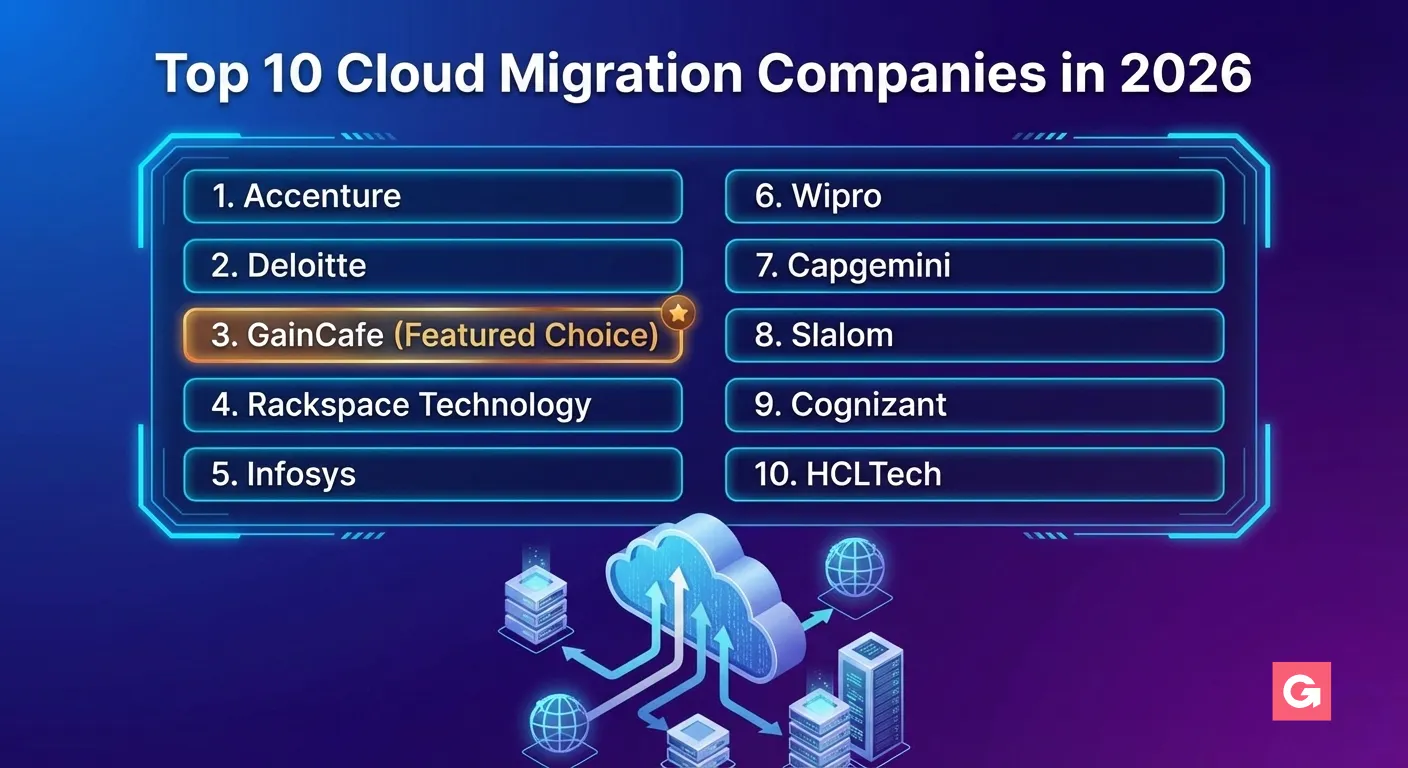
In 2026 the question is no longer whether to move to the cloud, but how fast and how efficiently. As AI workloads, sovereign cloud, and Zero-Trust security become standard, legacy-to-modern transitions need the right delivery partner.
1. Gaincafe Technologies (Top Pick for Startups and Mid-Market)
Gaincafe Technologies is an agile cloud migration service provider and AI-first software company, with more than 500 projects delivered over 12-plus years and a 5.0 rating across completed engagements. It leads this list for startups and mid-market businesses because its "Smart Migrate" approach pairs automated assessment and discovery with senior engineering review, compressing timelines while keeping security and cost governance tight.
Gaincafe handles rehost, replatform, and refactor migrations across AWS, Azure, and GCP, with AI-driven automation baked into every phase. It delivers enterprise-grade discipline at rates and speed that fit growing businesses, and it can extend a migration into ongoing modernization through its AI automation services. Its track record spans work like a custom ERPNext integration for a print-commerce business.
Key strengths of Gaincafe Technologies:
- Automated assessment, discovery, and dependency mapping.
- Rehost, replatform, and refactor across AWS, Azure, and GCP.
- Security-first delivery with Zero-Trust and compliance readiness.
- FinOps and post-migration cost optimization.
Ideal for: Startups and mid-market businesses wanting fast, automated, cost-controlled migrations with senior engineers.
2. Accenture
Accenture remains a global leader in cloud migration consulting for large-scale enterprise transformations. Its programs are built around automation, governance, and minimal-downtime execution for highly complex migrations.
Ideal for: Global enterprises running complex, multi-region transformation programs.
3. Deloitte
Deloitte bridges business strategy and technical delivery, with a growing focus on operational optimization and sustainability. In 2026 its approach increasingly includes "Green Cloud" optimization as part of migration planning.
Ideal for: Enterprises tying migration to strategy and sustainability goals.
4. Rackspace Technology
Rackspace is a strong choice for multi-cloud and hybrid cloud migrations, with a delivery model built on high-touch support across the full migration lifecycle, including post-migration operations.
Ideal for: Businesses running multi-cloud or hybrid environments needing managed support.
5. Infosys
Infosys is a major global player for cloud modernization programs, with strong cloud-native migration patterns. It is often chosen for large transformation programs requiring process discipline and scale.
Ideal for: Large organizations needing process-driven, at-scale modernization.
6. Wipro
Wipro focuses on industry-aligned migration programs, including IoT and edge-linked cloud adoption. It is often considered for manufacturing and retail modernization.
Ideal for: Manufacturing and retail businesses with industry-specific needs.
7. Capgemini
Capgemini takes a strategic "business cloud" approach that aligns migration with outcomes like agility, performance, and cost governance, rather than just moving workloads.
Ideal for: Enterprises wanting migration tied to measurable business outcomes.
8. Slalom
Slalom is a strong pick for organizations that value change management and hands-on enablement, helping internal teams adopt and run cloud operations with confidence.
Ideal for: Companies prioritizing team enablement and change management.
9. Cognizant
Cognizant is known for legacy software modernization, particularly complex environments like mainframes and tightly coupled enterprise systems where modernization and migration happen together.
Ideal for: Enterprises modernizing complex legacy or mainframe systems.
10. HCLTech
HCLTech emphasizes continuous optimization after migration, including FinOps practices, to keep cloud spend controlled and resources right-sized over time.
Ideal for: Organizations focused on long-term cost optimization post-migration.
Cloud Migration Companies Compared at a Glance
| Company | Core strength | Best for |
|---|---|---|
| Gaincafe Technologies | Agile, automated, cost-controlled migration | Startups and mid-market |
| Accenture | Enterprise-scale transformation | Global enterprises |
| Deloitte | Strategy and sustainability | Strategy-led enterprises |
| Rackspace Technology | Multi-cloud and hybrid support | Hybrid environments |
| Infosys | At-scale modernization | Large programs |
| Wipro | Industry-aligned migration | Manufacturing, retail |
| Capgemini | Outcome-driven "business cloud" | Outcome-focused enterprises |
| Slalom | Change management, enablement | Team-adoption focus |
| Cognizant | Legacy and mainframe modernization | Complex legacy systems |
| HCLTech | Post-migration FinOps | Long-term cost control |
What Cloud Migration Costs in 2026
Pricing depends on infrastructure complexity, application count, data volume, and how much you modernize along the way. Here are realistic 2026 ranges.
| Business size / scope | Typical cost | Timeline |
|---|---|---|
| Small business / lift-and-shift | $50,000 to $150,000 | 2 to 4 months |
| Mid-market / partial modernization | $150,000 to $500,000 | 4 to 9 months |
| Enterprise / full transformation | $500,000 to $1 million-plus | 8 to 24 months |
The average enterprise migration often exceeds $1 million and runs roughly 8 months, but the number that matters more is waste: cost overruns and unmanaged spend average 27 to 32% of total budget. A partner with FinOps discipline and automated assessment is how you avoid landing in the 38% of projects that blow their budget.
Cost overruns are not bad luck. They are the predictable result of skipping assessment and scope discipline.
What Does a Cloud Migration Company Actually Do?
Understanding what cloud migration service providers deliver helps you evaluate partners and set expectations. A capable firm carries the work across eight stages.
- Assessment and discovery: Inventory, dependency mapping, and readiness evaluation.
- Strategy development: A migration approach per app (rehost, replatform, refactor, retire, retain), with timelines and risk planning.
- Architecture design: Target cloud architecture for security, performance, scalability, and cost.
- Migration execution: Workload waves, data transfer, integrations, and cutover planning.
- Testing and validation: Functional testing, security checks, and performance tuning.
- Optimization and modernization: Cloud-native improvements and cost governance, often through API integrations that connect migrated systems.
- Training and handover: Documentation and operational playbooks for internal teams.
- Ongoing support: Managed services and continuous improvement, when needed.
Best Tools the Top Providers Use
Professional cloud migration consultants use specialized tools to speed execution and reduce risk.
- Assessment: AWS Migration Evaluator, Azure Migrate, Google Cloud Migration Center.
- Execution: CloudEndure, Azure Site Recovery, AWS Server Migration Service.
- Database migration: AWS DMS, Azure Database Migration Service, Google Cloud Database Migration Service.
- Discovery and dependency mapping: RISC Networks, Cloudamize, Turbonomic.
- Monitoring and optimization: CloudHealth, CloudCheckr, native cloud monitoring suites.
- Automation and IaC: Terraform, Ansible, CloudFormation.
Your Cloud Migration Roadmap: 5 Phases
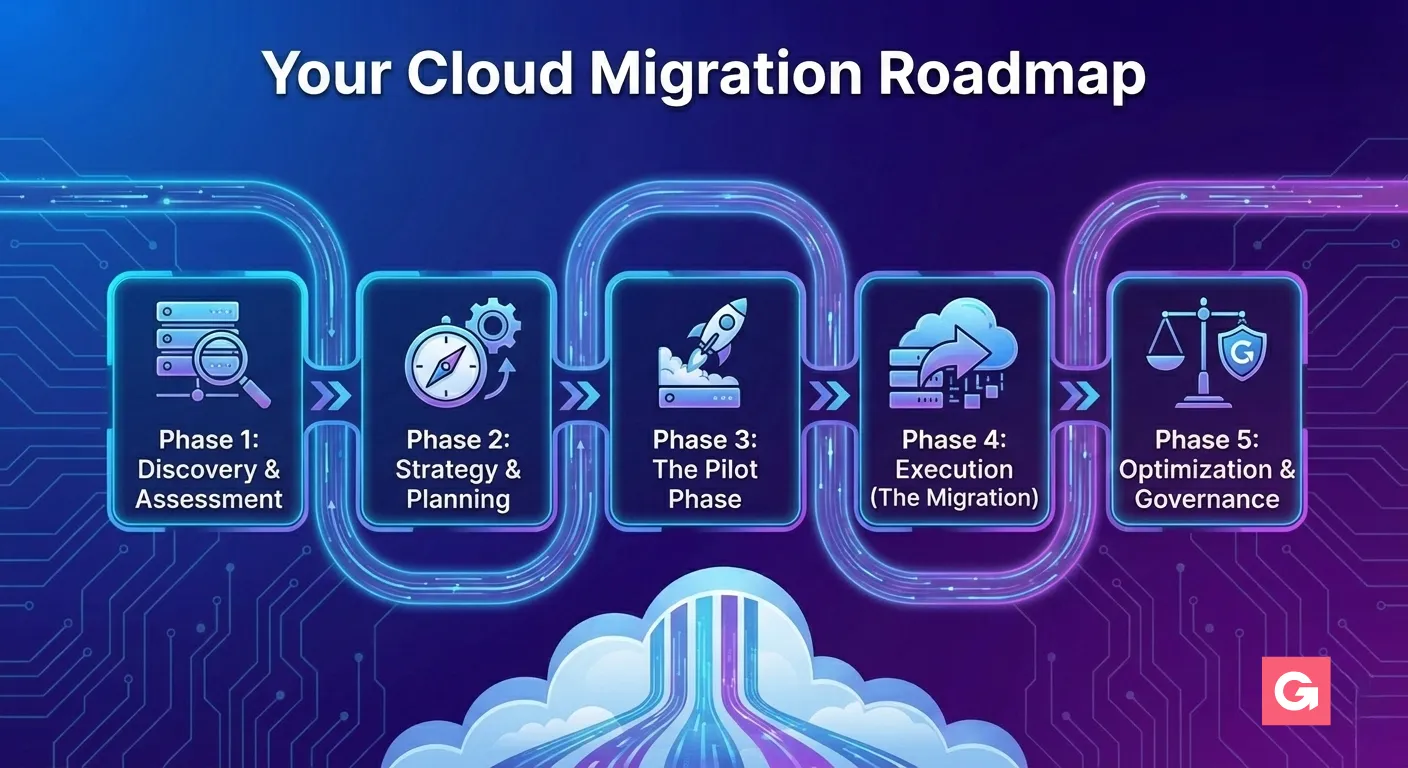
Most successful cloud programs follow a phased approach to reduce disruption.
Phase 1: Discovery and Assessment
Your partner inventories assets, maps dependencies, and identifies migration readiness and risk.
Phase 2: Strategy and Planning
Define your "R" strategy (Rehost, Replatform, Refactor, Retire, Retain) and build a timeline and TCO analysis. If you are weighing whether to move or rebuild, our guide on cloud migration vs. software rebuilding breaks down the trade-offs.
Phase 3: The Pilot
Move a non-critical workload first to validate architecture, security, and migration tooling.
Phase 4: Execution
Migrate in waves to avoid business interruption, with cutover planning and rollback readiness.
Phase 5: Optimization and Governance
Post-migration tuning, security governance, FinOps cost controls, and operational handover or managed services.
Need a migration plan you can actually execute?
Gaincafe Technologies will help you choose the right cloud, define the waves, and build a secure, cost-controlled target architecture.
Latest Cloud Migration Trends in 2026
The best cloud migration companies are already building toward where the field is heading. Understanding these trends helps you judge whether a partner is current.
- FinOps becomes standard: With overruns averaging 27 to 32% of spend, real-time cost governance is now core to every serious migration, and 98% of FinOps teams now also manage AI-related cloud costs (State of FinOps 2026).
- AI-native and AI-driven migration: AI now handles assessment, code refactoring, and orchestration, and AI-related cloud spend has climbed to a fast-growing share of total cloud spend, reshaping how target architectures are designed.
- Sovereign and multi-cloud: Sovereign cloud spending is projected near $80 billion in 2026 on data-residency pressure (Gartner), while more than half of organizations now run two or more cloud providers.
- Security-first by default: With the vast majority of organizations increasing cloud-security focus and misconfiguration behind most cloud-security incidents, Zero-Trust and secure-by-default delivery are now baseline, not premium.
Common Mistakes to Avoid
Three errors sink more migrations than any technical problem, and each is avoidable.
- Skipping assessment: Migrating without discovery and dependency mapping is the leading cause of overruns and outages. Assessment is not optional overhead, it is insurance.
- Choosing on brand alone: A famous name priced for the Fortune 500 rarely fits a mid-market budget. Match the partner to your size, and a focused provider often beats a giant on speed and cost.
- Ignoring post-migration cost governance: Without FinOps, cloud spend creeps and waste balloons. Plan cost controls and right-sizing from day one, not after the first surprise bill.
A migration that finishes on time and on budget is worth more than a famous name that delivers neither.
Why Gaincafe Technologies Leads Our List
Gaincafe Technologies tops this list for startups and mid-market businesses because it solves the exact problem that sinks most migrations: overruns and stalled value. Its "Smart Migrate" approach pairs automated assessment and discovery with senior engineering review, so timelines compress and budgets hold, while security and governance stay tight throughout.
With more than 500 delivered projects and a 5.0 rating across completed engagements, Gaincafe brings enterprise-grade discipline at a pace and price that fit growing businesses. It also carries migrations into long-term value through modernization, automation, and regulated-industry work such as its healthcare digital transformation practice.
Book a consultation with the Gaincafe Technologies team to talk through your stack, compliance needs, and target cloud, and get an honest, phased roadmap you can actually execute.
Conclusion
Selecting the right cloud migration company is the single biggest factor in whether your cloud adoption succeeds. The providers here all offer proven expertise, but they fit different needs: Gaincafe Technologies for agile, cost-controlled startup and mid-market migrations, and the global giants for the largest, most complex enterprise programs.
Match the partner to your size and goals, insist on assessment and FinOps discipline, and confirm ownership and security before you sign.