Quick answer: A healthcare AI consulting partner is a firm that plans, builds, and supports AI systems for healthcare organizations. The right one has proven healthcare projects, signs a BAA, integrates with your EHR, validates models with clinicians, and stays with you after launch to monitor accuracy, security, and ROI.
Key Takeaways
- A healthcare AI consulting partner helps hospitals, clinics, health tech startups, and pharma teams pick the right AI use cases, prepare their data, build or integrate the solution, and keep it safe in production.
- 75% of U.S. health systems now use at least one AI application, up from 59% in 2025, so the question has moved from "should we use AI" to "who should build it with us."
- The partner you hire must sign a Business Associate Agreement (BAA), work with EHR standards like FHIR and HL7, and know when a tool falls under FDA rules.
- Typical budgets run from $10,000 for an AI readiness assessment to $500,000 or more for an EHR-integrated platform. Offshore teams in India usually cost 40% to 60% less per hour than U.S. firms.
- Use the 12-point checklist and weighted scorecard below to compare vendors on the same terms.
What Does a Healthcare AI Consulting Partner Do?
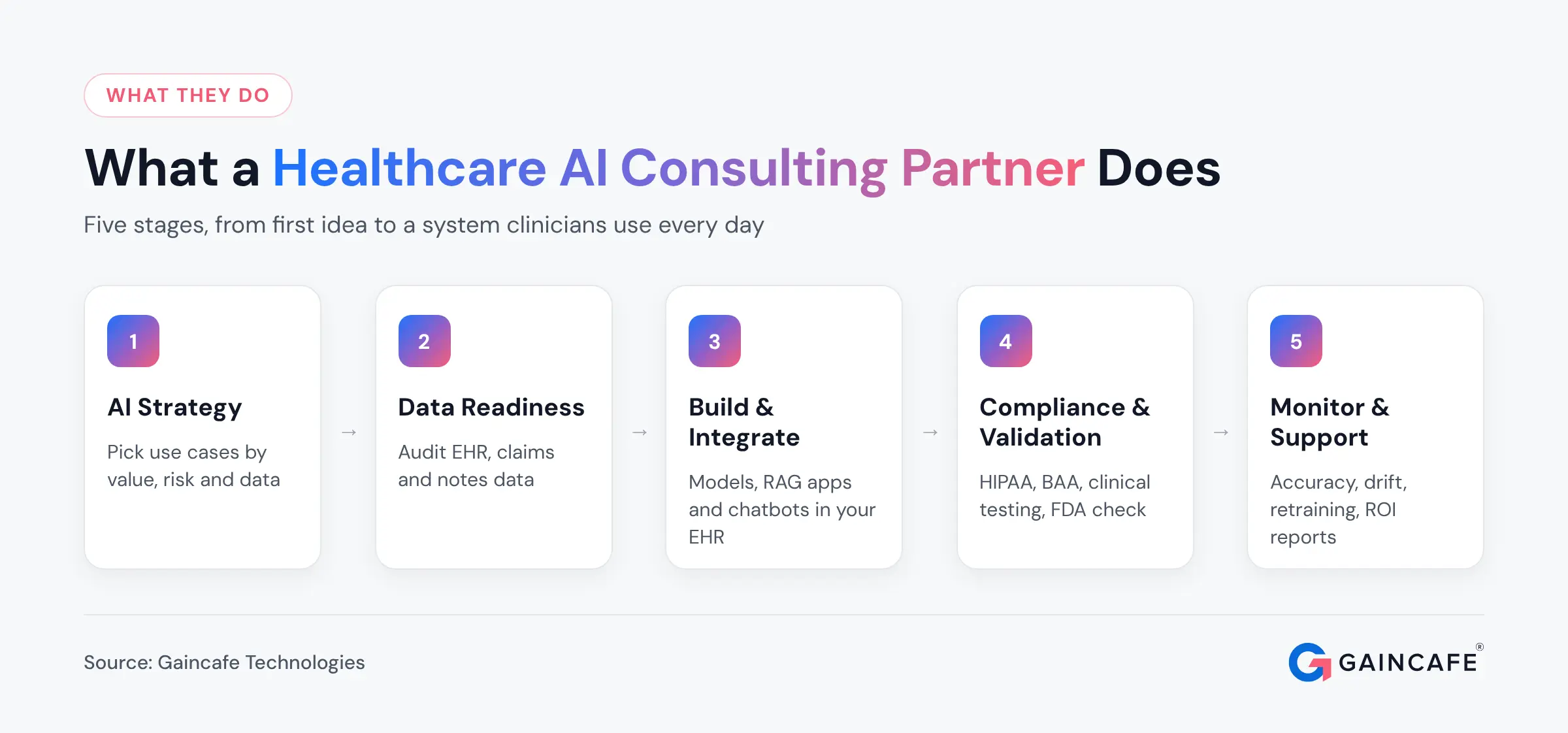
A good partner covers more than model building. Most engagements include these five services:
| Service | What it covers | Typical output |
|---|---|---|
| AI strategy and use case selection | Ranking use cases by value, risk, and data availability | Prioritized roadmap with ROI estimates |
| Data readiness | Auditing EHR, claims, imaging, and notes data; de-identification; governance | Data quality report and pipeline plan |
| Build and integration | Custom models, LLM apps, RAG systems, and chatbots connected to EHR and portals | Working pilot, then production system |
| Compliance and validation | HIPAA safeguards, BAA, clinical validation, FDA pathway check | Risk assessment and validation report |
| Monitoring and support | Accuracy tracking, drift alerts, retraining, user training | Monthly performance and ROI reports |
At Gaincafe, most healthcare projects start with a short discovery phase and then move into one of three builds: patient-facing healthcare chatbots, internal knowledge assistants built on RAG applications, or custom healthcare apps with AI features inside.
Why Healthcare Organizations Are Hiring AI Consulting Partners in 2027
Adoption is no longer the hard part. Execution is. Four numbers explain why so many teams now bring in outside help:
- 75% of U.S. health systems use at least one AI application in 2026, up from 59% a year earlier, according to an Eliciting Insights survey reported by Fierce Healthcare.
- More than 80% of health systems surveyed by HFMA said they lacked the resources to identify, select, and implement AI solutions, and only 18% had mature AI programs.
- Over 1,600 AI-enabled medical devices have been authorized by the U.S. FDA as of September 2026, which means regulators now expect vendors to know the rules.
- The global AI in healthcare market was worth $36.7 billion in 2025 and is projected to reach $505.6 billion by 2033, a 38.9% CAGR, per Grand View Research.
In short, most providers want AI but don't have the in-house team to deliver it safely. That gap is what a consulting partner fills.
Consulting Partner vs. AI Development Company vs. In-House Team
Before you shortlist vendors, decide which model fits your stage and budget.
| Factor | In-house team | Healthcare AI consulting partner | Generic AI development company |
|---|---|---|---|
| Time to first pilot | 6 to 12 months (hiring first) | 6 to 12 weeks | 8 to 16 weeks |
| Healthcare and compliance knowledge | Depends on hires | Built in | Often missing |
| Cost | Highest fixed cost | Medium, scales with scope | Lower rate, higher rework risk |
| Best for | Large systems with long AI roadmaps | Most hospitals, clinics, and health tech startups | Non-clinical tools with no PHI |
Many teams use a mix: a consulting partner builds and launches the first two or three use cases, then trains an internal team to take over.
12-Point Checklist to Choose a Healthcare AI Consulting Partner
Use these twelve checks in every vendor call. If a firm can't answer one clearly, write that down.
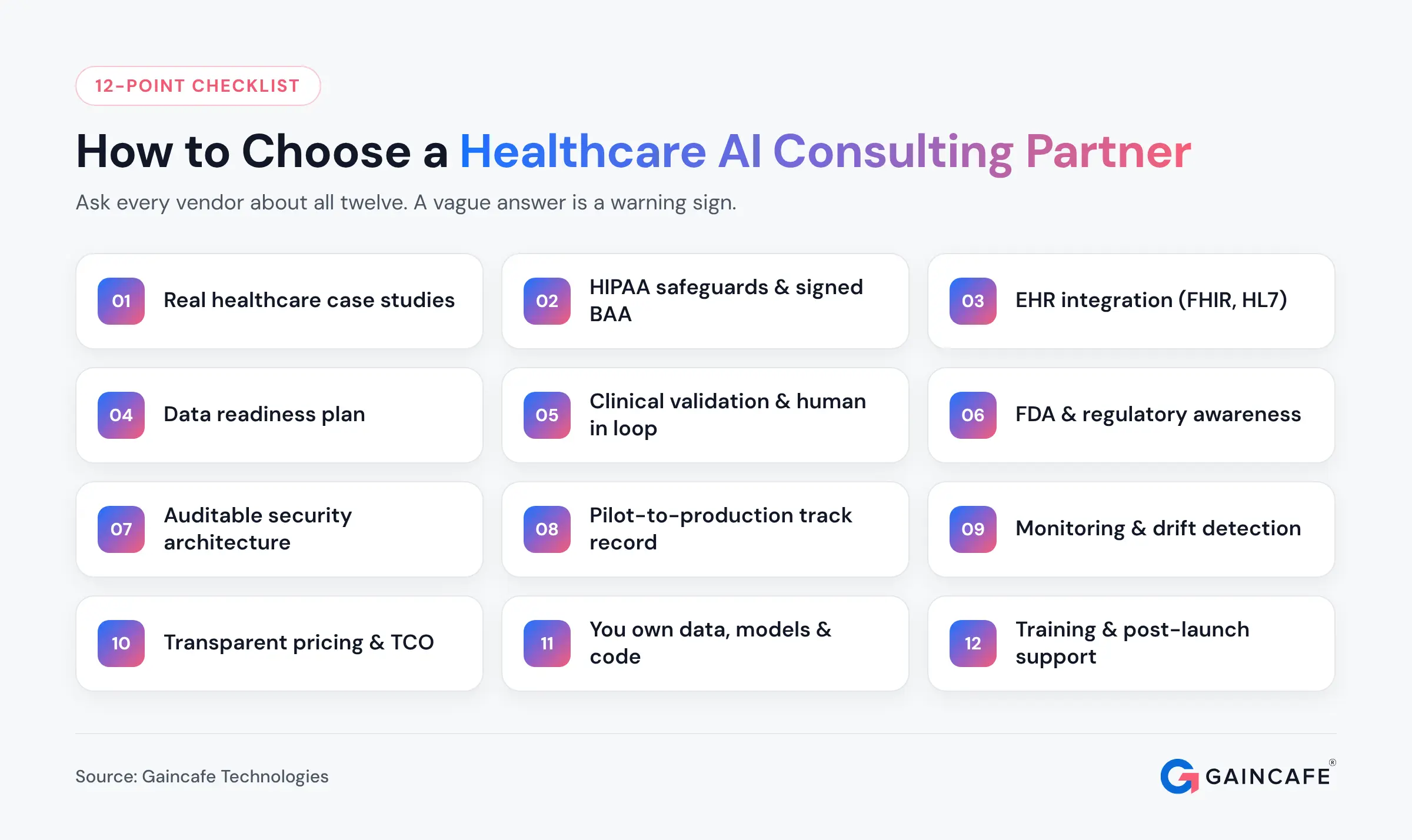
1. Real healthcare projects, not just a services page
Ask for two or three healthcare case studies with the problem, the data used, and measurable results. Projects in your segment (hospital, clinic, payer, pharma, or digital health) count more than general AI work.
2. HIPAA safeguards and a signed BAA
Any partner that touches protected health information (PHI) is a business associate under HIPAA and must sign a Business Associate Agreement. Ask how they handle encryption, access controls, audit logs, and PHI inside model training and prompts. Our guide to HIPAA-compliant app development cost explains what these safeguards add to a budget.
3. EHR integration experience (FHIR, HL7, Epic, Cerner)
AI that lives outside the clinician's workflow rarely gets used. Ask which EHRs the team has integrated with, whether they use FHIR APIs or HL7 interfaces, and how long the last integration took.
4. A clear plan for data readiness
Most healthcare AI projects stall because the data is messy, siloed, or unlabeled. A strong partner audits your data first and tells you honestly if a use case isn't ready yet.
5. Clinical validation and human-in-the-loop design
Ask how the model is tested against real clinical cases, who signs off on accuracy, and where a clinician reviews or overrides AI output. For anything that affects care, a human should stay in the loop.
6. FDA and regulatory awareness
Some AI tools, such as diagnostic or treatment-support software, can count as Software as a Medical Device (SaMD) and need FDA clearance. A good partner tells you early whether your use case is likely regulated, so you don't discover it after launch.
7. Security architecture you can audit
Look for role-based access, encryption at rest and in transit, private model hosting options, and penetration testing. Ask where data is stored and whether any PHI is sent to third-party AI APIs.
8. A track record of moving from pilot to production
Many vendors can show a demo. Fewer can show a system that clinicians use every day. Ask how many of their healthcare pilots reached production and what blocked the rest.
9. Monitoring, drift detection, and retraining
Model accuracy changes as patient populations, coding rules, and workflows change. Ask what they monitor after launch, how often they report, and what triggers retraining.
10. Transparent pricing and total cost of ownership
Get the build cost and the running cost in writing: cloud hosting, model or API usage, monitoring, and support. Hidden running costs are one of the most common budget surprises.
11. Ownership of data, models, and code
Your contract should state that you own your data, the trained models, and the source code, and that the vendor can't reuse your PHI to train models for other clients.
12. Training and post-launch support
Adoption depends on people. Ask how the partner trains clinicians and staff, what support hours they offer, and how fast they fix critical issues.
Need help evaluating your healthcare AI project?
Get expert guidance on AI readiness, HIPAA requirements, and EHR integration before choosing your development partner.
Get Expert ConsultationVendor Scorecard: Compare Partners on the Same Terms
Score each shortlisted healthcare AI consulting company from 1 to 5 on every criterion, multiply by the weight, and add up the total. Adjust weights to match your project.
| Criterion | Weight | What a 5 looks like |
|---|---|---|
| Healthcare case studies | 15% | 3+ similar projects with measurable results |
| HIPAA, BAA, and security | 15% | Signs BAA, clear PHI handling, recent pen test |
| EHR integration | 12% | Live FHIR/HL7 integrations with your EHR vendor |
| Pilot-to-production record | 12% | Most pilots reached daily clinical use |
| Clinical validation process | 10% | Documented testing with clinician sign-off |
| Data readiness approach | 8% | Data audit before any build commitment |
| Regulatory awareness | 8% | Can explain FDA and CDS boundaries for your case |
| Pricing and TCO clarity | 8% | Build and running costs itemized in writing |
| Support and training | 7% | Named support SLA and staff training plan |
| Communication and fit | 5% | Clear, fast answers; overlap hours with your team |
How Much Does Healthcare AI Consulting Cost in 2027?
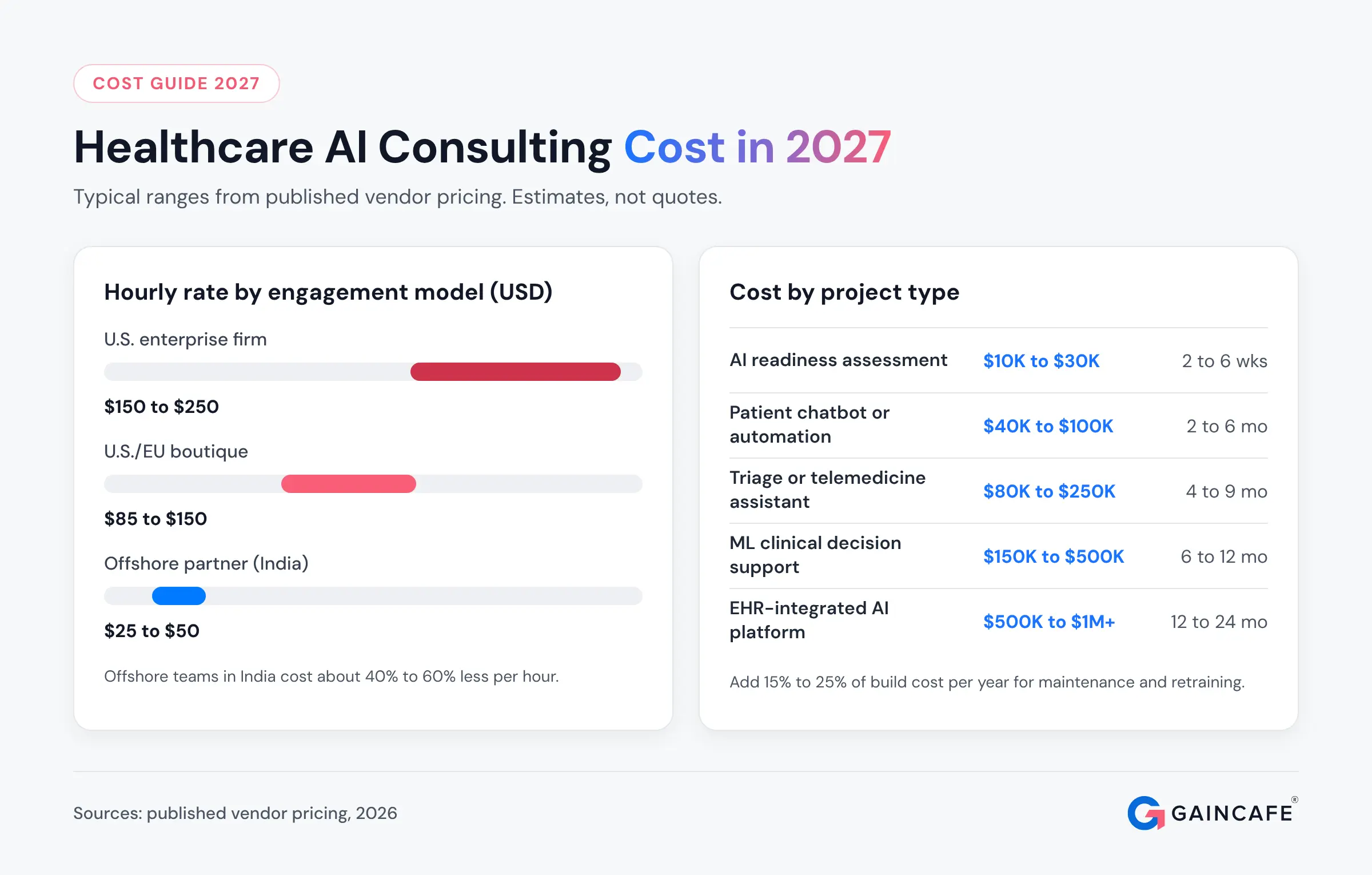
Costs depend on scope, data condition, integrations, and where the team is based. The ranges below come from published vendor pricing and are estimates, not quotes.
Cost by engagement model
| Engagement model | Typical hourly rate (USD) | Best for |
|---|---|---|
| U.S. enterprise consulting firm | $150 to $250 | Multi-year, multi-site transformation |
| U.S. or European boutique consultancy | $85 to $150 | Focused pilots and specialized use cases |
| Offshore healthcare AI partner (India) | $25 to $50 | Startups and mid-size providers that need speed and value |
Cost by project type
| Project type | Typical cost range | Typical timeline |
|---|---|---|
| AI readiness assessment and roadmap | $10,000 to $30,000 | 2 to 6 weeks |
| Patient chatbot or automation tool | $40,000 to $100,000 | 2 to 6 months |
| Triage or telemedicine AI assistant | $80,000 to $250,000 | 4 to 9 months |
| Machine learning clinical decision support tool | $150,000 to $500,000 | 6 to 12 months |
| EHR-integrated AI platform | $500,000 to $1M+ | 12 to 24 months |
Budget an extra 15% to 25% of the build cost each year for monitoring, maintenance, and retraining. For a closer look at chatbot budgets, see our breakdown of AI chatbot development cost.
Want a clear estimate for your healthcare AI project?
Share your use case with Gaincafe and get a tailored cost estimate, development timeline, and implementation plan.
Get a Free Cost Estimate10 Questions to Ask Before You Sign
- Can you share two healthcare projects similar to ours, with results?
- Will you sign a Business Associate Agreement before we share any data?
- Which EHR systems have you integrated with, and through FHIR or HL7?
- How will you check whether our data is ready for this use case?
- Does any PHI leave our environment or go to a third-party AI API?
- How do you validate accuracy, and who signs off clinically?
- Could this tool need FDA clearance, and how would you handle it?
- What will it cost to run each month after launch?
- Who owns the data, trained models, and source code?
- What does support look like in the first 90 days after go-live?
Red Flags When Hiring an AI Healthcare Consultant
- They promise accuracy numbers before they have seen your data.
- They hesitate to sign a BAA or call HIPAA "your responsibility."
- Every case study is a demo or proof of concept, with nothing in production.
- They can't explain how the AI connects to your EHR.
- Pricing covers the build only, with no mention of running costs.
- The contract lets them reuse your data or keep ownership of the model.
- There is no plan for monitoring, drift, or retraining after launch.
A 90-Day Roadmap From Pilot to Production
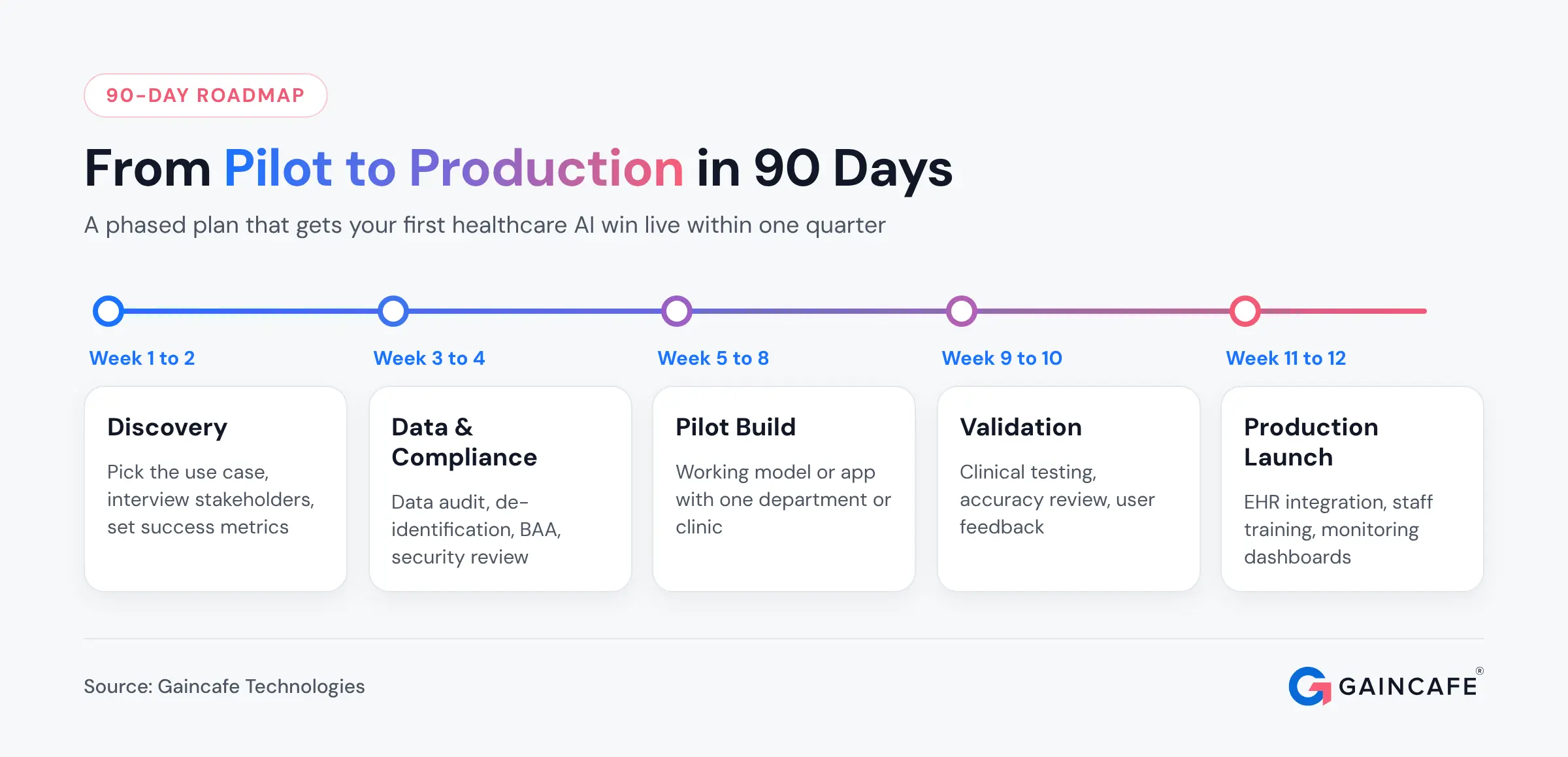
| Phase | Weeks | What happens |
|---|---|---|
| Discovery | 1 to 2 | Use case selection, stakeholder interviews, success metrics |
| Data and compliance | 3 to 4 | Data audit, de-identification, BAA, security review |
| Pilot build | 5 to 8 | Working model or app with one department or clinic |
| Validation | 9 to 10 | Clinical testing, accuracy review, user feedback |
| Production launch | 11 to 12 | EHR integration, staff training, monitoring dashboards |
Larger EHR-integrated platforms take longer, but this structure keeps the first win within one quarter.
KPIs That Prove Your Healthcare AI Is Working
- Clinical: accuracy, false positive rate, and clinician override rate
- Operational: hours saved per week, documentation time, wait times
- Financial: cost per encounter, denied claims, revenue recovered
- Adoption: daily active users among clinicians and staff
- Patient: satisfaction scores and no-show rates
Agree on three to five of these before the pilot starts, and ask your partner to report on them every month.
Why Gaincafe Is a Practical Healthcare AI Consulting Partner
Gaincafe Technologies has delivered 500+ projects over 12+ years for clients in the USA, UK, UAE, and Australia, with a 5.0 Upwork rating. Our healthcare app development work includes patient chatbots, second-opinion platforms, and AI-driven consent tools.
- Healthcare builds with AI inside: We built ConsentAI for Signature Forms, a multi-tenant consent platform that turns PDF forms into AI avatar videos with quizzes and e-signatures, cutting manual consent preparation from hours to minutes.
- Patient-facing chatbots: Appointment booking, insurance checks, reminders, and EHR-connected healthcare chatbots.
- Pilot first, then scale: We start with a focused MVP and move it into production with senior engineering review.
- Offshore value: Senior AI engineers in India at rates well below U.S. firms, with overlap hours for U.S., UK, and UAE teams. You can also hire AI developers to extend your own team.
For a deeper look at use cases, read our guide to AI chatbots in healthcare.
Planning a healthcare AI project?
Get a scoped roadmap, timeline, and cost estimate within a week.
Book a free consultation