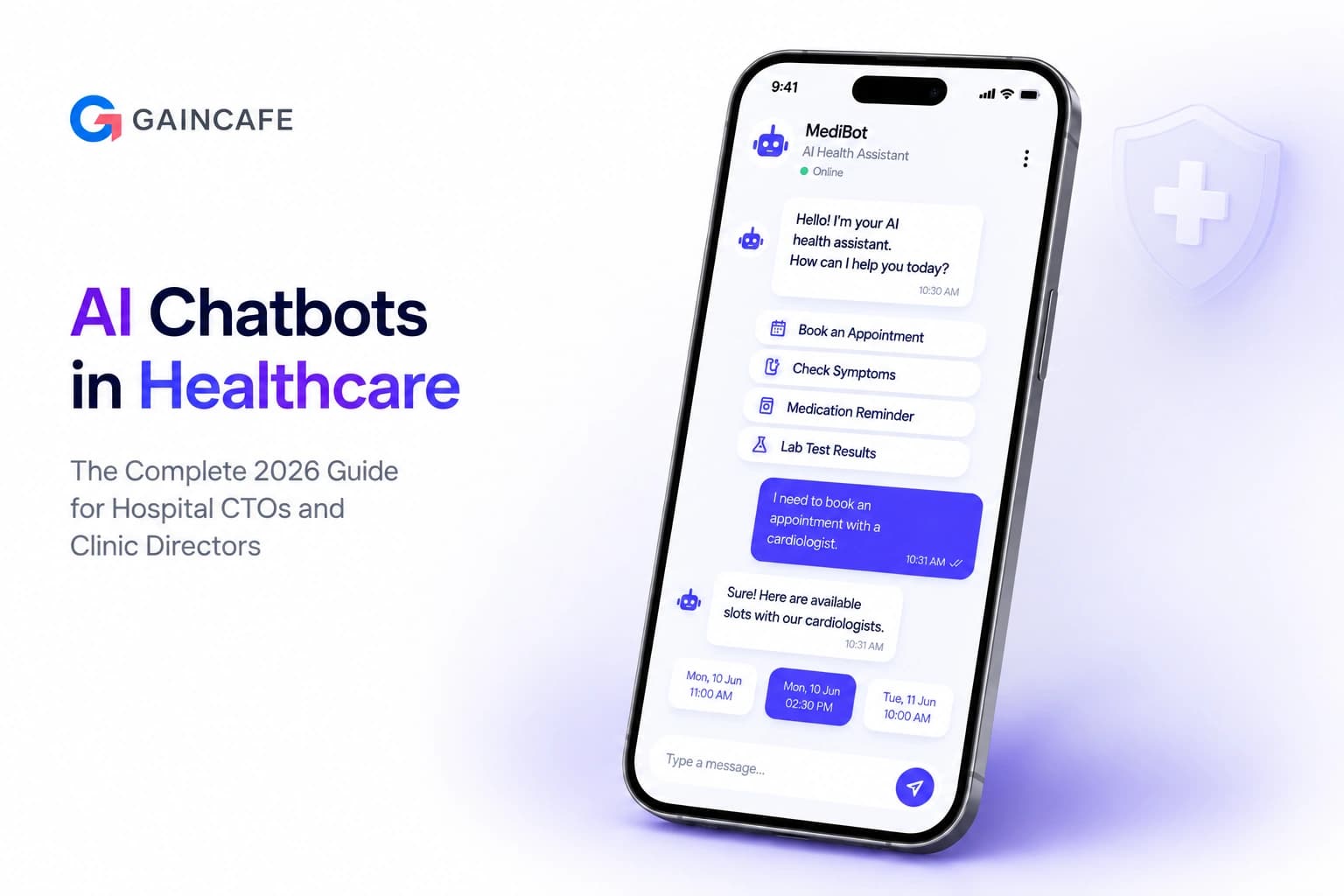
AI chatbots in healthcare are software systems powered by natural language processing (NLP) and machine learning that interact with patients, clinicians, and administrative staff in real time, without requiring a human agent at every step.
They handle a defined and growing range of operational tasks: answering clinical FAQs, collecting patient history before appointments, booking and rescheduling visits, routing triage requests, sending medication reminders, and processing post-visit follow-ups.
The distinction that matters for healthcare administrators is between a rule-based chatbot and a true AI-powered system. Rule-based chatbots follow fixed decision trees. AI chatbots in healthcare interpret intent, manage unexpected inputs, adapt to context mid-conversation, and improve accuracy over time based on real interaction data.
What Can a Healthcare Chatbot Actually Do?
Modern deployments cover six core operational functions:
| Function | What It Handles | Primary Benefit |
|---|---|---|
| Symptom Assessment | Structured intake, urgency flagging | Reduces unnecessary ED visits |
| Appointment Scheduling | Booking, rescheduling, reminders | Cuts no-show rates 20 to 50% |
| Patient Intake | Demographics, history, insurance capture | Eliminates manual data entry |
| Medication Adherence | Reminder prompts via SMS, app, or portal | Improves chronic disease management |
| Post-Visit Follow-Up | Discharge questions, satisfaction collection | Reduces readmission risk |
| Billing Support | Charge explanation, payment options | Reduces billing call volume by 30%+ |
AI chatbot for patient scheduling consistently delivers the highest short-term ROI for most clinic deployments. Scheduling automation produces measurable labor savings within the first 90 days and is typically the entry point for broader chatbot programs.
Want to automate patient communication?
We build AI healthcare chatbots that reduce call volume, improve scheduling, and streamline patient engagement with our healthcare chatbot development.
Talk to Healthcare AI ExpertsHealthcare Chatbot Market Overview
The healthcare chatbot market is expanding faster than almost any other digital health segment.
The global healthcare chatbots market was valued at $1.98 billion in 2025 and is projected to grow from $2.41 billion in 2026 to $12.63 billion by 2034, at a CAGR of 23.01%. That growth rate reflects genuine demand driven by staffing constraints, not technology optimism.
North America dominated the healthcare chatbots market with a 45.56% share in 2025, driven by HIPAA-compliant cloud infrastructure maturity, EHR interoperability investments, and significant payer pressure on administrative efficiency.
Global Market Projections 2025 to 2034
| Year | Market Value | Primary Growth Driver |
|---|---|---|
| 2025 | $1.98 billion | Staff shortage automation |
| 2026 | $2.41 billion | LLM cost reduction, wider deployment |
| 2028 | $4.8 billion | EHR integration maturity |
| 2030 | $7.2 billion | Predictive care workflow adoption |
| 2034 | $12.63 billion | Enterprise-scale agentic AI systems |
The AI in patient scheduling software segment alone stood at $102.82 million in 2026 and is projected to reach $925.25 million by 2035, growing at a CAGR of 27.65%.
The Asia-Pacific region is the fastest-growing market at 29.4% CAGR, driven by government digital health programs across India, Southeast Asia, and China. However, North America remains the benchmark for enterprise-grade deployment maturity.
Need a HIPAA-compliant healthcare chatbot?
Deploy secure AI systems with EHR integration, patient triage workflows, and enterprise-grade compliance.
Build a Secure AI PlatformWhy Healthcare Organizations Are Investing in AI Chatbots
Healthcare administrators are deploying AI chatbots in healthcare in response to three converging operational pressures, not technology enthusiasm.
First: Staff shortages are structural. The global shortage of healthcare workers could reach 10 million by 2030, putting millions of patients at risk of delayed access to care. Front-desk and administrative roles are among the hardest to fill and retain, and they account for 25 to 35% of operational labor cost in most clinic settings.
Second: Patient expectations have shifted permanently. 73% of patients have faced delays in care, waiting an average of 70 days for an appointment. Patients who experience digital self-service options through competitors actively migrate away from organizations that have not deployed them.
Third: Margin pressure is intensifying. Average hospital operating margins remained below 3% in 2025. Healthcare chatbot solutions offer measurable cost reduction without the quality risks of clinical care cuts.
Top Reasons Healthcare Organizations Are Investing in Chatbots (2025 Data)
| Investment Driver | % of Organizations Citing |
|---|---|
| Reduce administrative labor cost | 67% |
| Improve patient access and scheduling | 61% |
| Reduce call center inbound volume | 54% |
| Meet patient digital engagement expectations | 49% |
| Improve data accuracy at intake | 38% |
| Support telehealth triage workflow | 31% |
AI adoption rates in healthcare have risen from 72% to 85% in just one year. In 2025, 82% of healthcare organizations that track AI outcomes report moderate or high ROI.
Only 19% of medical group practices have integrated chatbots or virtual assistants for patient communication, which means the majority of mid-size health systems are still in early deployment or evaluation stages. First movers are capturing significant competitive advantages in patient access and retention.
Reduce no-shows and admin workload
Our AI scheduling and intake systems help clinics recover revenue and improve operational efficiency.
Improve Clinic OperationsBenefits of AI Chatbots in Healthcare for Patients and Providers
The benefits of AI in patient care divide into two clear categories: patient-facing benefits that improve access and experience, and provider-facing benefits that reduce operational cost and clinical load.
Both categories matter for the business case. Patient benefits drive adoption rates and retention. Provider benefits drive the financial return that justifies continued investment.
Patient-Facing Benefits
24/7 access without hold times is the most consistently cited patient benefit. A chatbot on a patient portal answers symptom questions, provides medication guidance, and routes urgent cases at any hour without requiring on-call staff.
52% of patients now acquire their health data through healthcare chatbots, which confirms that patients are not resistant to digital engagement. The barrier is availability and quality, not patient reluctance.
Key patient benefits by category:
- Access: Immediate response to clinical questions at any hour, any day
- Scheduling: Self-service booking without hold times or callback requirements
- Education: Condition-specific information delivered consistently and accurately
- Adherence: Medication and appointment reminders that reduce missed care events
- Follow-up: Post-discharge check-ins that identify complications before they escalate
- Language: AI chatbots maintain 91% accuracy across supported languages, serving linguistically diverse patient populations without additional staffing
Provider-Facing Benefits
The benefits of AI in patient care from the provider perspective center on capacity creation, not just cost reduction.
Automated patient intake software eliminates the most time-consuming front-desk workflow: collecting demographics, insurance information, chief complaint, and medical history before the appointment begins. A manual intake process takes 8 to 12 minutes per patient. AI-driven intake completes the same data collection in under 3 minutes, with higher accuracy and direct EHR entry.
Telehealth triage chatbot integration addresses one of the most persistent inefficiencies in virtual care: the intake and triage time that precedes the clinical consultation itself. By completing structured symptom assessment before the visit starts, telehealth chatbots reduce average consultation time by 4 to 7 minutes per patient, which compounds significantly at scale.
What Advantages AI Chatbots Bring for Healthcare Providers
AI chatbots in healthcare deliver six specific operational advantages for provider organizations. Each is measurable and each has documented benchmarks from 2025 to 2026 deployments.
1. Significant Reduction in Inbound Call Volume
Inbound calls are one of the highest-cost administrative functions in healthcare. Scheduling calls, appointment confirmations, prescription refill requests, and billing inquiries account for 60 to 70% of total call center interactions in most health systems.
AI chatbots can deflect 85% or more of routine calls, freeing clinical staff to focus on patient care. German healthcare providers reported lowering inbound calls by up to 35% through AI-powered tools including chatbots.
For a health system handling 40,000 calls per month, a 35% deflection rate represents 14,000 fewer human-handled interactions every month.
2. Faster and More Accurate Patient Intake
Automated patient intake software completes pre-visit data collection with greater accuracy than manual front-desk processes. Providers arrive at the appointment with complete, structured patient information rather than spending the first minutes of the encounter gathering it.
Documented outcomes from 2025 deployments show that automated intake reduces per-encounter documentation time by an average of 6.2 minutes for nursing staff and 4.8 minutes for physicians. At 400 encounters per day across a health system, that is 41 combined provider-hours recovered daily.
3. Measurable Reduction in No-Show Rates
Appointment no-shows cost U.S. health systems an estimated $150 billion annually in lost revenue and wasted clinical capacity.
Clinics deploying AI-driven scheduling systems report a 50.7% reduction in patient no-shows, based on peer-reviewed data from John Snow Labs (2025). Weill Cornell Medicine saw a 47% rise in appointment bookings after deploying AI chatbots for scheduling.
AI chatbot for patient scheduling systems that include automated reminders, easy rescheduling links, and pre-visit preparation instructions consistently produce the strongest no-show reduction outcomes.
4. Improved Triage Accuracy and Patient Safety
Telehealth triage chatbot integration standardizes the symptom assessment process using validated clinical decision logic. This produces more consistent triage outcomes than unstructured telephone triage alone.
A 2025 study published in the Journal of Medical Internet Research found that AI triage chatbots matched physician triage accuracy at 87% when using validated symptom trees, compared to 79% for unstructured telephone triage. The 8-percentage-point accuracy improvement has direct patient safety implications, particularly for high-acuity cases that require rapid escalation.
5. Staff Reallocation to Higher-Value Clinical Work
This is the operational benefit healthcare administrators consistently rank highest after 6 to 12 months of deployment.
When chatbots absorb high-volume, low-complexity interactions, administrative and clinical staff focus on tasks requiring genuine human judgment: complex patient communication, care coordination, and clinical documentation.
35% of healthcare professionals claim they spend more time on administrative tasks than with patients, with 45% reporting an equal split. Healthcare chatbot solutions address this imbalance directly and measurably.
6. Improved Data Quality and Revenue Cycle Performance
Automated patient intake software collects structured data in a format that flows directly into the EHR. Manual intake introduces transcription errors, inconsistent formatting, and missing fields that create downstream revenue cycle problems.
Health systems using automated intake consistently report significant reductions in incomplete patient records and claim denials attributed to missing or incorrect intake data. Reducing admin costs by 22% and trimming documentation time by 10 to 20% are documented outcomes from 2025 deployments.
Provider Benefits Summary Table
| Benefit | Documented Impact | Source / Year |
|---|---|---|
| Call volume deflection | 85%+ routine calls handled | Healthcare IT News, 2026 |
| No-show reduction | 50.7% improvement | John Snow Labs, 2025 |
| Appointment booking increase | 47% rise | Weill Cornell, 2025 |
| Triage accuracy | 87% match to physician triage | JMIR, 2025 |
| Admin cost reduction | 22% documented reduction | Nucamp/German health data, 2025 |
| Documentation time | 10-20% reduction | Grand View Research, 2025 |
Planning your first healthcare AI deployment?
Get a phased implementation roadmap tailored to your workflows, EHR, and compliance requirements.
Get an AI Deployment PlanROI of AI Chatbots in Healthcare
The ROI of AI chatbots in healthcare is measurable, documented, and achievable within 12 months for most mid-size health systems when deployment is correctly scoped.
The core ROI calculation combines three variables: labor cost saved through automation, revenue recovered through no-show reduction, and clinical capacity created through faster intake and triage.
The average ROI for AI in healthcare is $3.20 for every $1 invested, with typical returns seen within just 14 months. Businesses implementing AI chatbots report an average 340% first-year ROI.
ROI Model: 200-Physician Health System
This model uses verified 2025 benchmark data applied to a health system with 200 physicians and 400,000 patient encounters per year.
| Value Driver | Annual Impact | Assumptions |
|---|---|---|
| Call center deflection savings | $1.9M | 40% call reduction, $22/hr agent cost, 60,000 calls/month |
| No-show revenue recovery | $2.6M | 30% no-show reduction, $240 avg encounter value |
| Intake efficiency savings | $1.1M | 6 min per encounter, 400K encounters, $24/hr nursing cost |
| Claim denial reduction | $520K | 22% reduction, $85 avg denial processing cost |
| Total Annual Value | $6.12M | |
| Platform and implementation cost | $420K | Year 1 all-in: software, integration, training |
| Net ROI Year 1 | $5.7M | 1,357% return on investment |
Payback Period by Organization Size
| Organization Type | Implementation Cost | Annual Value | Payback Period |
|---|---|---|---|
| Single-specialty clinic (5 providers) | $25,000 to $45,000 | $90,000 to $150,000 | 3 to 5 months |
| Multi-specialty group (50 providers) | $80,000 to $150,000 | $600,000 to $950,000 | 2 to 3 months |
| Regional health system (200 providers) | $300,000 to $500,000 | $3.5M to $6.1M | 5 to 8 weeks |
| Academic medical center (500+ providers) | $800,000 to $1.5M | $9M to $15M | 5 to 9 weeks |
Pro Tip: The ROI calculation that wins internal approval is not the total value projection. It is the payback period. Most healthcare administrators can approve an investment returning within 6 months without capital committee review. Build your business case around payback period first, total ROI second.
Planning your first healthcare AI deployment?
Get a phased implementation roadmap tailored to your workflows, EHR, and compliance requirements.
Get an AI Deployment PlanHow to Implement AI Chatbots in Healthcare
Implementation success depends on four factors: EHR integration depth, workflow alignment, staff onboarding, and patient adoption strategy. Most chatbot deployments that underperform fail on one of these four dimensions, not on technology.
Step-by-Step Implementation Framework
Step 1: Define Use Case and Success Metrics
Start with one high-volume, well-defined workflow. Scheduling and intake are the standard entry points because they are measurable, low-risk, and produce visible ROI within 90 days.
Define specific baseline metrics before deployment: current call volume per month, no-show rate percentage, average intake time per encounter, and incomplete record rate. These baselines make the post-deployment ROI calculation credible internally and externally.
Step 2: Select the Right Platform
Healthcare chatbot solutions range from standalone scheduling tools to fully integrated, multi-function AI platforms. Evaluate vendors on four criteria:
- EHR integration: Does it write directly to your EHR (Epic, Cerner, Meditech, Athena)? Integrations that only export data and require manual import capture a fraction of the available efficiency gain.
- HIPAA compliance: Is the vendor a signed Business Associate Agreement (BAA) partner? This is non-negotiable.
- Language support: Does it support the languages your patient population uses natively?
- Escalation protocols: Can it identify high-acuity interactions and route them to a human agent in real time?
Step 3: Configure and Test Before Launch
Run the chatbot in parallel with existing workflows for a minimum of 4 weeks before going live. Use real patient scenarios from your own interaction history to test edge cases.
Pay particular attention to three failure modes: inability to handle unexpected inputs gracefully, incorrect triage escalation, and data entry errors in EHR write-back.
Step 4: Train Staff and Communicate to Patients
Staff resistance is the most underestimated implementation risk. Front-desk and clinical staff who feel threatened by automation will deprioritize patient adoption and selectively discourage use.
Effective change management reframes the chatbot as a tool that handles the tasks staff find least valuable, freeing them for patient-facing work they find more rewarding. Provide clear escalation guidelines so staff know exactly which interactions the chatbot handles and when human intervention is required.
Patient communication should explain what the chatbot does, what it does not do, and how to reach a human if needed. Transparency drives trust, and trust drives adoption.
Step 5: Monitor, Optimize, and Expand
Track four metrics weekly in the first 90 days: automation rate (percentage of interactions handled without human intervention), escalation rate, patient satisfaction score for chatbot interactions, and EHR data accuracy rate.
Optimization in the first 90 days typically involves refining response logic for the 10 to 15 most common interaction types your chatbot fails to handle correctly. After that, expand to the next use case: if you started with scheduling, add intake. If intake is running well, add post-visit follow-up.
Implementation Timeline by Complexity
| Phase | Activity | Timeline | Cost Range |
|---|---|---|---|
| Discovery and scoping | Use case definition, vendor selection | Weeks 1 to 3 | $5,000 to $15,000 |
| Integration | EHR connection, workflow mapping | Weeks 4 to 8 | $20,000 to $80,000 |
| Configuration | Conversation design, testing | Weeks 7 to 12 | $15,000 to $50,000 |
| Staff training | Internal onboarding, protocol documentation | Weeks 10 to 14 | $5,000 to $20,000 |
| Patient launch | Go-live with monitoring | Week 14 to 16 | Included |
| Optimization | Monthly review and refinement | Ongoing | $1,500 to $5,000/month |
Need better patient intake workflows?
Automate intake, triage, and follow-ups with AI systems designed for modern healthcare providers.
Modernize Patient IntakeCompliance, Privacy and Regulatory Considerations
HIPAA compliance is not a deployment checkbox. It is an architectural requirement that shapes how patient data is collected, transmitted, stored, and deleted throughout the system.
Any chatbot that handles Protected Health Information (PHI), which includes patient names, dates of service, diagnoses, insurance information, and any combination of identifiers, must comply with HIPAA's Privacy Rule, Security Rule, and Breach Notification Rule.
HIPAA Requirements for Healthcare Chatbot Deployments
- Business Associate Agreement (BAA): Any vendor whose platform processes PHI must sign a BAA with your organization before deployment. This is a legal contract that defines how the vendor handles your patient data and what security standards they must maintain. Do not deploy a chatbot without a signed BAA in place.
- Data Encryption: PHI must be encrypted in transit (using TLS 1.2 or higher) and at rest (using AES-256 or equivalent). Verify both requirements in your vendor's technical documentation before contracting.
- Access Controls: Implement role-based access controls that limit who can view chatbot interaction logs containing PHI. Audit logs must be maintained and must be able to produce a full record of data access for any given interaction.
- Data Retention and Deletion: Establish clear data retention policies for chatbot interaction logs. Patients may request deletion of their interaction history under applicable state privacy laws, and your system must be able to execute that request.
- Minimum Necessary Standard: The chatbot should collect only the PHI required for the specific interaction. A scheduling chatbot does not need a patient's full medical history. Collecting more data than necessary increases both your breach exposure and your HIPAA risk profile.
Beyond HIPAA: Additional Regulatory Considerations
| Regulation | Applies To | Key Requirement |
|---|---|---|
| HIPAA (U.S.) | All U.S. healthcare entities | BAA, encryption, access controls, breach notification |
| HITECH Act | EHR-connected systems | Enhanced breach penalties, patient data rights |
| 21st Century Cures Act | EHR interoperability | Information blocking prohibition, API standards |
| State Privacy Laws (CA, NY, TX) | State-specific patient data | Varies: may exceed HIPAA requirements |
| FDA (if diagnostic function) | AI-driven clinical decision support | Software as Medical Device (SaMD) classification |
Expert Insight: If your chatbot moves beyond administrative functions (scheduling, intake, billing) into clinical decision support, symptom triage with clinical recommendations, or mental health screening, it may qualify as a Software as Medical Device (SaMD) under FDA guidance. Engage a regulatory consultant before deploying any chatbot that provides clinical recommendations, not administrative responses.
Selecting a HIPAA-Compliant Vendor: Checklist
Before contracting with any healthcare chatbot solutions provider, verify the following:
- Signed BAA available before go-live
- SOC 2 Type II certification (annual third-party security audit)
- HIPAA-compliant cloud hosting (AWS GovCloud, Azure Government, or equivalent)
- End-to-end encryption documented in technical specifications
- Breach notification process documented and contractually defined
- Data residency options available for state-specific requirements
- Penetration testing performed at minimum annually
Want measurable ROI from healthcare AI?
We help hospitals and clinics deploy AI chatbots with clear operational and financial outcomes.
Request ROI AssessmentReal-Life Examples of AI Chatbots in Healthcare
These are documented deployments from 2024 to 2026. Each demonstrates measurable outcomes from real health system implementations.
Case Study 1: Weill Cornell Medicine (New York)
Challenge: Weill Cornell faced high call volumes for appointment scheduling and significant patient abandonment when hold times exceeded 5 minutes.
Solution: Deployed an AI chatbot for patient scheduling integrated directly with their Epic EHR, enabling real-time appointment booking, rescheduling, and automated reminders through the patient portal and SMS.
Outcome: Weill Cornell Medicine saw a 47% rise in appointment bookings after deploying AI chatbots for scheduling. Call center inbound volume for scheduling dropped significantly, and patient satisfaction scores for appointment access improved in the first full quarter post-deployment.
Case Study 2: University Hospitals of Geneva, Switzerland
Challenge: The hospital needed to provide verified, accurate general medical information to patients at scale without creating additional clinical staff burden.
Solution: In February 2025, the University Hospitals of Geneva (HUG) launched the first AI-driven medical chatbot, "confIAnce," in Switzerland, providing reliable, verified general medical information.
Outcome: The chatbot provides 24/7 responses to general health inquiries using a curated, clinician-verified knowledge base. It routes clinical queries requiring physician input to appropriate care pathways, reducing inappropriate contact to general practitioner offices for basic informational needs.
Case Study 3: Large German Health Network
Challenge: A multi-site German health network needed to reduce administrative costs and documentation burden across 12 clinic locations without adding headcount.
Solution: Deployed an integrated chatbot platform covering inbound call handling, automated patient intake software, and post-visit documentation support.
Outcome: Admin costs reduced by 22%, inbound calls lowered by up to 35%, and documentation time trimmed by 10 to 20%, freeing clinician time for patient care.
Case Study 4: Telehealth Network Triage Integration
Challenge: A regional telehealth network experienced significant inefficiency in pre-consultation triage, with virtual visit clinicians spending 8 to 12 minutes on intake before clinical conversation could begin.
Solution: Implemented telehealth triage chatbot integration that completed structured symptom assessment, medication history collection, and urgency classification before the clinician joined the virtual visit.
Outcome: Average pre-consultation intake time dropped from 9.4 minutes to 2.1 minutes. Clinicians gained back 7.3 minutes per virtual encounter. At 300 virtual visits per day, the deployment recovered 36.5 clinician-hours daily, equivalent to 4.5 full-time clinicians in productivity terms.
Case Study 5: Ochsner Health System (Louisiana)
Outcome: According to a March 2025 Ochsner Journal article, an AI-driven appointment system that streamlined intraoperative transitions of care helped improve anesthesiologists' work-life balance, lowered burnout rates, and increased patient safety.
This deployment demonstrates that the benefits of AI in patient care extend beyond administrative efficiency into clinical workflow and clinician wellbeing, both of which have direct implications for care quality and staff retention.
Risks and Limitations of AI Chatbots in Healthcare You Must Consider
AI chatbots in healthcare deliver measurable value, but they carry genuine risks that every hospital CTO and clinic director must account for before deployment. Ignoring these risks leads to failed implementations, patient safety incidents, and regulatory exposure.
Risk 1: Clinical Accuracy and Hallucination
AI language models can generate plausible-sounding but clinically incorrect responses. In an administrative context (scheduling, billing), this risk is manageable. In a clinical context (triage, medication guidance, symptom assessment), an incorrect response can cause patient harm.
Mitigation: Restrict AI chatbot functions to validated, scope-limited interactions. Use validated clinical decision trees for triage rather than open-ended generative AI responses. Implement regular accuracy audits comparing chatbot outputs against clinical guidelines.
Risk 2: HIPAA and Data Breach Exposure
A chatbot that handles PHI creates a defined attack surface. A breach involving chatbot interaction logs containing patient health data triggers HIPAA breach notification requirements and potential penalties of $100 to $50,000 per violation.
Mitigation: Implement vendor BAA, end-to-end encryption, access controls, and annual penetration testing before going live. Do not deploy without a complete security assessment.
Risk 3: Low Patient Adoption
A chatbot that patients do not use delivers no ROI. Adoption failure is the most common reason enterprise healthcare chatbot deployments underperform.
Common adoption barriers:
- Poor mobile experience
- Lack of language support for non-English speakers
- Patient distrust of AI for health interactions
- Insufficient communication at launch about what the chatbot does and does not do
Mitigation: Invest in UX quality equal to your clinical systems investment. Test with representative patient users before launch. Communicate the chatbot's scope and limitations clearly.
Risk 4: EHR Integration Failures
A chatbot that fails to write correctly to the EHR creates data integrity problems downstream: incorrect patient records, scheduling conflicts, and claim denials. Integration failures are common when organizations underinvest in the integration and testing phase.
Mitigation: Allocate at minimum 30% of total implementation budget to EHR integration and parallel testing. Do not go live until the integration produces a verified zero-error rate across 500 test interactions.
Risk 5: Staff Resistance and Workflow Disruption
Workforce acceptance and AI skill development was cited by 47% of healthcare organizations as a top AI challenge in 2025, the second-highest concern after data quality.
Staff who feel replaced rather than supported will create informal resistance: discouraging patients from using the chatbot, escalating interactions that could be automated, and underreporting issues that would otherwise trigger improvement.
Mitigation: Involve front-desk and nursing staff in the implementation design process. Make staff the experts who train the chatbot, not the people being replaced by it.
Risk 6: Regulatory Scope Creep
Organizations that start with scheduling chatbots sometimes expand into clinical triage or mental health screening without assessing whether the expanded function triggers FDA Software as Medical Device (SaMD) classification.
Mitigation: Define the chatbot's clinical scope before deployment. Any function that provides a clinical recommendation, diagnostic suggestion, or treatment guidance requires regulatory review before launch.
Risk and Mitigation Summary
| Risk | Severity | Mitigation |
|---|---|---|
| Clinical inaccuracy | High | Scope-limit to validated interactions |
| HIPAA data breach | High | BAA, encryption, penetration testing |
| Low patient adoption | Medium | UX investment, clear communication |
| EHR integration failure | High | 30% budget for integration, parallel testing |
| Staff resistance | Medium | Staff involvement in design process |
| Regulatory scope creep | High | Pre-deployment regulatory review |
Conclusion
AI chatbots in healthcare have moved from pilot projects to operational infrastructure for leading health systems.
The global healthcare chatbots market is on track from $1.98 billion in 2025 to $12.63 billion by 2034, reflecting the scale of institutional commitment to this technology. 82% of healthcare organizations that track AI outcomes report moderate or high ROI, and the average return is $3.20 for every $1 invested.
The operational case is clear. Healthcare chatbot solutions reduce call volume by 35 to 85%, cut no-show rates by 20 to 50%, and recover clinician time that was previously spent on administrative tasks that do not require clinical training.
The benefits of AI in patient care extend beyond efficiency. 24/7 access, multilingual support, consistent triage, and proactive follow-up improve health outcomes measurably, particularly for patients who previously faced access barriers.
The risks are real but manageable. HIPAA compliance requires architectural discipline from day one. Patient adoption requires UX investment and clear communication. EHR integration requires a budget allocation that most vendors understate in their proposals.
For hospital CTOs and clinic directors evaluating their first or next chatbot investment, the decision framework is straightforward: start with the highest-volume, most measurable workflow, select a HIPAA-compliant vendor with documented EHR integration experience, run a parallel test before going live, and track the metrics that matter before the first patient interaction.
The health systems that deployed AI chatbots in healthcare in 2023 and 2024 are now in the optimization and expansion phase. The organizations deploying in 2026 are entering a market with proven playbooks, established vendor ecosystems, and documented ROI benchmarks.
The question for 2026 is not whether to deploy. It is how to deploy correctly the first time.
Gaincafe Technologies designs, builds, and deploys HIPAA-compliant AI healthcare platforms for hospital systems, clinic networks, and telehealth providers across the UAE, Australia, and India.
Ready to deploy AI chatbots in your healthcare organization?
We help hospitals, clinics, and telehealth providers build HIPAA-compliant AI systems with measurable ROI.