Quick answer: Use an AI app builder like Lovable or Bolt when you need a fast, cheap prototype or MVP to test an idea, roughly $25 to $95 a month plus your own time. Hire a developer or agency when your app handles payments, sensitive data, custom logic, or real scale, typically $15,000 to $150,000 over two to six months. Most successful startups do both: build fast with AI to validate, then bring in developers to harden it for production. The winner is not a tool or a team. It is the sequence.
The choice between AI app builders vs hiring a developer is the first real fork in the road for most founders in 2026. One path promises a working app in a weekend for the price of a dinner. The other promises a production-grade product built by people who own the outcome. Both are right, for different startups, at different stages. This guide shows you exactly which one fits you now, when to switch, and how to avoid the costly mistake of choosing the wrong path for your stage. We will compare cost, speed, control, and risk with real 2026 numbers, so you can decide with evidence instead of hype.
Key Takeaways
- AI app builders win early: they are fastest and cheapest for prototypes, MVPs, and idea validation.
- Hiring a developer wins later: for payments, compliance, custom logic, security, and real scale.
- The most cost-effective path is usually hybrid: validate with AI, then harden with developers.
- The real comparison is total cost to production and rebuild risk, not the monthly tool price versus an agency invoice.
- Whatever you choose, protect code ownership and validate demand before you spend heavily.
What Are AI App Builders?
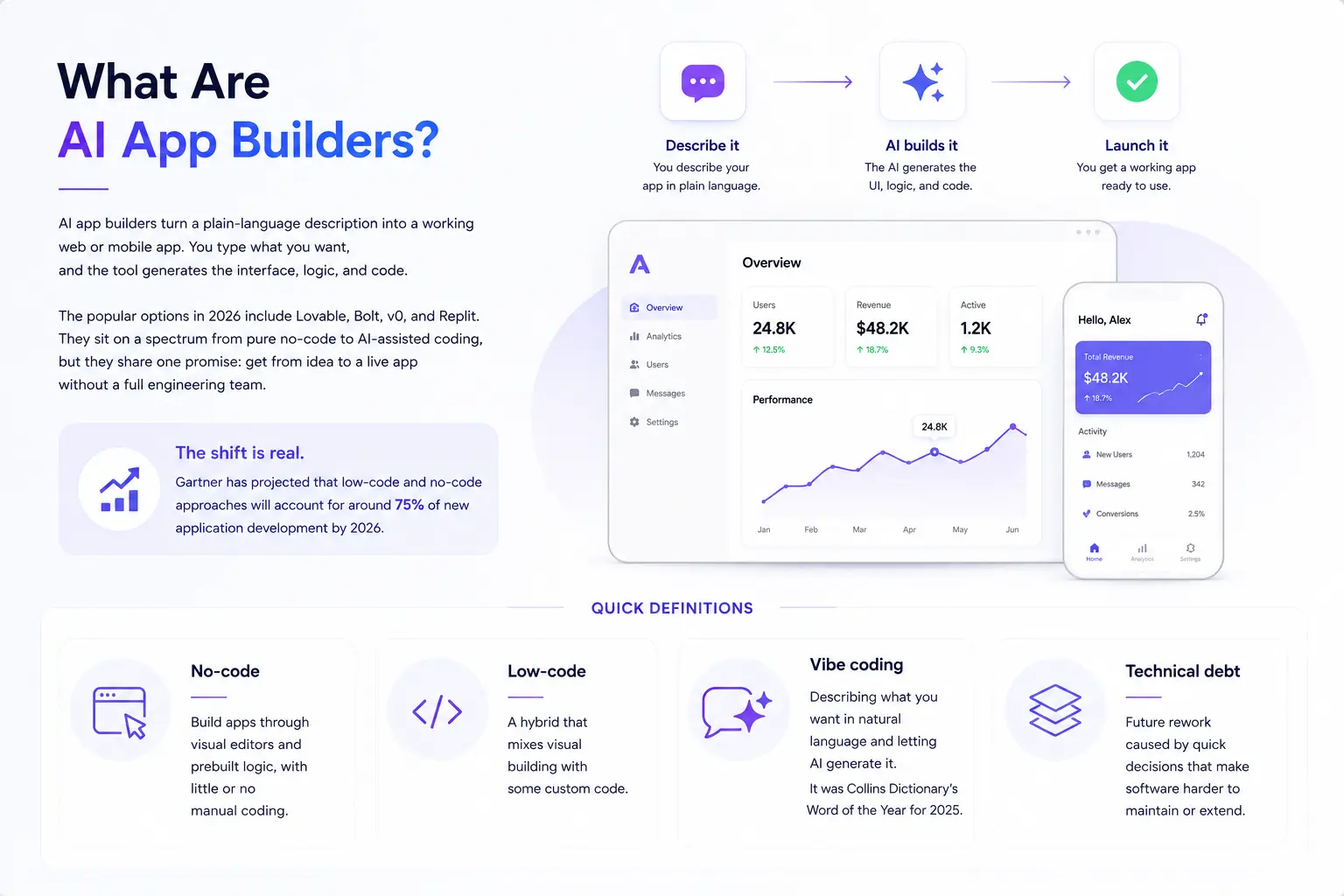
AI app builders turn a plain-language description into a working web or mobile app. You type what you want, and the tool generates the interface, logic, and code.
The popular options in 2026 include Lovable, Bolt, v0, and Replit. They sit on a spectrum from pure no-code to AI-assisted coding, but they share one promise: get from idea to a live app without a full engineering team.
Quick definitions, so the rest of this guide is clear:
- No-code: Build apps through visual editors and prebuilt logic, with little or no manual coding.
- Low-code: A hybrid that mixes visual building with some custom code.
- Vibe coding: Describing what you want in natural language and letting AI generate it. It was Collins Dictionary's Word of the Year for 2025.
- Technical debt: Future rework caused by quick decisions that make software harder to maintain or extend.
The shift is real. Gartner has projected that low-code and no-code approaches will account for around 75% of new application development by 2026. AI app builders are the fastest-growing edge of that shift.
What AI App Builders Do Well, and Where They Hit Walls
To choose well, you need a clear picture of the real strengths and limits of AI builders in 2026. They are powerful, but not magic.
Where AI app builders shine:
- Turning an idea into a working interface in hours
- Building standard apps such as dashboards, booking tools, simple marketplaces, and internal tools
- Cutting the cost of learning what users actually want
- Producing real, editable code you can hand to a developer later
- Letting non-technical founders ship without hiring first
Where they hit walls:
- Complex, custom business logic and unusual workflows
- Advanced performance tuning and heavy scale
- Strict security and compliance requirements
- Deep third-party integrations that need careful engineering
- Long-term maintainability, where quick generation can create technical debt
Read those two lists against your own product. If most of what you need sits in the first list, an AI builder is a strong start. If it sits in the second, plan for developers sooner.
What Does Hiring a Developer Actually Mean?
Hiring a developer is not one choice. It is three, and they cost and behave very differently.
| Option | Typical cost | Best for | Main risk |
|---|---|---|---|
| Freelancer | $2,000 to $40,000 | Small, well-scoped custom work | No backup if they disappear |
| Development agency | $15,000 to $150,000 | Complex, high-stakes builds | Higher cost, scope creep |
| In-house hire | $90,000+ per year | Long-term product ownership | Slow, expensive to hire |
The common thread is accountability. When you hire a developer or agency, someone is responsible for the result, the security, and the fixes when things break. That accountability is exactly what you are paying for, and exactly what a tool cannot give you.
For a first version, many founders start lean by working with a team that offers focused MVP development services, rather than a full in-house build.
AI App Builders vs Hiring a Developer: Head-to-Head
Here is the honest comparison, factor by factor. Neither side wins every row, which is the whole point.
| Factor | AI App Builders | Hiring a Developer |
|---|---|---|
| Speed to first version | Hours to days | Weeks to months |
| Upfront cost | $25 to $95 per month | $15,000 to $150,000 |
| Best for | Prototypes, MVPs, internal tools | Production, complex, high-stakes apps |
| Custom logic | Limited | Full control |
| Security and compliance | Basic, needs review | Built to standard |
| Scale and performance | Fine early, strains later | Engineered to scale |
| Code ownership | Varies by tool | Full, if contracted |
| Accountability | You own the outcome | The team owns the outcome |
The headline price is the cheapest part of the decision. What actually matters is total cost to production, and the risk of rebuilding later.
That last point is where many founders get caught. A tool that costs $40 a month can still cost you three months and a full rebuild if you scale on top of a shaky foundation.
Not sure which path fits your idea?
Get a free, no-pressure scoping call with Gaincafe to map the fastest route from your idea to a real product.
Book a Free Scoping CallWhen AI App Builders Win
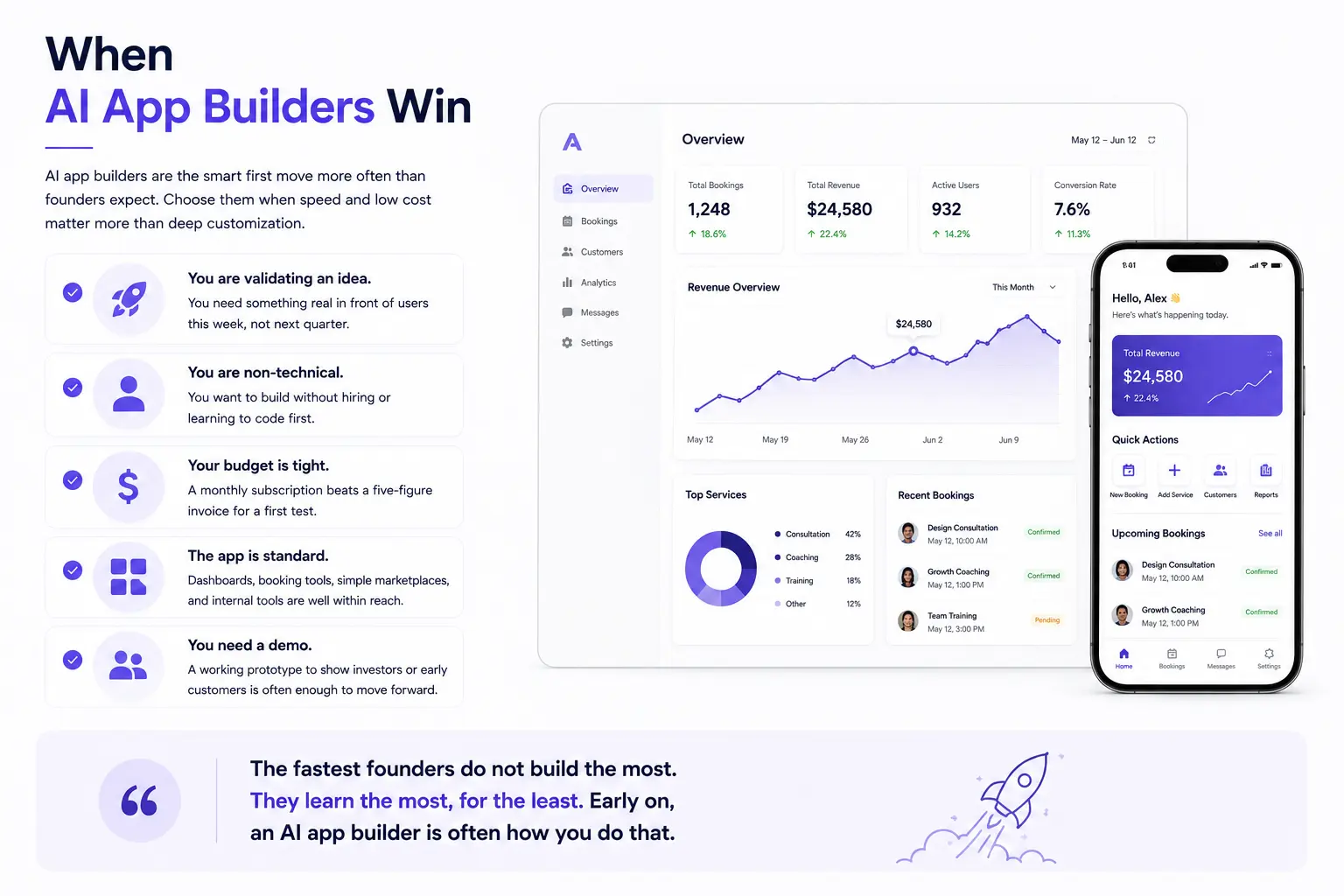
AI app builders are the smart first move more often than founders expect. Choose them when speed and low cost matter more than deep customization.
- You are validating an idea. You need something real in front of users this week, not next quarter.
- You are non-technical. You want to build without hiring or learning to code first.
- Your budget is tight. A monthly subscription beats a five-figure invoice for a first test.
- The app is standard. Dashboards, booking tools, simple marketplaces, and internal tools are well within reach.
- You need a demo. A working prototype to show investors or early customers is often enough to move forward.
In these cases, spending months and thousands of dollars on custom development is the expensive mistake, not the safe choice. You would be building before you know what to build.
The fastest founders do not build the most. They learn the most, for the least. Early on, an AI app builder is often how you do that.
When Hiring a Developer Wins
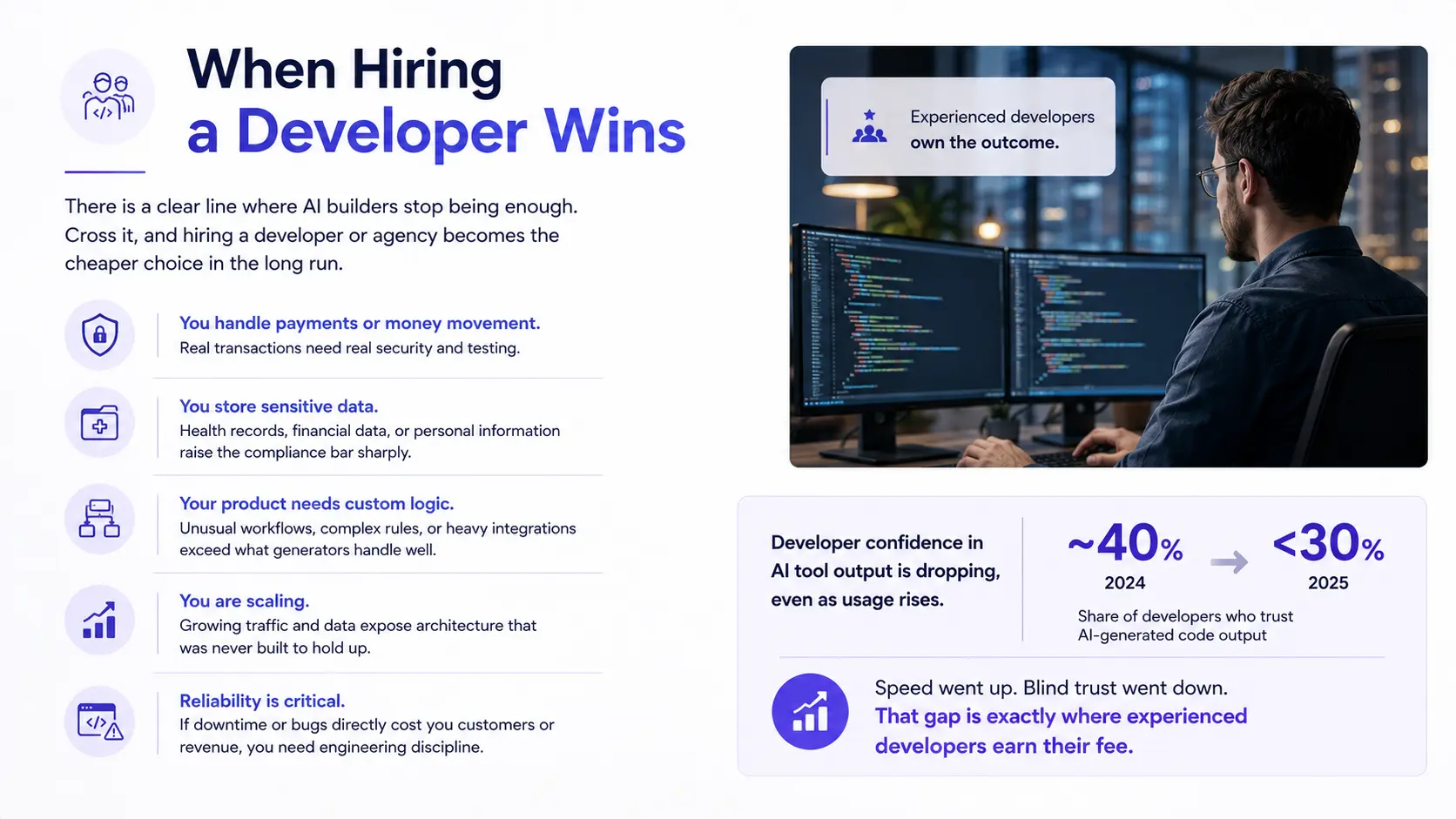
There is a clear line where AI builders stop being enough. Cross it, and hiring a developer or agency becomes the cheaper choice in the long run.
- You handle payments or money movement. Real transactions need real security and testing.
- You store sensitive data. Health records, financial data, or personal information raise the compliance bar sharply.
- Your product needs custom logic. Unusual workflows, complex rules, or heavy integrations exceed what generators handle well.
- You are scaling. Growing traffic and data expose architecture that was never built to hold up.
- Reliability is critical. If downtime or bugs directly cost you customers or revenue, you need engineering discipline.
There is a trust signal worth noting here. Even as AI coding tools have exploded, developer confidence in their output has fallen. Recent developer surveys show a large majority now use AI tools, yet the share who trust the output has dropped, from roughly 40% in 2024 to under 30%. Speed went up. Blind trust went down. That gap is exactly where experienced developers earn their fee.
The Real Cost Comparison
Comparing a monthly tool fee to an agency invoice is the wrong math. The right math is total cost to a product you can actually run and grow.
| Path | Direct cost | Your time | Hidden cost |
|---|---|---|---|
| AI app builder (prototype) | $25 to $95 per month | High (you build it) | Possible rebuild to scale |
| Freelancer | $2,000 to $40,000 | Medium (you manage) | Gaps if they leave |
| Agency | $15,000 to $150,000 | Low (they deliver) | Scope changes, timelines |
| Hybrid (AI then developer) | Low, then scaled | Medium | Lowest rebuild risk |
Notice the hidden-cost column. An AI-built app that works today can still trigger an expensive rebuild if it was never designed to scale. Meanwhile, an agency build that skips validation can spend your whole budget on a product nobody wanted.
Cheap and fast is not the same as low-cost. The lowest total cost usually comes from validating cheaply, then investing only in what the evidence supports.
The Hybrid Path: How Smart Startups Actually Win
Here is the approach most successful founders land on, and the one competitors mention only in passing. You do not pick AI builders or developers. You sequence them.
Stage 1: Validate with AI
Use an AI app builder to ship a prototype or MVP in days. Put it in front of real users. Learn what they actually do, not what you assumed.
Stage 2: Harden with Developers
Once the idea shows real signal, bring in engineers to rebuild or refactor the parts that need security, scale, and clean architecture. This is where a team that can take a vibe-coded app to production-ready is worth far more than its cost.
This sequence gives you the best of both. You keep AI's speed and low cost during the risky, unproven phase, and you add engineering discipline exactly when the stakes rise. Many founders who start on AI tools then hire a Lovable expert to take the build the rest of the way, so they never pay for a full custom build before the idea is proven.
The tools themselves support this. Because platforms like Lovable can sync your code to GitHub, a developer can pick up where the AI left off, rather than starting from scratch. Pairing a builder with a ready-made backend like Supabase makes that handoff even smoother. The result is a product that moved fast when speed was cheap, and got serious engineering exactly when it counted.
The question is not AI builders versus developers. It is which one you need first, and when to bring in the other.
Built something with AI and ready to scale it?
Gaincafe helps founders turn AI-built prototypes into secure, production-grade products, with full code ownership.
Talk to Our TeamWhat This Looks Like in 2026
The ground has shifted fast, and a few 2026 realities shape this decision more than they did even a year ago.
- AI is now standard in development. A large majority of developers already use AI coding tools daily, so the line between "AI-built" and "developer-built" is blurring.
- Trust has not kept pace with adoption. Usage is up sharply, but the share of developers who trust AI output has fallen, which is why human review still matters.
- App stores are stricter. Platforms have tightened rules against thin, template-style apps, so a distinct, well-built product matters more than a generic one shipped fast.
- Handovers are smoother. Because many AI builders now sync code to GitHub, moving from an AI prototype to a developer-led build is easier than ever.
The practical takeaway: in 2026, the smartest founders treat AI builders and developers as stages of one journey, not rival camps.
Common Mistakes Founders Make in This Decision
The choice itself is not hard once you see the traps. These are the errors that cost founders the most time and money.
- Building custom before validating. Spending months and thousands on a full build before confirming anyone wants it. The most expensive product is the one built perfectly that nobody needed.
- Scaling on a prototype. Treating an AI-built demo as a finished product and pushing real traffic through it, then facing a forced rebuild.
- Choosing on price alone. Picking the cheapest option without counting the total cost to production, including rebuilds and lost time.
- Ignoring code ownership. Not confirming, in writing, that you own the code and accounts, then getting locked in.
- Framing it as either-or. Believing you must pick one path forever, instead of sequencing AI and developers by stage.
Almost every failed build traces back to one of these, and every one of them is avoidable with a clear plan up front.
How to Decide: A Simple Framework
Run your idea through these questions, in order. The answers point clearly to one path.
- Is the idea validated? If not, start with an AI app builder and test cheaply first.
- Does it handle money, health, or sensitive data? If yes, plan for developers early, even if you prototype with AI.
- Is the core logic standard or custom? Standard favours AI builders. Custom favours developers.
- What happens if it breaks? If downtime costs real money, you need accountable engineering.
- What is your runway? Tight budgets favour AI-first, then invest once demand is proven.
A useful rule of thumb: build the smallest version that can prove demand with the cheapest tool that can build it, then upgrade the team only when the evidence says it is worth it.
| Your situation | Best first move |
|---|---|
| Non-technical founder testing an idea | AI app builder |
| MVP for investor demo | AI app builder, then developer |
| Fintech, health, or payments app | Developer or agency |
| Internal tool or dashboard | AI app builder |
| Proven idea ready to scale | Developer or agency |
| Complex, custom, high-stakes product | Developer or agency |
Want an honest recommendation for your specific idea?
Tell us your product, stage, and budget. We will point you to the right path, even if it is not us.
Get Honest AdviceConclusion
The AI app builders vs hiring a developer debate has a clear answer once you stop framing it as either-or. AI builders are the smartest, cheapest way to test an idea and reach your first users. Developers are how you turn a validated idea into a secure, scalable product that lasts.
Start with the cheapest tool that can prove demand. Bring in developers when the evidence, and the stakes, justify it. That sequence protects your budget, your timeline, and your odds of building something people actually want. There is no single right answer for every startup, only the right answer for your stage, and it can change as you grow.
If you have an idea to validate or an AI-built prototype ready to scale, Gaincafe can help you choose the right path and build it properly, with senior engineering and full code ownership from day one.
Ready to build your product the right way?
From AI-powered MVPs to production-grade apps, Gaincafe helps founders ship fast without cutting the corners that matter.
Start Your Project