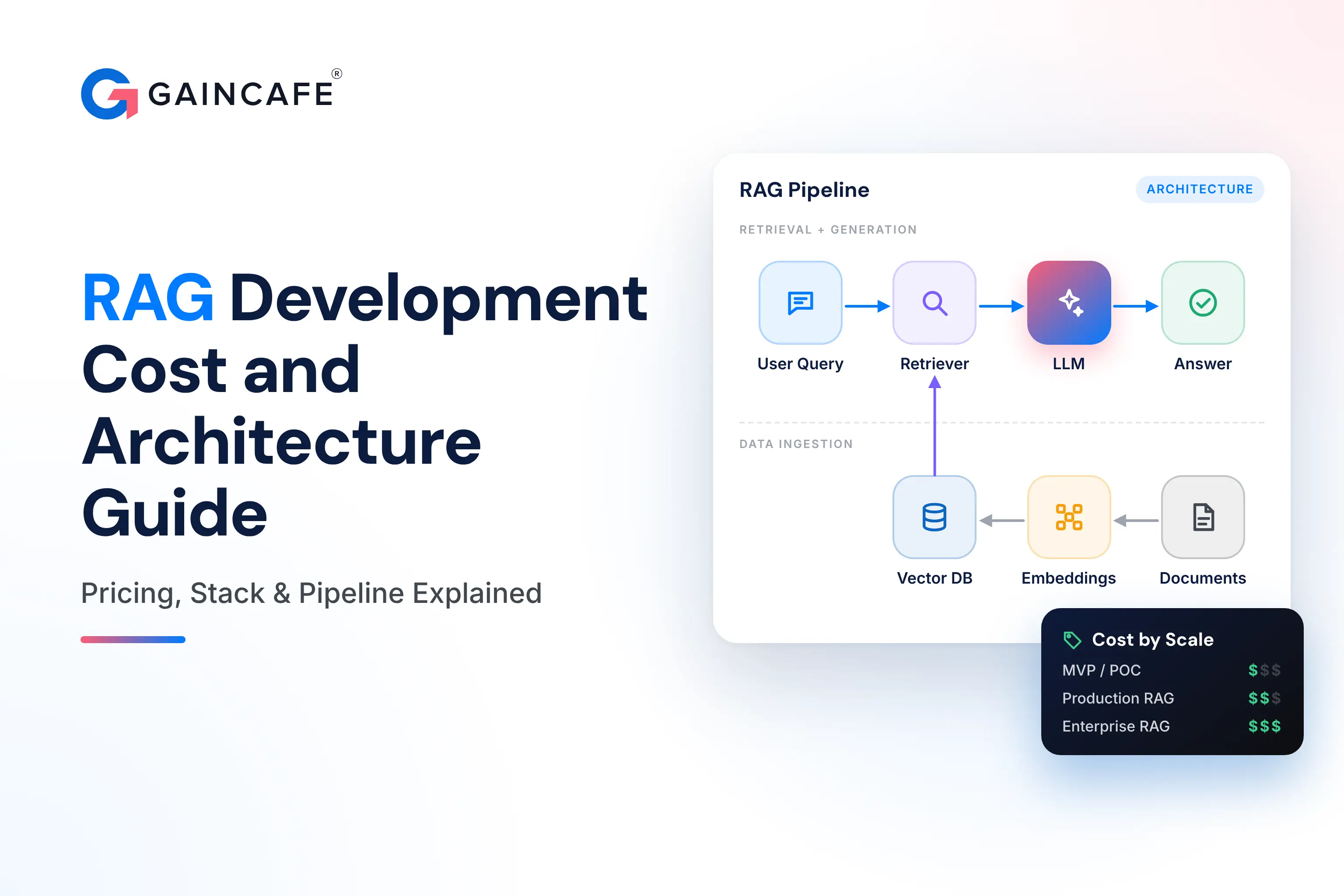
RAG development cost in 2026 ranges from about $10,000 for a proof of concept to $250,000 or more for an enterprise system, with most production builds landing between $30,000 and $80,000. But the number nobody warns you about is data preparation, which often eats 30 to 40% of the budget. This guide covers both sides most articles only do one of: the real cost, tier by tier and component by component, and the architecture underneath it, so you know exactly what you are paying for. Every figure reflects live 2026 market pricing.
Quick answer: A RAG proof of concept costs $10,000 to $25,000, a production system $30,000 to $80,000, and an enterprise or agentic system $80,000 to $250,000 or more. Monthly running costs run from $200 for a small internal tool to $25,000-plus for enterprise scale, driven mostly by LLM calls. Embeddings are nearly free; data preparation and generation are where the money goes. RAG is usually cheaper than fine-tuning when your information changes often.
Key Takeaways
- A RAG proof of concept costs $10K-$25K, a production system $30K-$80K, and an enterprise system $80K-$250K+.
- Data preparation is the biggest hidden cost, often 30 to 40% of the build, because messy PDFs and scattered sources need real cleanup.
- Embeddings are cheap (cents to index thousands of documents). LLM generation calls drive your monthly bill.
- The architecture has two paths: an offline ingestion pipeline and an online query pipeline, and retrieval quality decides everything.
- RAG is usually cheaper than fine-tuning when your knowledge changes often, because you update documents instead of retraining a model.
RAG is the default way to ground AI in your own data in 2026, which is why almost every business chatbot, knowledge assistant, and AI agent that works with company information uses it. For the wider view of AI budgets, our guide to AI integration cost sets the context before we dig into retrieval specifically.
What Is RAG, and Why Does It Matter?
RAG, or retrieval-augmented generation, is a way of making an AI model answer from your own documents instead of only its training data. When a user asks a question, the system first retrieves the most relevant passages from your knowledge base, then hands those to the language model to write a grounded, source-cited answer.
This matters for two reasons. It keeps answers accurate and current, because the AI is reading your real content rather than guessing, which dramatically reduces hallucinations. And it is far cheaper than training a custom model, because you update a document instead of retraining. That combination is why RAG became the standard pattern for enterprise AI, and it is the core of most RAG application development projects.
How RAG Architecture Works
Understanding the architecture is the fastest way to understand the cost, because each stage is a line item. A RAG system is really two separate pipelines.
The Ingestion Pipeline (offline, runs once or on updates)
- Load: connect and pull in your sources, documents, PDFs, wikis, databases, tickets.
- Chunk: split long documents into retrievable pieces. The strategy (fixed, semantic, or hierarchical) heavily affects quality.
- Embed: convert each chunk into a vector using an embedding model, so the system can search by meaning.
- Store: write the vectors into a vector database with metadata for filtering and permissions.
The Query Pipeline (online, runs on every question)
- Embed the query: turn the user's question into a vector using the same model.
- Retrieve: find the most relevant chunks, best done with hybrid search (semantic vectors plus keyword search) rather than vectors alone.
- Rerank: a reranker re-sorts the retrieved chunks so the most relevant end up on top, a 15 to 30% quality boost for modest cost.
- Generate: assemble the best passages as context and the LLM writes the final, cited answer.
The single biggest driver of answer quality is retrieval, not the model. A brilliant LLM fed the wrong passages still gives wrong answers, which is why good teams spend their effort on chunking, hybrid search, and reranking rather than just picking a bigger model.
Want a RAG system scoped to your data?
Tell us your documents and use case, and Gaincafe will map the architecture, cost, and timeline, free.
Get a Free RAG EstimateRAG Development Cost by Tier in 2026
The cleanest way to budget is by project size. Here are the honest 2026 ranges.
| Tier | What it includes | Build cost | Timeline |
|---|---|---|---|
| Proof of concept | One data source, basic chunking, simple chat UI, accuracy testing on sample questions | $10,000 to $25,000 | 3 to 4 weeks |
| Production system | 2 to 5 sources, hybrid search, reranking, citations, evaluation pipeline, monitoring | $30,000 to $80,000 | 8 to 12 weeks |
| Enterprise / agentic | Many sources, role-based access, audit logs, compliance, deep integrations, agentic retrieval | $80,000 to $250,000+ | 4 to 9 months |
Most businesses should start with a proof of concept, because it answers the only question that matters before a full build: can your documents actually answer your users' questions? If the PoC works, you scale with confidence. If it does not, you have spent a few thousand instead of a few hundred thousand.
RAG Development Cost by Component
Zoom into a build and the cost spreads across five components. Knowing which apply to you is the fastest way to a realistic estimate.
| Component | What it covers | Typical cost |
|---|---|---|
| Data preparation | Cleaning, structuring, and chunking your documents, including OCR for scans | Often 30-40% of the build |
| Embeddings | Converting text to vectors (compute only) | Cents to a few dollars |
| Retrieval pipeline | Hybrid search, reranking, query transformation, metadata filtering | $13,000 to $37,000 |
| Vector database | Storing and searching the vectors (Pinecone, Weaviate, pgvector) | Tens to a few hundred dollars a month |
| Generation and API | Context assembly, prompts, the chat interface, integrations | $5,000 to $15,000 |
| Access control and compliance | Role-based access, audit logs, security | $5,000 to $12,000 |
Two things surprise first-time buyers. Embeddings are nearly free, indexing 10,000 documents often costs cents, so do not let anyone pad the quote there. And data preparation is the real cost. Clean text files are quick, but scanned PDFs, tables, and multi-language documents need OCR, layout parsing, and manual checks that can double this phase. The state of your data predicts your RAG cost better than anything else.
Nobody blows a RAG budget on the AI model. They blow it on messy data nobody scoped, and on skipping the evaluation that would have caught bad answers before launch.
Cost by RAG Type and Cost Per Query
RAG is not one thing. The architecture you choose changes both build cost and the per-query running cost, which is the metric that keeps finance happy.
| RAG type | What it does | Cost per query | Best for |
|---|---|---|---|
| Naive RAG | Single vector search, one pass | $0.001 to $0.01 | Simple Q&A, document search |
| Advanced RAG | Hybrid search plus reranking | $0.005 to $0.03 | Production systems needing accuracy |
| Agentic RAG | Multi-step, multi-hop reasoning with tools | $0.01 to $0.10 | Complex research and reasoning |
At scale, a well-optimized production pipeline usually lands at $0.05 to $0.15 per query, and generation (the LLM call) accounts for 70 to 80% of that, because retrieved context inflates the prompt. Choosing the right model is its own decision, which our roundup of the top LLM development companies touches on. This is why model choice and sending fewer, better passages matter so much to your bill. Agentic RAG, where the system reasons in multiple steps, sits at the top of this range and overlaps with AI agent development cost.
Monthly Running Costs of RAG
The build is one-time; running the system scales with usage. Here is what to expect.
| Usage level | Queries per month | Typical monthly cost |
|---|---|---|
| Small (internal team tool) | Up to 10,000 | $200 to $1,500 |
| Medium (customer-facing) | 10,000 to 100,000 | $1,500 to $8,000 |
| Large (enterprise-wide) | 100,000+ | $8,000 to $25,000+ |
Three proven ways to cut the running bill: route simple questions to a smaller model and reserve the premium one for hard queries; cache frequent answers, since many internal tools get the same fifty questions repeatedly; and retrieve fewer, better passages, because a reranker that sends three strong chunks instead of ten weak ones cuts tokens and usually improves accuracy.
Worried about runaway RAG running costs?
We design retrieval that stays accurate and cheap at scale. Get a per-query cost estimate for your use case.
Get My Cost EstimateRAG vs Fine-Tuning: Which Costs Less?
This is the comparison most teams weigh, so here is the honest version. RAG usually costs less when your information changes regularly; fine-tuning can win at very high volumes on a fixed task.
| Factor | RAG | Fine-tuning |
|---|---|---|
| Upfront cost | Lower, no model training | Higher, needs labeled data and training runs |
| Updating information | Cheap, update docs and re-index | Expensive, needs another training cycle |
| Per-query cost | Higher, context adds tokens | Lower, shorter prompts |
| Citations and traceability | Built in, answers link to sources | Not available |
| Best for | Policies, product docs, knowledge bases, records | Fixed formats, tone, specialized classification |
For most business use cases, where knowledge changes and answers need to cite sources, RAG is the practical choice, and it reaches accuracy within a few points of fine-tuning at roughly half the first-year cost. Many mature systems eventually combine both.
What Drives RAG Development Cost Up or Down
Two RAG projects with the same goal can differ several times over in price. The levers that decide it:
- Data quality. Clean, structured sources are cheap. Scanned, messy, multi-language documents are the biggest cost driver.
- Number of sources. One knowledge base is simple. Many systems with different formats and permissions multiply the work.
- Accuracy requirements. A tool where a good-enough answer is fine is cheaper than one that must be right, which needs heavy evaluation.
- Access control and compliance. Role-based answers, audit logs, and HIPAA or GDPR add real engineering.
- Retrieval sophistication. Basic vector search is cheap; hybrid search, reranking, and query transformation add cost and quality.
- Team location. Rates vary several times over by region, which is why the same scope gets wildly different quotes.
A Real RAG Build: Promo AI
To ground these numbers, here is a real example. Gaincafe built Promo AI, an AI-powered CRM for promotional product distributors, on a custom RAG pipeline with its own embedding architecture and a vector database. The system answers from the client's own product and order data, using the Claude API for generation and custom Python for the retrieval layer.
The pattern held exactly as this guide describes: the model was the easy part, and the real work was in the data pipeline and retrieval tuning that made answers accurate and grounded. That is where a RAG project succeeds or fails, and why scoping the data honestly upfront matters more than the model you pick.
Build vs Buy: Should You Build RAG In-House?
You can buy an off-the-shelf RAG tool or build a custom pipeline. Buy when your use case is simple, standard, and low-volume, since setup is fast and cheap. Build custom when retrieval quality is a competitive advantage, you have many or sensitive data sources, or your volume makes per-seat tool pricing expensive. Building in-house costs more upfront, a production pipeline typically takes a small senior team several weeks, but it gives you full control over every component and lower cost at scale. Most businesses with real, proprietary knowledge end up building, because generic tools cannot tune retrieval to their specific data.
How to Reduce RAG Development Cost
Cutting cost is about spending on the right things, not buying the cheapest quote.
- Start with a proof of concept. Prove your documents can answer real questions before a full build.
- Clean your data first. It removes the single biggest hidden cost.
- Use pgvector on existing Postgres for small to mid workloads, avoiding a separate vector database bill.
- Route and cache. Send simple queries to cheaper models and cache common answers.
- Rerank for fewer, better passages, which cuts tokens and improves accuracy at once.
- Do not skip evaluation. It is cheaper than shipping a RAG system that gives confident wrong answers.
How to Choose a RAG Development Partner in 2026
Ask for a RAG system they built and how they measured its accuracy, since evaluation is what separates a demo from production. Confirm real experience with data preparation, hybrid search, and reranking, because that is where quality and most of the cost live. Check how they handle access control for sensitive data, ask for the all-in per-query cost at realistic volume, and make sure you own the pipeline, the data, and the vector store. A partner who talks openly about data quality and evaluation is far more trustworthy than one who only talks about the model. For broader AI work, our AI development company page covers how retrieval fits into agents and automation.
If your gap is capacity rather than know-how, you can also hire AI developers to extend your own team for the build.
Why Build Your RAG System With Gaincafe
A RAG system is only worth it if it answers accurately in production and stays affordable to run. Gaincafe builds custom RAG and knowledge assistants for businesses across the USA, UK, UAE, and Australia, with more than 500 projects delivered over 12-plus years and a 5.0 rating on completed work. We scope the data honestly, build the retrieval layer that actually decides quality, and evaluate against real questions before launch, rather than shipping a demo that breaks on real users.
Because we pair senior engineering with cost-effective delivery, you get a production-grade RAG pipeline, grounded and cited answers, and full ownership, without enterprise overhead. Explore our RAG development services or tell us about your documents, and we will map the architecture, cost, and a per-query estimate for your use case.
Ready to build AI that answers from your own data?
From a scoped proof of concept to an enterprise knowledge platform, Gaincafe builds RAG systems that stay accurate and affordable. Get a transparent estimate today.
Start Your RAG ProjectThe Bottom Line
RAG development cost in 2026 comes down to a few clear decisions: how clean your data is, how many sources you connect, how accurate it must be, and the per-query cost you will pay on every answer. A proof of concept starts around $10,000, most production systems land between $30,000 and $80,000, and enterprise builds climb past $80,000, with running costs from a few hundred to tens of thousands a month.
The teams that win with RAG do not overspend on the model. They scope the data honestly, invest in retrieval and evaluation, prove it on a small build, and scale from there. If you want a RAG system built that way, grounded, accurate, and affordable to run, Gaincafe Technologies can scope it, build it, and give you a real number for your documents.