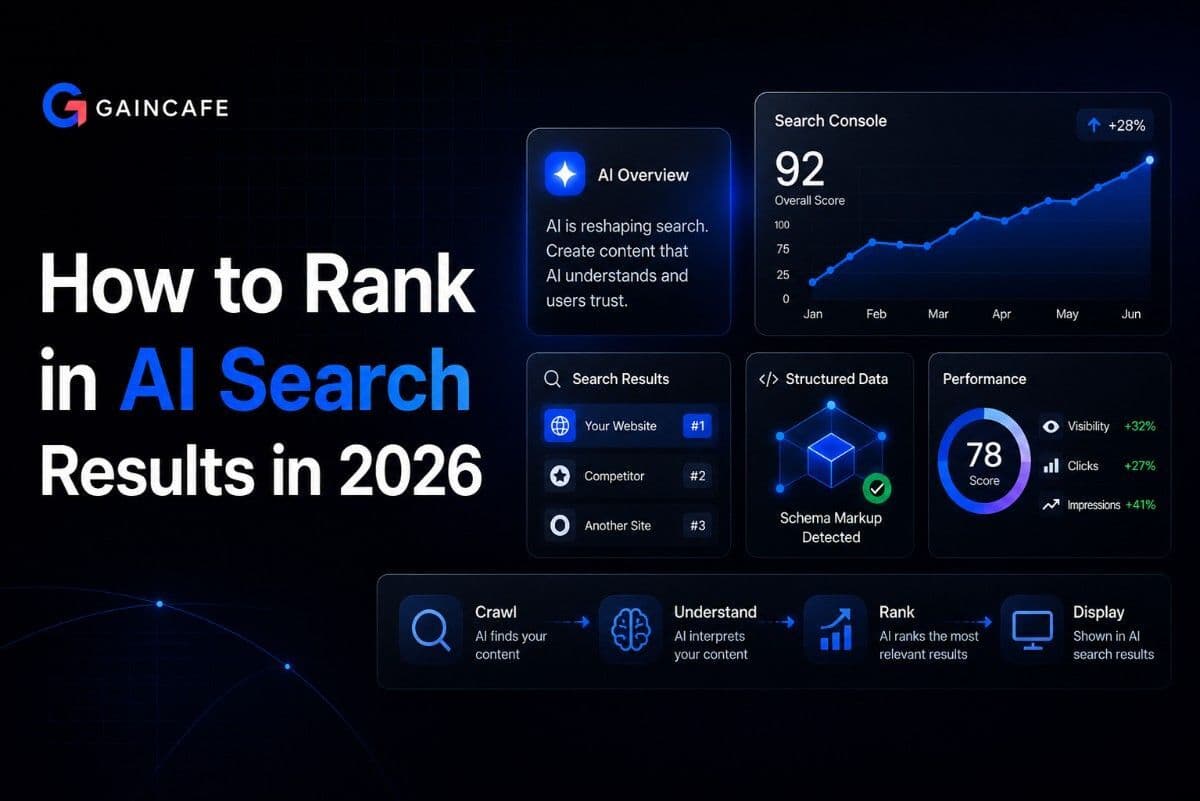
The short version: To rank in AI search results in 2026, write a clear answer to a real question near the top of the page, back your claims with named sources and real numbers, build authority through third-party mentions, keep pages genuinely fresh, and make sure AI crawlers can read your site. Then track which prompts cite you each month and improve from there.
Key Takeaways
- Learning how to rank in AI search results means earning a spot inside answers from ChatGPT, Perplexity, Gemini, Google AI Overviews, and Copilot, not fighting for one of ten blue links.
- AI answers name only 3 to 5 sources per query, so the goal has shifted from "rank on page one" to "be one of the few the model actually quotes."
- A strong Google ranking does not carry over automatically. Independent analysis found only around 12% of AI-cited pages also rank in Google's top 10, so AI visibility is its own discipline.
- The tactics that genuinely move the needle are backed by research, not hype. A peer-reviewed 2024 study found that adding citations, direct quotations, and statistics lifted a source's visibility in AI answers by up to 40%.
- Skip the shortcuts. In May 2026 Google publicly stated that llms.txt files, content chunking, and AI-specific markup are unnecessary, and multiple studies confirm AI crawlers largely ignore llms.txt today.
What "ranking" now means
For twenty years, ranking meant climbing a list of ten links. That definition is fading fast. People increasingly ask a full question and read one synthesized answer built from a handful of sources, and if your brand is not among them, you are invisible for that query no matter how well you rank in the traditional sense.
This matters because the audience is already here. BrightEdge's 2026 tracking shows Google's AI Overviews now appear on close to 60% of US searches, and Gartner has projected that roughly a quarter of organic search traffic will shift toward AI assistants. Figuring out how to rank in AI search results is no longer a forward-looking experiment. It is a present-tense revenue question for most brands.
The catch is that AI visibility does not track your Google position. Analysis from Ahrefs found only about 12% of the URLs that ChatGPT, Perplexity, and Copilot cite also sit in Google's top 10, and roughly 80% do not rank in Google's top 100 at all. Ranking well and getting cited are now two separate outcomes that require overlapping but distinct work.
AEO and GEO, explained without the jargon
Two acronyms dominate this space, and they are simpler than they sound. Answer engine optimization, or AEO, is about format: making a single clear answer so easy to extract that a machine lifts it straight into a response. Generative engine optimization, or GEO, is about trust: becoming a source the AI weaves into a longer answer because it considers you credible.
Traditional SEO still sits underneath both, because a model cannot cite what it never found in its index. The useful way to hold it: SEO gets you into the candidate pool, AEO makes your answer quotable, and GEO makes the AI pick you over a competitor. You need all three working together, since the same page now has to satisfy a ranking system, an answer extractor, and a human reader at once.
GEO is not marketing invention, which is worth knowing when you are deciding what to trust. The term comes from a peer-reviewed paper, "GEO: Generative Engine Optimization," presented at the ACM SIGKDD conference in 2024 by researchers from Princeton, Georgia Tech, the Allen Institute for AI, and IIT Delhi. Across roughly 10,000 test queries, they found that structuring content deliberately, especially by adding citations, quotations, and statistics, raised a source's visibility in AI answers by up to 40%.
How AI engines choose whom to cite
Three signals do most of the work, and they are remarkably consistent across platforms. Get these right and the rest gets easier.
Extractable structure. Models favor content they can chunk and quote cleanly, which is why a direct answer high on the page beats a slow build-up. Question-style headings, short answer paragraphs, lists, and tables all make your content easier to lift.
Earned authority. A 2025 University of Toronto study found a strong, systematic bias toward third-party authoritative sources over brand-owned pages, and it held across ChatGPT, Perplexity, and Gemini. The effect is measurable in surprising places: Seer Interactive found in May 2026 that brands with no third-party review profile had a median AI citation rate near 1%, while brands with even a minimal review profile jumped to over 53%.
Freshness that is real. Recency is a live signal, but models have learned to spot cosmetic updates. Swapping "2025" for "2026" in a headline does nothing if the underlying facts are unchanged, so meaningful refreshes (new data, revised claims, added context) are what actually register.
A quieter shift is worth flagging: topical depth is starting to beat raw domain size. A focused site that covers one subject thoroughly can now outcompete a giant general publisher for citations in that niche, because models increasingly treat a specialist as the more reliable source.
The playbook: how to rank in AI search results step by step
Work these in order. Each one builds on the last, and skipping a step tends to break the ones after it.
1. Lead with the answer
Put a clean, self-contained answer in the first sentence or two under each heading. This is the single most valuable change most pages can make, because the top of the page is exactly what models quote most.
2. Write headings as real questions
Turn "Our Approach" into "How does X work in 2026?" Pull the phrasing from People Also Ask boxes and your own sales and support conversations, since those mirror how buyers actually ask. This also feeds Google's "query fan-out," where the AI silently breaks one question into several sub-questions, so covering a topic from multiple angles gives you more chances to appear.
3. Back every claim with a named source or number
This is the research-proven part. Cite real studies, quote credible voices, and use concrete statistics rather than vague adjectives. It reads better for humans and demonstrably lifts citation rates for machines.
4. Build authority beyond your own site
Because engines weight earned media so heavily, ranking in AI search depends on being referenced across the wider web. Earn coverage in reputable outlets, keep your business facts identical everywhere, claim and fill out your review profiles, and go deep on a defined topic to build the specialist authority models now reward. A well-structured content cluster with clean internal linking, the kind we build through our generative SEO services, reinforces that authority across a whole subject instead of one page.
5. Make sure the machines can read you
Confirm your key content loads as server-rendered or static HTML, since most AI crawlers do not run JavaScript, and check that bots like GPTBot, PerplexityBot, and ClaudeBot are allowed in your robots.txt. Older sites and dated platforms are frequent offenders here, which is why we often review a client's technical stack, including their choice among the best ecommerce website building platforms, before any content work begins.
6. Add standard schema, but keep expectations honest
FAQ, Article, and Organization schema in JSON-LD help search engines parse your content. Google retired the visible FAQ rich result in May 2026, yet FAQPage schema still carries weight behind the scenes, with some 2026 analysis linking it to a higher chance of appearing in AI Overviews. Treat structured data as table stakes rather than a magic AI lever, since Google's own 2026 guidance found it gives little direct lift on its own.
Skip these shortcuts
The AI search boom has produced a cottage industry of tactics that sound clever and do almost nothing. The clearest example is the llms.txt file, a plain-text file some vendors sell as the key to AI visibility.
The evidence is blunt. One analysis of over 500 million AI bot events found that search and answer crawlers almost never fetch the file, a study of 300,000 domains put adoption at roughly one in ten sites, and Google has said on the record that it does not support llms.txt and compared it to the long-discredited meta keywords tag. Shipping one costs little, but treating it as a ranking strategy is a distraction.
On May 15, 2026, Google published its first consolidated official guide to appearing in AI Overviews and AI Mode, and its message reinforced the point. Google stated plainly that optimizing for its generative features is still, at its core, good SEO, and it named llms.txt, content chunking, AI-specific markup, and inauthentic brand mentions as tactics you can ignore. Google underlined that last warning with a June 2026 spam update, so buying or manufacturing brand mentions to game AI answers is a real risk, not a clever hack.
Ranking across ChatGPT, Perplexity, Gemini, and Google AI Overviews
The AI search market is now genuinely fragmented across several strong platforms rather than dominated by one, and each rewards slightly different work. A strategy tuned only to rank in ChatGPT leaves real audiences unserved.
| Platform | What it rewards most | Your practical priority |
|---|---|---|
| ChatGPT | Brand authority built over time through third-party mentions | Off-site reputation and consistent brand facts |
| Perplexity | Transparent, well-sourced content that cites its own sources | Publish research-grade pages with clear citations |
| Google AI Overviews | Overlap with strong traditional Google ranking | Keep classic SEO healthy, add answer-first intros |
| Gemini | Structured content plus multimodal signals | Clear formatting, useful images and video |
| Copilot | Professional and B2B sources via the Bing index | Bing indexing health and credible professional profiles |
To rank in ChatGPT, the work is mostly off-page, since it leans on brand strength built across the web rather than any single page edit. To rank in Perplexity, transparency wins, because it ties claims to sources more visibly than its rivals and rewards content that does the same. Google AI Overviews reward what strong SEO already produces, which is the one place traditional ranking and AI search optimization overlap most directly.
How to measure whether it is working
You cannot improve what you do not measure, and AI citations rarely show up cleanly in standard analytics because native apps often strip the referrer and dump AI visits into "direct" traffic. The good news is that measurement got easier in mid-2026, when Google began rolling out a dedicated Search Console report showing how your pages perform inside AI Overviews and AI Mode, separate from your traditional organic data.
Alongside that, use the simplest manual method, which is also the most revealing. Pick 20 to 30 questions your real buyers ask, spread across informational, comparison, and decision-stage intent, then run each one through ChatGPT, Perplexity, Gemini, and Google AI Overviews every month. Log everything: where you are cited, where you are only mentioned without a link, and which competitor won the spots you missed.
Watch conversion quality rather than raw volume, because the traffic here is small but unusually valuable. Adobe reported that AI-referred traffic converted 42% better than other traffic in early 2026, and Similarweb's clickstream data put AI referral conversion around 7%, second only to paid search. The AI has effectively pre-qualified the visitor before they ever reach your page.
Common mistakes that keep brands out of AI answers
Four errors show up constantly, and each is fixable once you know to look.
Burying the answer. A long, throat-clearing introduction pushes your actual answer past the part of the page models quote most. Lead with it instead.
Optimizing only your own pages. Brands that ignore earned media and third-party reviews hit a ceiling quickly, because the engines weight outside validation so heavily. On-page polish alone rarely earns citations.
Chasing shortcuts over substance. Time spent on llms.txt files and schema tricks is time not spent on the original research and clear answers that actually get quoted.
Blocking the crawlers. Some sites unintentionally block AI bots or hide content behind JavaScript, then wonder why they never appear. If the crawler cannot read the page, nothing else matters.
When to do this in-house and when to get help
Some of this is genuinely do-it-yourself. Rewriting key pages with answer-first intros, converting headings into real questions, and adding basic FAQ schema are all within reach of a capable content and web team, because these are learnable format changes.
The work rewards a partner when it becomes a sustained program: building authority across the web, engineering a topical content cluster at scale, fixing crawlability at the code level, and tracking citations across five platforms every month. That is cross-functional, ongoing work, and it is where a team that combines content, technical SEO, and engineering produces results a single freelancer usually cannot.
Why Gaincafe helps brands rank in AI search results
Gaincafe Technologies is an AI-first software development and digital growth company with over 12 years of experience and more than 500 projects delivered for clients across the USA, UK, UAE, and Australia. Ranking in AI search sits exactly where our two strengths meet: we understand the content and authority signals that answer engines reward, and we have the engineering depth to fix the technical foundations most content agencies cannot touch.
That combination matters because AI search optimization is never purely a writing task or purely a technical one. Through our AI automation and engineering work we build content clusters, structured data, and clean internal linking as one connected system, backed by senior-hardened code review and a 5.0 rating across completed Upwork engagements. For local and service businesses, the same logic extends to AI-driven "near me" queries, which we handle through dedicated GMB optimization so you surface whether a customer asks Google or an assistant.
The brands building these signals now are compounding an advantage that gets harder to catch each quarter. If you want a clear read on where you stand in AI search today and what to fix first, book a consultation with the Gaincafe team. We will audit how the major engines see you now and map the fastest path to citations that actually convert.
Find Out Where You Stand in AI Search Today
Book a consultation with the Gaincafe team. We will audit how the major engines see you now and map the fastest path to citations that actually convert.
Book a Consultation