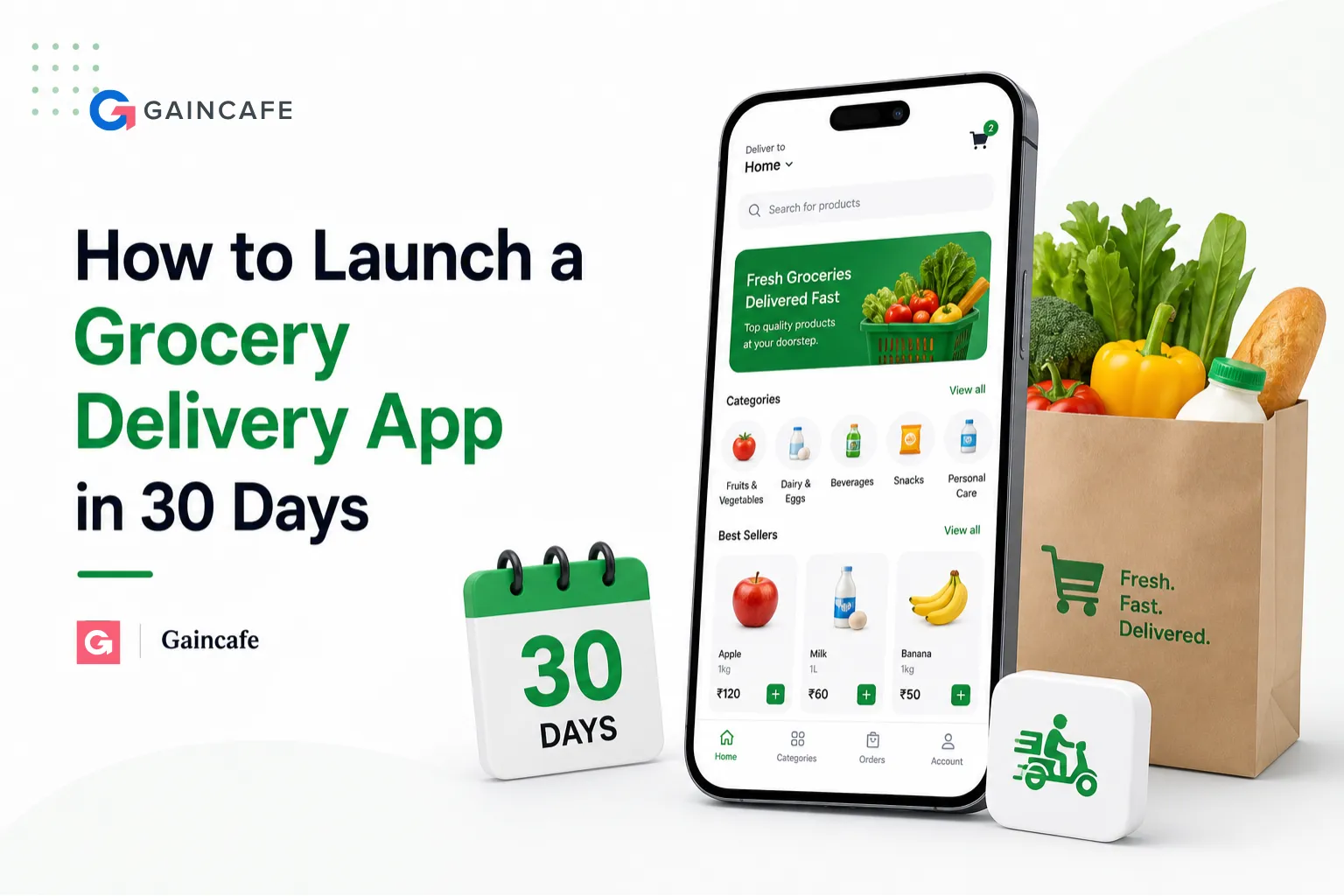
The demand for grocery delivery app development is booming globally as the on-demand economy transforms retail. Entrepreneurs who master this space are capturing market share that legacy retailers are losing fast. If you have been evaluating an on-demand delivery platform as your next venture, the timing has never been better.
According to Statista, the online grocery market is projected to surpass $1.1 trillion by 2027, making this sector one of the highest-ROI technology bets available today. But knowing when to invest in a digital storefront is only half the battle. The real challenge is executing the development process without burning months of runway.
Most founders approach building their product with the wrong priorities, aiming for full-scale platforms when a lean MVP would validate the market in weeks. This guide reframes launching your grocery app as a disciplined 30-day execution sprint. Whether you are a first-time founder or a seasoned operator, understanding the technical roadmap from day one is your competitive edge. At its core, a successful rollout is less about the code and more about the strategy behind it.
Why the Market Cannot Wait
The global online grocery sector crossed $785 billion in 2023, with projections pushing past $1.1 trillion by 2027. In the UAE alone, the market for on-demand grocery apps is expanding at a 14.3% CAGR. This growth is driven by high smartphone adoption and a tech-forward consumer base that expects same-day delivery as a standard, not a premium feature.
Dark stores, micro-fulfillment hubs, and hyperlocal logistics have permanently changed the retail landscape. The startups that proactively invested in grocery delivery app development over the last two years now hold brand loyalty and supply chain relationships that latecomers will find incredibly difficult to displace.
Waiting another quarter to launch your e-grocery platform is a strategic decision in itself,one that actively costs you market share. The window for first-mover advantage in most GCC sub-markets is closing fast, making rapid execution critical.
Want to launch your grocery app fast?
Get a 30-day MVP roadmap tailored to your business model, market, and budget.
Tech Stack: A Comparison Table
The technology choices you lock in during Week 1 determine your scalability ceiling six months post-launch. The table below compares the most commonly evaluated options across every layer of the grocery delivery platform.
| Layer | Option A | Option B | Best Fit |
|---|---|---|---|
| Frontend Mobile | React Native | Flutter | React Native |
| Frontend Web | React.js | Next.js | Next.js |
| Backend | Node.js | Django | Node.js |
| Database | PostgreSQL | MongoDB | PostgreSQL |
| Real-time | Socket.io | Firebase | Firebase |
| Cloud | AWS | Google Cloud | AWS |
| Payments | Stripe | PayTabs | Stripe + PayTabs |
For a 30-day timeline, React Native is the correct frontend choice. One codebase, two platforms, and faster iteration on feedback. Node.js on the backend handles real-time order concurrency without the architectural overhead that Django introduces at this scale.
Your Complete Grocery Delivery App Development Roadmap: 30 Days
Thirty days is achievable, but only with locked scope and zero tolerance for mid-sprint changes. Each week below has specific, non-negotiable outputs. Miss one, and the downstream weeks compress.
Week 1: Discovery and Requirements (Days 1–7)
The most expensive mistake in app development is building before you know exactly what you are building. Week 1 exists entirely to eliminate ambiguity.
Deliverables by end of Day 7:
- Competitor audit covering 3–5 direct players in your target geography
- Business model decision: commission-based, subscription, or hybrid revenue
- Logistics model: owned delivery fleet or third-party courier integration
- Feature prioritization matrix separating must-haves from Version 2 additions
- Tech stack selection with vendor shortlist and cost estimates
Teams that work with Gaincafe's MVP Development Services complete this phase in three days instead of seven, because pattern recognition from similar builds eliminates the guesswork.
Week 2: UI/UX Design and Architecture (Days 8–14)
Design is your first real market signal. An onboarding flow that is one tap too long can cut conversions by 20%. A checkout process that requires card details on a second screen can drop order completion by 30%.
Deliverables by end of Day 14:
- Wireframes covering all three panels: customer, vendor, and delivery agent
- High-fidelity prototypes signed off by all stakeholders
- Complete user flow documentation including error states and edge cases
- API architecture plan and third-party integration specifications
- Database schema finalized and reviewed by the lead engineer
One specific warning: the delivery agent panel is always deprioritized and always causes problems at launch. An agent who cannot accept, navigate, and confirm a delivery in under four taps creates operational chaos at scale. Design it properly in Week 2.
Week 3: The Grocery Delivery App Development Sprint (Days 15–21)
This is the build week. A senior engineering team running focused sprints with a locked scope can deliver a production-ready MVP in seven days. The keyword is "locked." Any scope addition in Week 3 adds minimum two days, often more.
Core modules shipping this week:
- User authentication: social login, OTP verification, and guest checkout
- Product catalog: real-time search, category filters, and image-optimized listings
- Cart and checkout: dynamic pricing, coupon logic, and address management
- Payment integration: Stripe for international cards, PayTabs for UAE and GCC
- Vendor panel: order management, inventory controls, and earnings reporting
- Real-time tracking: Google Maps API or HERE Maps with live driver location
- Push notifications: order confirmation, dispatch alerts, and delivery updates
Everything outside this list goes into a Version 2 backlog. That backlog is valuable. It becomes the product roadmap you present to investors post-launch.
Week 4: QA, Launch, and Go-to-Market (Days 22–30)
A payment failure at launch is not just a technical bug. It is a one-star App Store review that stays public for years. QA is not the phase you compress when you are behind schedule.
Launch checklist for Week 4:
- Unit, integration, and end-to-end test coverage across all user flows
- Device and OS testing: iOS 16+, Android 12+, and major screen sizes
- Load test to simulate 500 concurrent users before the app goes live
- App Store and Google Play submission with 2–3 days reserved for review cycles
- Controlled beta rollout to 50–100 users for real-world feedback
- Monitoring setup: Sentry for error tracking, Firebase Crashlytics, and uptime alerts
Need help executing this roadmap?
Our team builds grocery delivery MVPs in weeks, not months.
30-Day Roadmap at a Glance
| Phase | Days | Key Activities | Deliverable |
|---|---|---|---|
| Discovery & Planning | 1–7 | Market research, competitor analysis, feature prioritization, tech stack selection | Scope document and project blueprint |
| UI/UX Design | 8–14 | Wireframes, high-fidelity prototypes, API architecture, database schema | Stakeholder-approved prototype |
| Development Sprint | 15–21 | Core module build, payment gateway, real-time tracking, vendor and agent panels | Functional, testable MVP |
| QA & Launch | 22–30 | End-to-end testing, App Store submission, beta rollout, monitoring setup | Live app in both stores |
The Core Features Every Grocery Delivery Platform Needs
Scope discipline determines whether your product ships in 30 days or gets delayed for 90. To prevent scope creep, you must focus entirely on your Minimum Viable Product (MVP). The features below represent the essential technical requirements for an on-demand grocery app to function, acquire users, and generate revenue from day one.
1. The Customer App (User Experience & Retention)
Your consumer-facing interface needs to prioritize friction-free purchasing.
- One-Click Reordering: Allow users to instantly duplicate past purchase histories to drive higher retention rates.
- Smart Delivery Scheduling: Integrate live slot availability and dynamic cutoff timers for reliable fulfillment.
- Real-Time Order Tracking: Provide a live map view with GPS driver location to reduce customer anxiety and support tickets.
- Omnichannel Support: Include in-app chat with defined response SLAs to handle order modifications or delivery issues.
- Localized Payment Gateways: Support multiple secure payment options, including international credit cards, regional digital wallets (like Apple Pay), and Cash on Delivery (COD).
2. The Vendor & Store Panel (Inventory Management)
Grocery retailers need a streamlined dashboard to manage their digital storefront without disrupting physical operations.
- Live Inventory Syncing: Automated catalog management with real-time low-stock alerts to prevent fulfillment failures.
- Order Lifecycle Controls: Seamless toggles for order acceptance, rejection, preparation, and dispatch.
- Automated Revenue Analytics: A comprehensive financial dashboard detailing daily, weekly, and monthly payout histories.
- Marketing & Campaign Tools: Built-in capabilities to generate promo codes and launch limited-time flash discounts.
3. The Delivery Agent App (Logistics & Fleet Operations)
A frictionless driver experience is the secret to scaling your hyperlocal logistics.
- AI-Assisted Route Optimization: Smart mapping that calculates the most efficient paths for multi-stop and batched deliveries.
- Digital Proof of Delivery (PoD): Mandatory photo capture and digital customer signatures to resolve potential disputes.
- Transparent Earnings Tracker: A clear dashboard showing completed delivery history, tips, and pending payouts.
- Shift Management: Simple online/offline toggles to help fleet managers track active driver availability.
4. The Admin Dashboard (Centralized Platform Control)
The command center where platform owners manage the entire e-grocery ecosystem.
- Unified User Management: Centralized oversight for all registered customers, partnered vendors, and active delivery agents.
- Dynamic Commission Configuration: Granular controls to adjust vendor commissions and set zone-based dynamic delivery fees.
- Advanced Platform Analytics: Deep data reporting on order volume, user retention cohorts, and overall revenue trends.
- Dispute Resolution Hub: Dedicated tools for managing flagged orders, issuing refunds, and monitoring vendor performance.
Why an MVP Is the Smartest First Move
Building a fully featured platform before you have a single paying customer is the most common and most expensive mistake in on-demand app development. The market does not reward completeness. It rewards speed and fit.
A well-scoped MVP costs 60 to 70 percent less than a full platform build. More importantly, it gives you real data within weeks: which product categories sell, which delivery zones are profitable, and which features users actually care about. That data makes every subsequent build decision cheaper and smarter.
Gaincafe's MVP Development Services are built specifically for founders who need to move fast without compromising on code quality. Every engagement runs on a fixed scope, fixed timeline model so your budget is protected from day one to launch day.
Want to launch your grocery app in 30 days?
Work with a team that specializes in fast, production-ready MVPs. Get a clear roadmap, fixed pricing, and zero delays.
How to Choose the Right App Development Company
The technology partner you choose dictates your real deadline, not the calendar. A generalist agency often treats your project as just another ticket in their queue. In contrast, a specialized mobile app development company focused on on-demand marketplaces treats your launch as a critical business objective, not just a coding task.
Here are the four criteria that actually matter when evaluating a development partner:
- Proven Marketplace Expertise: Look for a verifiable portfolio of on-demand or delivery MVPs that were successfully shipped on time, not just basic informational websites.
- In-House Quality Assurance: Demand direct accountability from in-house QA engineers, rather than outsourced testing teams that lack ownership over the final product.
- Transparent Agile Delivery: Ensure they provide daily progress reports and sprint updates that give your team complete visibility into the build process.
- Post-Launch SLAs: Never launch without a strictly defined Service Level Agreement (SLA) outlining guaranteed response and resolution windows for bugs.
Gaincafe Technologies is a Dubai-based software development agency with a focused practice in on-demand platforms across the UAE and GCC. We operate on a fixed-scope, fixed-timeline model purpose-built for founders who simply cannot afford to burn runway on delays.
Need a reliable development partner?
Work with a team that has shipped multiple on-demand MVPs on time and on budget. No delays, no guesswork, just execution.