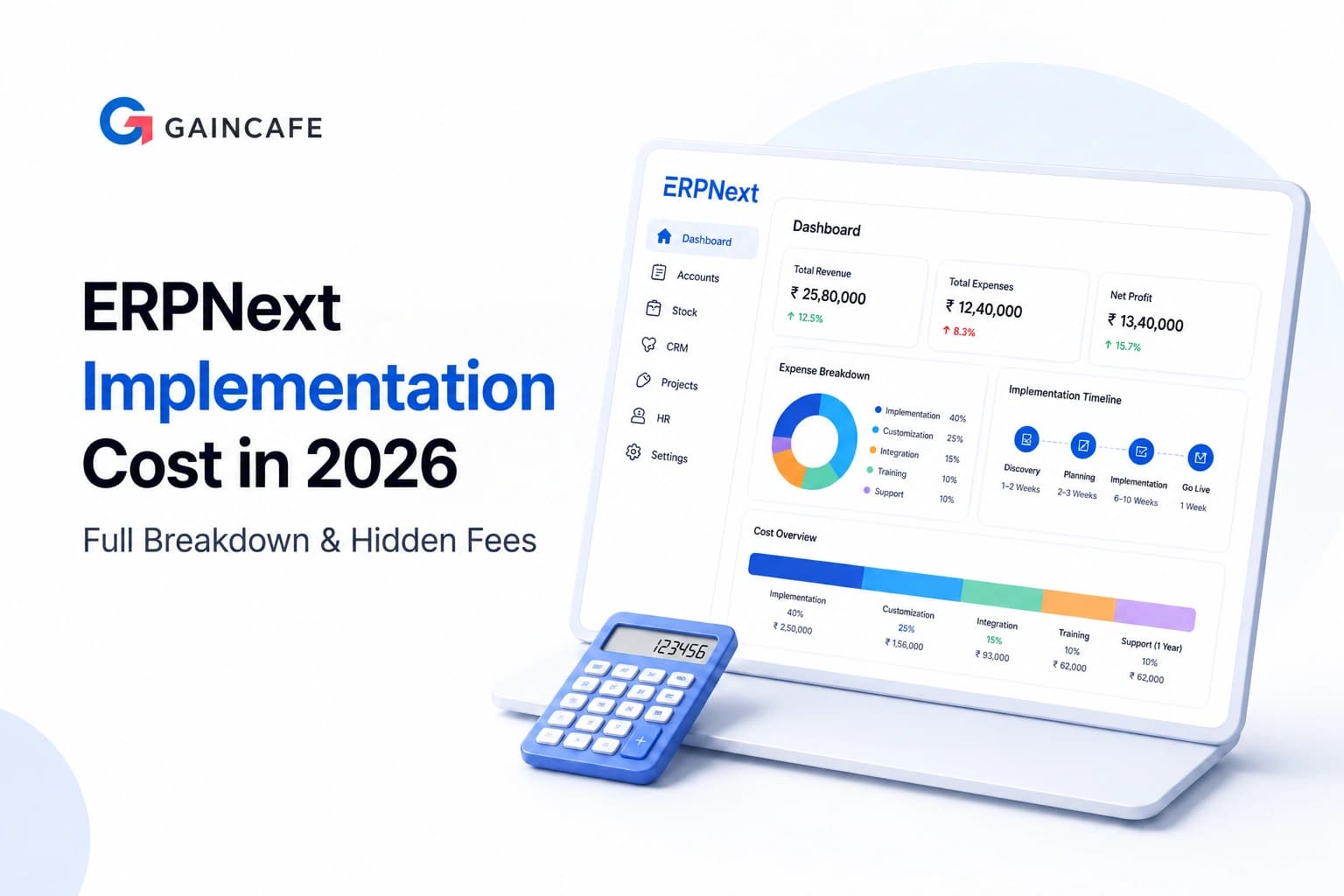
Quick Answer ERPNext software is free and open-source, with no per-user or per-module license fee. Your real ERPNext implementation cost comes from hosting, implementation, customization, data migration, training, and support. For a mid-sized business, a standard first-year implementation typically runs $25,000 to $90,000, while managed hosting on Frappe Cloud starts at just $5 per month. The biggest cost driver is not the software, it is how much custom work your business processes require.
Most ERP projects do not fail because the software was wrong. They fail because the budget was built on the vendor's brochure rather than the actual cost of making the software work inside a real business.
ERPNext has changed the conversation for mid-market companies and growing enterprises. As an open-source platform built on the Frappe framework, it offers a level of customization and cost transparency that proprietary ERP systems have never been able to match. But "open-source" does not mean "free to implement," and confusing the two is one of the most expensive mistakes a finance or operations team can make.
Understanding the real ERPNext implementation cost means looking beyond the license fee. It means accounting for customization, data migration, training, hosting, and the ongoing support that keeps the system running after go-live. This guide breaks down every cost layer so your budget reflects reality from day one.
Whether you are evaluating ERPNext for the first time or trying to understand why a previous ERP project went over budget, the numbers and frameworks here will give you a clearer picture of what you are actually buying.
What ERPNext Actually Is and Why It Has Gained Serious Traction
ERPNext is a full-stack, open-source ERP platform covering accounting, inventory, manufacturing, HR, CRM, project management, and e-commerce in a single system. It is built on Frappe, a Python-based web framework, which makes it unusually flexible for custom development compared to most ERP platforms.
The platform has seen significant adoption across the UAE and GCC, particularly among manufacturing businesses, trading companies, and professional services firms that need serious ERP functionality without the cost structure of SAP or Oracle
Three reasons it has earned genuine enterprise attention:
- No per-user license tax: Most ERP software charges per seat. ERPNext's open-source model removes that cost entirely, which changes the economics significantly for companies scaling their user count.
- Real customizability: The Frappe framework allows developers to build custom modules, workflows, and integrations that genuinely extend the platform rather than working around it.
- Active development and community: ERPNext releases regular updates, and the implementation ecosystem has matured considerably, particularly in emerging markets where proprietary ERP costs are prohibitive.
What Is New in ERPNext Version 16 (2026)
The current release, ERPNext Version 16, shipped in January 2026 and brought a faster engine called Frappe Caffeine, a redesigned interface, Phantom BOMs for manufacturing, and enhanced payroll. For a 2026 implementation, building on Version 16 matters, since it affects performance, hosting requirements, and how little custom work you may need.
Not sure about ERPNext cost?
Get a detailed breakdown based on your business workflows and requirements.
ERPNext Implementation Cost: The Full Breakdown
The table below covers every meaningful cost category across three deployment scales: a basic single-department setup, a standard multi-department rollout, and a full enterprise implementation.
| Cost Factor | Basic Setup | Standard Deployment | Enterprise Rollout |
|---|---|---|---|
| ERPNext Hosting (Frappe Cloud, compute-based, unlimited users) | $5/mo (Sites) | $20 to $125/mo | $400+/mo |
| Implementation Partner Fees | $3,000 to $8,000 | $10,000 to $35,000 | $40,000 to $150,000+ |
| Custom Module Development | Not required | $5,000 to $20,000 | $25,000 to $80,000+ |
| Data Migration | $500 to $2,000 | $3,000 to $10,000 | $15,000 to $40,000 |
| Staff Training | $500 to $1,500 | $2,000 to $8,000 | $10,000 to $30,000 |
| Server and Hosting | $50 to $200/mo | $300 to $800/mo | $1,000 to $3,000+/mo |
| Post-Launch Support (annual) | $1,000 to $3,000 | $5,000 to $15,000 | $20,000 to $60,000 |
| Estimated First-Year Total | $5,000 to $15,000 | $25,000 to $90,000 | $110,000 to $350,000+ |
A few points worth noting about these figures. The license cost is zero for self-hosted deployments. The implementation partner fees carry the most variance because they reflect how much customization your business processes require. The gap between a basic and enterprise rollout is not about the software, it is about the complexity of making the software fit the business.
The first-year total for a standard deployment typically lands between $25,000 and $90,000 for most mid-sized businesses. That range is wide because your specific industry, the number of modules you need, and the state of your existing data have a larger impact on cost than any single vendor factor.
ERPNext Hosting: Frappe Cloud Pricing in 2026
ERPNext's hosting is billed by compute usage, not by user count, which is one of its biggest financial advantages. A company with 100 users pays the same as one with 10 if they use the same server resources. Here are the current official Frappe Cloud tiers.
| Plan | Price (2026) | Best for |
|---|---|---|
| Sites (shared) | From $5/mo | Startups, proof of concept |
| Servers (shared VM) | From $20/mo | Small teams |
| Dedicated | From $125/mo | SMBs, 10 to 150 users |
| Premium dedicated | Up to $400+/mo | Mid-market and enterprise |
| Hybrid (your own servers) | From $1,000/mo | Data sovereignty needs |
All plans include unlimited users, automated backups, SSL, and automatic upgrades, and an application warranty is included on plans above $50 per month.
On ERPNext, adding users adds training and configuration time, but never software cost. That is the single biggest reason growing teams choose it over SAP or Oracle.
Ready to implement ERPNext?
Build a scalable ERP system aligned with your business workflows.
The Hidden ERP Costs Nobody Talks About in 2026
Implementation partners quote what they can see. The costs that sink ERP budgets are almost always the ones that were not scoped upfront.
Process Redesign Before Configuration
ERPNext is built around standard business workflows. If your current processes are heavily manual, inconsistent across departments, or built on workarounds from a previous system, those processes need to be documented and redesigned before configuration begins.
This work is often invisible in initial quotes. It can add two to six weeks of consulting time and $5,000 to $25,000 in unbudgeted cost depending on the scale of process complexity.
Data Migration Underestimation
Moving data from a legacy system, a collection of spreadsheets, or a combination of both is almost always more complex than it appears. Data quality issues, format inconsistencies, and missing field mappings surface during migration and require manual resolution.
Companies with five or more years of transaction history routinely find that their data migration takes twice as long as initially estimated. Budget the time as carefully as you budget the cost.
Change Management and Training
The most technically successful ERP implementation can still fail if the people using it were not properly trained and the change was not managed thoughtfully. Resistance to new workflows is the primary cause of low adoption, and low adoption means your ERP investment is sitting idle.
Training costs are real but consistently underbudgeted. For a deployment across 20 to 50 users, factor a minimum of $3,000 to $8,000 for structured training, documentation, and initial support.
Integration with Existing Systems
Most businesses do not replace every system at once. ERPNext will need to connect with existing tools including e-commerce platforms, logistics systems, payment gateways, or industry-specific software.
Each integration is a custom development project. A single API integration with proper error handling, logging, and testing typically costs $2,000 to $8,000. Multiple integrations stack quickly and should be scoped individually rather than estimated as a single line item.
Avoid hidden ERP implementation costs
Identify risks early with expert ERPNext planning and scoping.
ERPNext vs. Other ERP Systems: A Direct Comparison in 2026
Before committing to any ERP solution, it is worth understanding where ERPNext sits in the broader market. The comparison below focuses on factors that matter to growing businesses and enterprises.
| Criteria | ERPNext | SAP Business One | Oracle NetSuite | Microsoft D365 |
|---|---|---|---|---|
| License Model | Open-source / SaaS | Perpetual + annual | Subscription only | Subscription only |
| Starting Cost | Free (self-hosted) | $80,000+ | $36,000+/year | $70,000+/year |
| Customization | Very high (Python) | Moderate | Limited without add-ons | High (complex) |
| Implementation Time | 4 to 16 weeks | 6 to 18 months | 3 to 12 months | 6 to 24 months |
| SME Friendliness | Excellent | Moderate | Low (enterprise-first) | Low (complex setup) |
| GCC/UAE Market Fit | Strong and growing | Established | Growing | Growing |
| Vendor Lock-in Risk | Low (open-source) | High | High | High |
The cost difference between ERPNext and proprietary ERP software like SAP or Oracle is substantial at every scale. For businesses with 20 to 500 users that need genuine customizability without enterprise pricing, ERPNext consistently delivers better total cost of ownership over a three to five year horizon.
The vendor lock-in difference is also worth serious consideration. With ERPNext, you own your data and your codebase. If you switch partners, you take your implementation with you. With subscription-based ERP platforms, the relationship between your data and the vendor is considerably less straightforward.
Choosing ERPNext for your business?
Get expert guidance on implementation, customization, and long-term scalability.
ERPNext vs SAP: 5-Year Total Cost of Ownership
The gap between ERPNext and proprietary ERP is widest over time, because per-user license fees compound every year. Here is an illustrative five-year comparison for a 50-user deployment.
| Cost element | ERPNext | SAP Business One |
|---|---|---|
| Software license (5 yrs) | $0 | $90,000 to $250,000+ |
| Implementation | $25,000 to $90,000 | $80,000 to $150,000 |
| Hosting (5 yrs) | $3,000 to $24,000 | Included or extra |
| Support and upgrades | $25,000 to $75,000 | 15 to 22% of license per year |
| 5-year estimate | $55,000 to $190,000 | $250,000 to $500,000+ |
For a 50-user business, the five-year saving with ERPNext often exceeds $200,000, with the added benefit that you own your data and codebase.
Key Factors That Determine Your Final Implementation Cost in 2026
Two companies in the same industry with the same user count can have ERPNext implementation costs that differ by $50,000 or more. Here is what actually drives the variance.
- Number of modules activated: ERPNext covers accounting, HR, manufacturing, CRM, inventory, and more. Each module you activate adds configuration, testing, and training time. A company using three modules costs significantly less to implement than one using eight.
- Degree of process customization: Standard workflows in ERPNext work well out of the box for most businesses. Heavily customized workflows require Python development time on the Frappe framework, which adds both cost and timeline.
- Data volume and history: Migrating two years of transaction data is a different project than migrating ten years. The volume and quality of your historical data is one of the most reliable predictors of migration cost.
- Number of legal entities and currencies: Multi-entity setups with intercompany transactions, multiple base currencies, and consolidated reporting add meaningful configuration complexity.
- Deployment model: Self-hosted deployments on your own infrastructure give you full control but require in-house server management. Frappe Cloud removes that overhead at a monthly cost that is well-justified for most mid-sized businesses.
- Partner experience level: An ERPNext implementation partner who has delivered twenty projects in your industry will identify problems in Week 1 that a generalist partner discovers in Month 3. Experience is priced into rates, but it is rarely a more expensive choice once you account for the cost of mistakes.
What will your ERPNext cost look like?
Get a tailored estimate based on your modules, workflows, and business complexity.
How ERPNext Cost Scales With Business Size
Because hosting is compute-based and there is no per-user fee, ERPNext cost scales with complexity, not headcount. Here is a realistic first-year picture by company size.
| Business size | Typical users | Modules | First-year total |
|---|---|---|---|
| Small business | 5 to 20 | 2 to 3 | $5,000 to $20,000 |
| Mid-market | 20 to 100 | 4 to 6 | $25,000 to $90,000 |
| Enterprise | 100 to 500+ | 6 to 10+ | $110,000 to $350,000+ |
Notice that user count barely moves the software cost. What moves it is the number of modules, the depth of customization, and the state of your existing data.
How to Reduce Your ERPNext Implementation Cost in 2026
You can cut ERPNext cost meaningfully without cutting quality, if you plan for it early.
- Start with standard workflows: Only customize where the standard truly does not fit. Every custom module adds development and testing cost.
- Phase your rollout: Launch two or three core modules first, prove value, then add the rest. A phased rollout spreads cost and lowers risk.
- Clean your data before migration: Most overruns come from messy legacy data. Cleaning it upfront is far cheaper than fixing it mid-project.
- Choose Frappe Cloud over self-hosting early on: Unless you have in-house server expertise, managed hosting removes DevOps cost and starts at $5 per month.
Pick an experienced ERPNext development partner. A specialist spots in week one what a generalist finds in month three, and that experience is almost always cheaper than the rework it prevents.
The cheapest ERPNext project is not the one with the lowest quote. It is the one scoped correctly the first time, so you never pay to rebuild it.
Conclusion
ERPNext delivers genuine enterprise functionality at a cost structure that makes serious ERP accessible to businesses that would otherwise have no viable option. But the software is only part of the investment.
The full ERPNext implementation cost is a function of your business complexity, your data quality, the modules you need, and most importantly the quality of the partner doing the work. Getting those variables right from the start is what separates an ERP project that transforms operations from one that drains budget without delivering value.
If you are in the early stages of evaluating ERPNext or trying to rescue a project that has stalled, Gaincafe Technologies works with businesses across the UAE and GCC to deliver implementations that actually work. Explore our Custom App Development Services or reach out directly to talk through your specific requirements.
Ready to implement ERPNext the right way?
Plan, build, and scale your ERP system with experienced developers.