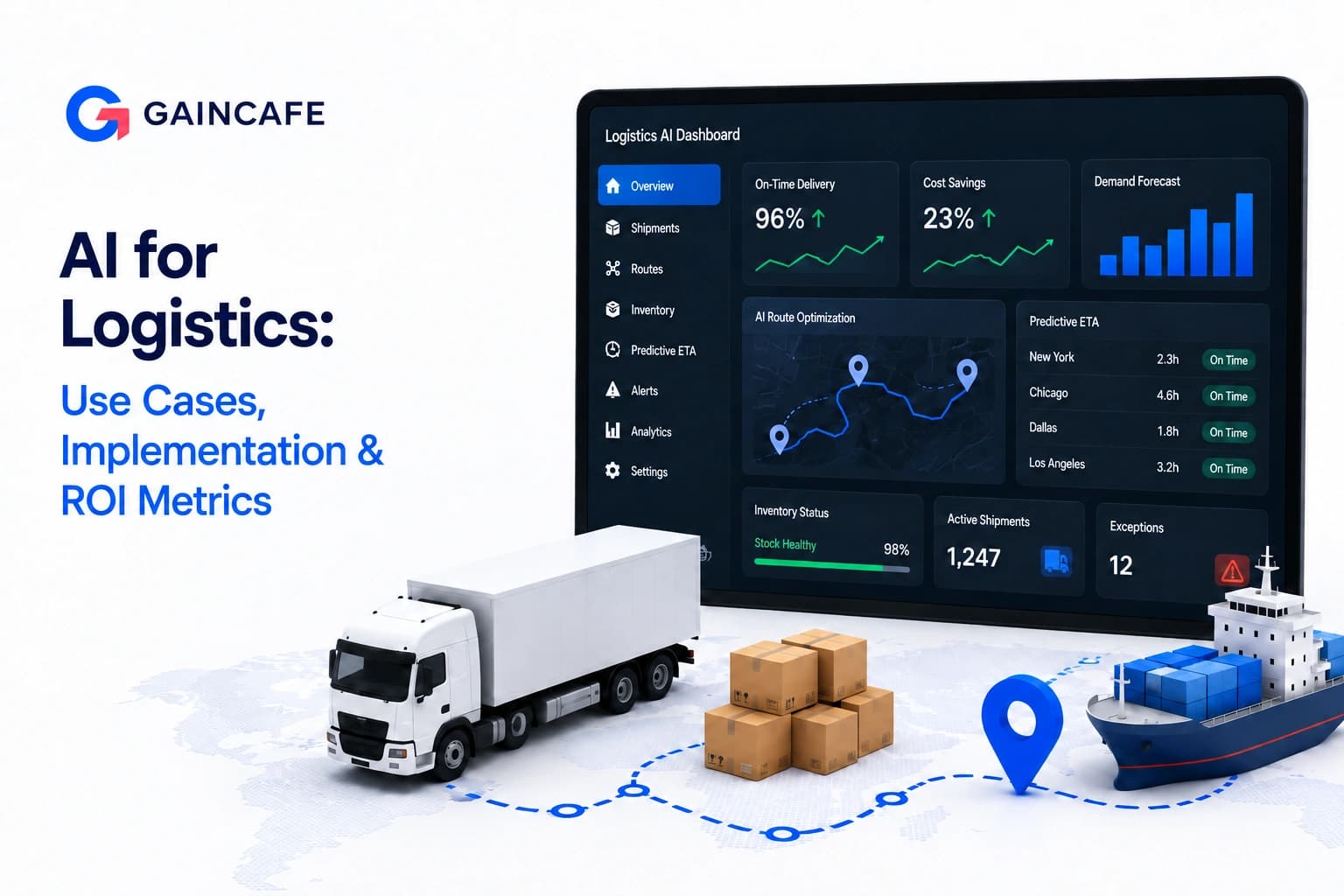
AI for logistics is transforming the logistics supply chain operations through visibility reduction of operational costs, and delivery of effective customer services. Various studies have proved that the adoption of AI-driven solutions in logistics and supply chain management ensures a decrease in the level of prediction errors by up to 50% while cutting down the expenses on keeping storage facilities by 20%. The benefits of implementing the AI-driven logistics solutions include optimised routing, predictive maintenance, inventory management, and demand forecasting.
The increasing implementation of AI for logistics services has been driven by such factors as the rise of high customer expectations, high fuel and labor costs, and disruptions in the global supply chain. The modern AI solutions in logistics are based on such techniques as machine learning, IoT, analytics, and automation that help detect possible problems and facilitate the decision-making process. There are several areas of the application of AI in the logistics industry.
How AI is Transforming Logistics Businesses Worldwide In 2026?
AI is transforming the logistics industry into an effective, quick, and cost-efficient. By offering route optimisation, warehouse automation, and demand forecasting, among others, AI for logistics helps logistics firms minimise delays, increase the accuracy of deliveries, and provide a better customer experience. Advanced AI algorithms are able to process high quantities of real-time data related to various aspects such as fuel usage, traffic details, cargo tracking, and weather information, thus allowing decision-making to be done quickly. Research indicates that AI logistics solutions contribute to lower transport costs and an efficient supply chain, thus giving a competitive edge to firms around the world.
One such area where AI is transforming logistics management is through predictive analytics and automation. With the application of intelligent sensors and robotics, AI can help make predictions about inventory needs, perform automated tasks in warehouses and identify disruptions in the supply chain process. A good illustration of how this is happening is through the application of robots that have been fitted with AI by Amazon.
AI for logistics technology has revolutionised customer services and increased transparency in operations. Companies can keep up with the progress of deliveries by giving accurate predictions for deliveries and automating customer service using chatbots and voice recognition software with the help of AI. For example, consider an online shopping company that uses the logistics technology of AI to divert deliveries when there are traffic jams.
Want smarter route planning with AI?
We build AI-powered logistics platforms that optimise routes, reduce fuel costs, and improve delivery performance using real-time operational data.
Discuss Your Logistics ProjectUnderstanding Real-Life Use Cases Of Incorporating AI for Logistics Operations
1. Predictive Demand Forecasting
Business Problem
In most cases, companies have an inflated view of the demand, and as a result, invest more in excess inventory and higher costs associated with warehousing. On the other hand, underestimating the amount of demand leads to a shortage of stocks.
AI-driven Solution
Models that use machine learning examine past sales figures, schedules of promotions, seasonal changes, outside variables like weather information and macroeconomic statistics to simulate and predict demand.
Real-Life Use Case
Walmart uses AI for logistics forecasting system that processes around 200 variables to adjust inventory allocation daily, helping reduce overstock and enhance on-shelf availability for dynamic businesses.
Overall Business Impact
- Improved order fulfilment rates
- Minimised holding stock cost
- Lower write-off from perishable goods
2. Route Optimisation & Effective Scheduling
Business Problem
Driver's hours and fuel costs are two high operational costs in the logistics sector. Static or traditional route planning cannot adapt to real-time traffic conditions, weather changes or certain shipment delays.
AI Solution
AI for logistics solutions typically combines real-time GPS data, weather forecasts, traffic patterns and delivery constraints to adjust routes and schedules effectively. Algorithms can factor in vehicle capacity and driver shifts to streamline overall utilisation.
Real-Life Example
DHL’s Resilience 360 solution is based on AI that analyses disruption data from live sources to make adjustments to shipment routes in order to mitigate weather and infrastructural disruptions.
Overall Business Results
- Fewer late delivery instances
- Decreased use of fuel in the long run
- Improving the productivity of drivers
3. Warehouse Automation & Robotics
Business Problem
Manual picking, packing, and sorting slow throughput, ultimately increasing error rates and making scaling up during peak season more costly and labour-intensive.
AI-Backed Solution
AI-based robotics uses computer vision to detect, select, and separate items with minimal human interference. The picking process is made more efficient through the use of artificial intelligence that finds a shorter route within the warehouse for picking.
Real-Life Instance
Ocado’s fulfilment centres use AI for logistics solution processes thousands of orders per hour, leveraging robotic picking arms coordinated by a central algorithm that maps out movement down to just milliseconds.
Business Outcome
- Prompt order processing approach with AI
- Lower dependency on seasonal labour spike
- Minimised picking errors in long-term operations
4. Supply Chain Visibility & Risk Management
Business Problem
Where shipments are delayed or lost, it is usually caused by some underlying problems existing somewhere within the supply chain, which only become apparent once the problem occurs. Conventional monitoring systems can detect such a problem after it occurs.
AI-Backed Approach
AI for logistics systems uses data from freight forwarders, customs, IoT devices, and shipping companies to track goods throughout the entire process on one screen. What is even better is that the use of predictive analysis helps prevent potential delays.
Real-Life Example
IBM's Sterling Supply Chain solution utilises AI technologies to predict weather and custom delays in advance, adjusting shipment estimates accordingly.
Business Outcome
- Improved customer trust over time
- Fewer chances of surprise delays
- Resilient supply chain operations
5. Predictive Maintenance for Fleet & Equipment
Business Problem
Delays in the delivery of cargo or increased maintenance costs arising from equipment failures would result in inefficiencies in the logistics process, hence influencing the level of customer satisfaction negatively.
AI-Based Solution
AI for logistics models analyse engine, brake, or other sensor data to detect the first signs of part or system malfunction and schedule preventive maintenance before actual failure happens.
Use Case Example
In order to prevent potential machine problems of its vehicles during transportation and to repair them while they are in the ports, Maersk adopted AI logistics solutions.
Business Results
- Lower repair and replacement costs
- Minimised unplanned downtime
- Achieving extended asset lifespan
Looking to implement AI for logistics operations?
Gaincafe Technologies helps logistics companies build AI-powered solutions for route optimisation, predictive analytics, warehouse automation, and supply chain visibility.
Talk to AI ExpertsHow Can Businesses Incorporate AI for Logistics Solutions?
1. Identify Logistics Challenges and Business Goals
Identify the problem areas in your logistics system that can be addressed by your choice of using AI for logistics. Some examples include delays in delivery processes, ineffective routes, expensive fuels, no real-time tracking, inadequate storage practices, and ineffective inventory management, among others. In addition, determine the goals that will help you decide on the most suitable technology.
2. Collect and Organise Logistics Data
AI solutions depend on good-quality data that is used for deriving accurate insights and automating tasks. Organisations need to source data from TMSs, GPS trackers, WMSs, IoT sensors, ERP systems, fleet data, and customer order data. Moreover, clean data helps in pattern recognition, demand forecasting, and improving decision-making processes.
3. Select the Right AI Use Cases
Rather than incorporating AI technology in all fields, pick out those areas in which you can derive quick benefits through it. Some of the uses of AI technology in businesses in logistics may include predictive maintenance, route optimisation, inventory prediction, warehousing, package tracking, demand forecasting, and the use of chatbots for customer support.
4. Integrate AI With Existing Logistics Systems
Successful AI for logistics implementation typically needs seamless integration with your existing software and operational tools. AI platforms must connect with CRM tools, ERP systems, supply chain management platforms, fleet tracking software and warehouse systems to allow real-time data exchange.
Full integration will help make sure that all the processes are executed properly due to the automated nature of these operations.
5. Train AI Models and Automate Processes
With all infrastructure in place, companies can now create models using historical and current data from their logistics operations. AI for logistics models learn things such as delivery patterns, maintenance schedules, traffic patterns, consumer behaviour, and inventory levels so that they can automate tedious tasks.
6. Monitor Performance and Optimise Continuously
The process of introducing AI is set to continue. The company needs to track different parameters in terms of performance, which may include delivery time, fuel consumption, truck performance, order precision, client satisfaction, and warehouse efficiency.
7. Ensure Security, Scalability, and Employee Adoption
To effectively introduce AI for logistics operations, firms need to consider a number of questions concerning compliance, security, and training of personnel to recognise the benefits of using AI in logistics.
Improve supply chain visibility with AI
Gain real-time shipment tracking, predictive disruption alerts, and intelligent supply chain insights powered by advanced AI solutions.
Explore AI Supply Chain SolutionsAI For Logistics: Top ROI Metrics To Keep In Check
| ROI Metric | What It Measures | Why It Matters | Business Impact |
|---|---|---|---|
| Delivery Time Reduction | Improvement in overall delivery speed and route efficiency | AI-based route optimisation assists in reducing delays and enhancing customer satisfaction | Businesses can reduce delivery times by 15 to 30% |
| Fleet Utilisation Rate | Measures how effectively vehicles are used | AI enhances vehicle scheduling and load balancing | Higher utilisation increases profitability |
| Fuel Cost Savings | Reduction in fuel consumption | AI evaluates routes and traffic patterns | Lower transportation expenses |
| Predictive Maintenance Savings | Reduction in breakdowns | AI identifies issues before failure | Reduced downtime and repair costs |
| Inventory Accuracy | Accuracy of stock monitoring | AI forecasting reduces shortages and overstocking | More reliable supply chains |
| Customer Satisfaction Level | Delivery performance and service quality | AI improves tracking and communication | Higher loyalty and repeat business |
| Order Accuracy Rate | Orders delivered without errors | AI automates order processing | Improved retention and trust |
Final Takeaway!
AI for logistics is not a futuristic thought anymore; rather, it is emerging as a significant element that enhances the efficiency of operations, customer satisfaction, and savings in the supply chain process. Implementation of AI-backed logistics solutions enables businesses to achieve quick decision-making, positive return on investment (ROI), and precise deliveries.
An AI for logistics system becomes crucial when developing logistics operations in a highly competitive business environment characterised by high customer expectations. Do you look forward to establishing efficient logistics operations using AI technology? Get in touch with Gaincafe Technologies now for efficient, ROI-driven logistics operations.
Ready to transform logistics operations with AI?
Gaincafe Technologies builds AI-powered logistics solutions that improve delivery efficiency, optimise routes, automate warehouses, and maximise ROI.
Book a Consultation