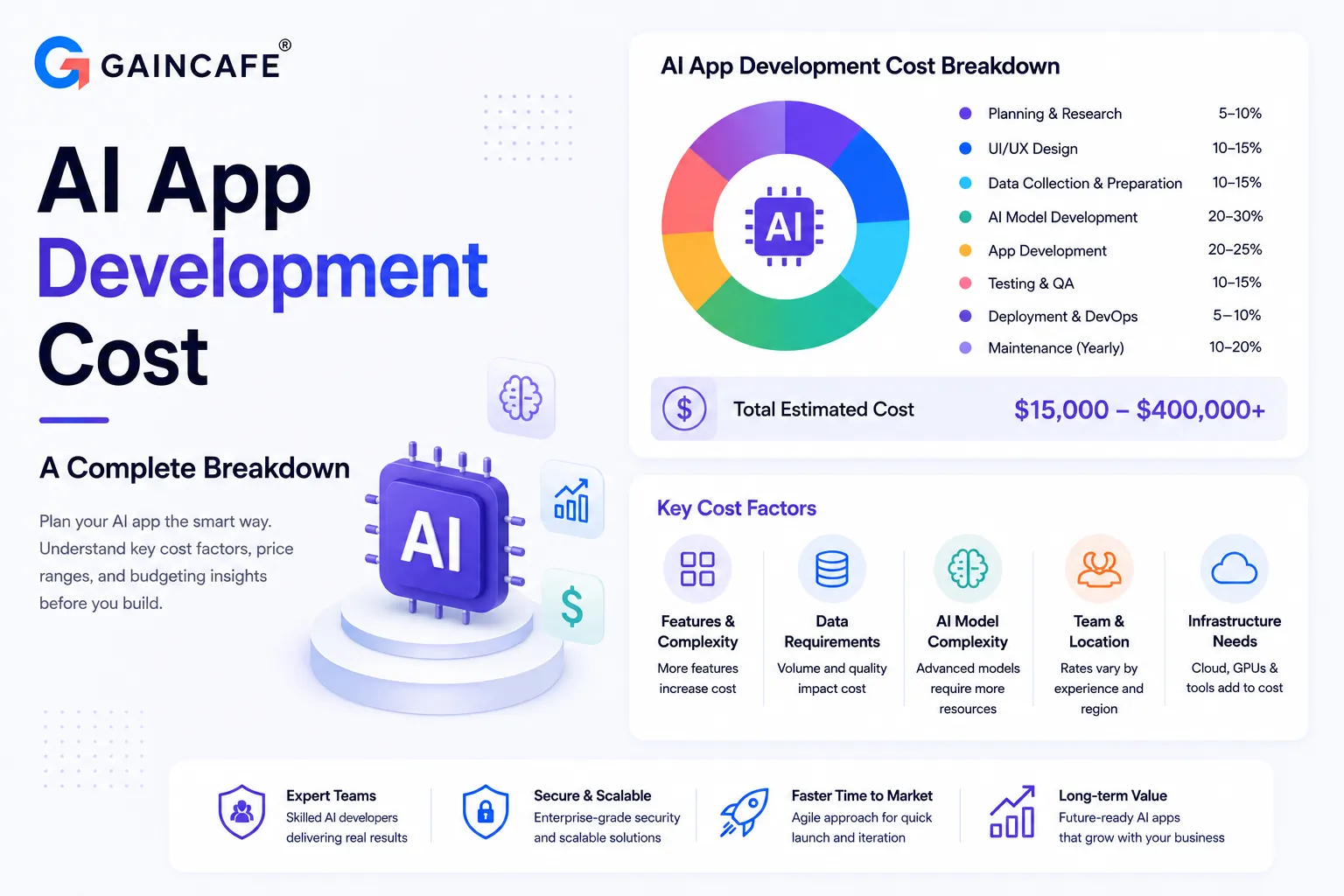
Quick answer: Most AI app development cost in 2026 lands between $15,000 and $400,000+. A basic AI feature such as a chatbot or simple recommendation logic built on a pre-built model API costs $15,000 to $45,000. A mid-complexity AI app with a custom interface, retrieval pipeline, and multiple integrations runs $45,000 to $120,000. A custom-trained model with enterprise integrations and compliance work costs $120,000 to $400,000 or more. On top of the build, expect ongoing model API, hosting, and maintenance costs of roughly 15 to 30% of the original build cost every year.
AI app development cost in 2026 typically falls between $15,000 for a single AI feature bolted onto an existing product and $400,000 or more for a custom, enterprise-grade AI application built from the ground up. The number that actually applies to your project depends less on "AI" as a buzzword and more on three practical questions: how much of the app is genuinely AI versus a normal app with a smart feature attached, whether you use a pre-built model API or train something custom, and who is doing the building.
This guide breaks down real 2026 pricing for every layer of an AI app: the build itself, the AI features inside it, the model and API bills that show up after launch, and the maintenance costs most founders never budget for. We also show where the industry's cost estimates tend to go wrong, and where Gaincafe Technologies has actually built and shipped AI products for clients across the USA, UK, UAE, and Australia.
Whether you are asking what the cost to build an AI app looks like for a first version, or trying to work out AI application development cost for a full platform rebuild, the same underlying framework applies. Every number in this guide is grounded in verified 2026 pricing, current model API rates, and Gaincafe's own project data, not recycled estimates from older articles.
Key Takeaways
- A basic AI app built on pre-built APIs such as OpenAI, Anthropic, or Google costs $15,000 to $45,000 and typically ships in 6 to 10 weeks.
- Fine-tuning or training a custom model pushes AI application development cost to $60,000 to $400,000+, mostly because of data preparation and GPU compute time.
- Model API pricing has dropped sharply: Claude Sonnet 5 runs $2 per million input tokens and $10 per million output tokens as of August 2026, while GPT-5.6's mid-tier model runs $2 input and $12 output per million tokens.
- Offshore and nearshore development teams typically cost 40 to 60% less than US-based in-house teams for comparable AI engineering work.
- McKinsey's 2025 global AI survey found 88% of organizations now use AI in at least one business function, up from 78% the year before, which is why "what does this cost" has become the first question every founder asks.
The cheapest AI app to build is rarely the cheapest AI app to run. A $20,000 chatbot that handles 50,000 conversations a month can quietly cost more in API fees over a year than it cost to build in the first place. Keep that in mind as you read the numbers below.
What Actually Counts as an "AI App" in 2026?
Before the numbers, a quick definition, because this is where most estimates go wrong. Most cost guides skip it, and it is the reason two "AI apps" can cost $20,000 or $200,000 with no obvious explanation why.
- AI-feature apps: A normal app with one AI capability added, like a support chatbot or a smart search bar. This is most projects, and it is the cheapest category by far.
- AI-native apps: The product's core value depends entirely on AI, such as a diagnostic tool or a content generation platform. Costs climb because the AI has to be reliable, not just present.
- AI-orchestrated apps: Multiple models or agents work together to complete multi-step tasks with limited human input. This is the newest and most expensive category in 2026, and the one most likely to be quoted inaccurately.
Knowing which of these three you are actually building, before you ask anyone for a quote, is the fastest way to get an estimate that holds up. Most people asking "how much does an AI app cost" are picturing the first category, but budgeting for the third, which is exactly where AI app development pricing conversations tend to go sideways. Getting this classification right before you scope anything is the first real step in pricing the cost to develop an AI app accurately.
How Much Does AI App Development Cost in 2026?
AI app development cost breaks down into three broad tiers based on complexity, not app category. A simple habit tracker with an AI-generated summary and a full diagnostic AI platform with computer vision are worlds apart in price, even though both get called "AI apps."
Here is how the three tiers typically shake out, whether you are building a web product, a dedicated AI-powered mobile application, or an internal tool.
| Complexity Tier | What It Includes | Typical Cost Range (USD) | Typical Timeline |
|---|---|---|---|
| Basic | One AI feature (chatbot, tagging, simple recommendations) using a pre-built model API, standard UI | $15,000 to $45,000 | 6 to 10 weeks |
| Mid-Complexity | Multiple AI features, custom UI/UX, a retrieval pipeline (RAG) or light fine-tuning, several integrations | $45,000 to $120,000 | 3 to 5 months |
| Advanced / Enterprise | Custom-trained models, multi-agent workflows, deep system integrations, compliance and security work | $120,000 to $400,000+ | 6 to 12+ months |
Three variables move a project from the low end of a range to the high end almost every time: how much custom data engineering the project needs, how many existing systems it has to talk to, and whether the team building it is US-based, offshore, or a blended model. We cover each of these in detail below.
Not sure which tier your idea actually falls into? Talk to Gaincafe's team for a free, no-pressure scoping call before you commit to a full quote anywhere else.
AI App Development Cost by Feature
Most AI apps are not "one big AI system," they are a normal application with one or two specific AI capabilities inside it. Pricing each capability on its own is usually the fastest way to get an accurate estimate for your project.
| AI Feature | Typical Cost Range (USD) | What Drives the Price |
|---|---|---|
| AI Chatbot / Virtual Assistant | $8,000 to $40,000 | Knowledge base size, conversation complexity, whether it needs to take actions (book, refund, escalate) |
| Computer Vision (image or video recognition) | $25,000 to $90,000 | Labeled image volume, real-time vs. batch processing, hardware constraints |
| Recommendation Engine | $20,000 to $70,000 | Data volume, personalization depth, real-time vs. batch scoring |
| Generative AI (text, image, or content generation) | $30,000 to $100,000 | Prompt engineering complexity, guardrails, brand-safe output controls |
| Voice AI / Speech Recognition | $20,000 to $80,000 | Language support, accent handling, latency requirements |
| Predictive Analytics | $25,000 to $85,000 | Data quality, forecasting horizon, model retraining frequency |
If you already have a working platform and just want to add one of these capabilities, the math changes quite a bit. We have written a separate, detailed breakdown on the cost to add AI to an LMS that walks through what "bolt-on AI" costs versus building AI in from day one, and the same logic applies to most existing SaaS products.
Want a real number for your AI app?
Get a transparent, fixed-scope estimate from Gaincafe, based on your actual features, data, integrations, and expected user volume.
Get a Free AI App EstimateWhat Drives AI App Development Cost?
Five factors decide where your project lands inside these ranges. Get these right early and your estimate will actually hold.
- Data readiness: Clean, labeled, structured data is rare. Data cleaning and preparation alone commonly consumes 15 to 25% of a project's total budget, and it is the single most underestimated line item in AI application development cost. Teams that skip a data audit before scoping the build almost always see the estimate move later, not because the developers were wrong, but because nobody checked what the data actually looked like first.
- Model choice: A pre-trained API call costs a fraction of fine-tuning, which costs a fraction of training a model from scratch. Most businesses never need the third option, and choosing it anyway is the single biggest avoidable cost driver in this entire guide.
- Integration depth: Connecting an AI feature to a legacy CRM, an ERP, or a compliance system takes real engineering time, often $2,000 to $15,000 per system connected. Apps that need to touch four or five internal systems cost meaningfully more than a standalone AI tool, even if the AI itself is identical.
- Custom vs. pre-trained: Off-the-shelf models handle a large share of use cases in 2026. Custom training only pays off when your data or use case is genuinely unique, which is a smaller group of businesses than most pitch decks assume.
- Compliance and governance: HIPAA, GDPR, and industry-specific rules add real cost, particularly in healthcare, finance, and legal apps, where audit trails and explainability are not optional. Building this in from the start is consistently cheaper than retrofitting it after an audit flags a gap.
- Team composition: A project needs a mix of a product engineer, an AI or ML specialist, and often a data engineer. Skipping the data engineer role to save money is a common false economy that shows up later as slow pipelines and unreliable output.
A useful way to think about this: many businesses start with AI automation for one or two specific workflows and expand from there, rather than committing to a full custom AI platform on day one. That staged approach is usually cheaper and lower-risk than it sounds.
A working AI feature is not the same as an AI product, and confusing the two is the fastest way to blow past a budget. A demo that answers questions correctly 80% of the time is a prototype. Getting it to 95%+ reliability, with proper fallbacks and monitoring, is where most of the real engineering cost sits.
AI App Cost by Approach: APIs vs. Fine-Tuning vs. Custom Models
How you build the "AI" part of your app changes the cost of AI app development more than almost anything else. There are three real paths in 2026, and most projects should not default to the most expensive one.
| Approach | Build Cost (USD) | Ongoing Cost | Best For |
|---|---|---|---|
| Pre-built AI APIs (OpenAI, Anthropic, Google) | $10,000 to $50,000 | Usage-based, pay per token or per call | Most apps: chatbots, content tools, search, classification |
| Fine-tuning an existing model | $40,000 to $150,000 | Retraining every quarter, typically $10,000 to $40,000 per cycle | Domain-specific accuracy needs (legal, medical, technical support) |
| Custom model built from scratch | $150,000 to $500,000+ | Ongoing research and infrastructure team required | Proprietary data advantage, unique problem no existing model solves well |
In practice, most of what companies now call "custom AI" is really a well-built API integration wired into their product with good prompt design, retrieval, and guardrails around it. That is not a lesser approach, it is usually the smarter one financially. Training a model from scratch only makes sense when a pre-trained model genuinely cannot do the job, which is rarer than most pitch decks suggest.
AI App Cost by Team Location: US, UK, UAE, and Australia
Where your development team sits changes AI app development cost as much as the technical approach does. Hourly rates and annual salaries vary widely across regions, and the gap has held steady through 2026. Most cost guides only compare the US against India, but Gaincafe works with founders across the USA, UK, UAE, and Australia, so we have included all four markets here.
| Region | Typical Hourly Rate (USD) | Typical Annual Salary, In-House (USD) |
|---|---|---|
| United States | $100 to $200 | $130,000 to $220,000 |
| United Kingdom | $90 to $180 | $110,000 to $190,000 |
| Australia | $55 to $110 | $70,000 to $165,000 |
| UAE | $35 to $90 | $30,000 to $150,000 |
| Western Europe | $80 to $150 | $90,000 to $170,000 |
| Eastern Europe | $50 to $90 | $45,000 to $85,000 |
| India | $25 to $60 | $25,000 to $65,000 |
A few notes on the newer additions to this table. UAE salaries are converted from AED using the fixed dirham to dollar peg, and skew wide because Dubai and Abu Dhabi pay a real premium for senior AI talent compared to the rest of the region. Australia's numbers reflect a market where senior engineers increasingly work as day-rate contractors rather than salaried staff, which pushes effective hourly costs above what the base salary alone would suggest.
Businesses that build with offshore or nearshore AI teams typically see 40 to 60% savings compared to an all US or UK in-house team, without sacrificing quality, provided the vendor actually has senior AI engineers rather than generalists relabeled as "AI developers." If you are weighing an in-house hire against a partner team, our guide on how to hire AI developers for custom AI solutions walks through the roles you actually need and how to evaluate them.
A blended model, where a US, UK, UAE, or Australian product owner works with an offshore engineering team, is now the most common setup for startups managing AI app development pricing carefully. It keeps product decisions close to the business while keeping engineering costs sane, and it is a major reason the cost to build an AI app has become more predictable in 2026 than it was a couple of years ago.
The Hidden Costs of AI Apps
This is where most cost guides stop short, and it is where AI app budgets actually get blown. The build is a one-time cost. Everything below is recurring, and it does not stop when the app ships.
Model and API Usage Fees
Every AI call has a per-token or per-request price attached, and it adds up fast at scale. Here is what the major model providers charged per million tokens as of August 2026:
| Model | Input (per 1M tokens) | Output (per 1M tokens) |
|---|---|---|
| Claude Opus 5 (Anthropic) | $5.00 | $25.00 |
| Claude Sonnet 5 (Anthropic) | $2.00 | $10.00 |
| Claude Haiku 4.5 (Anthropic) | $1.00 | $5.00 |
| GPT-5.6 Sol (OpenAI) | $5.00 | $30.00 |
| GPT-5.6 Terra (OpenAI) | $2.00 | $12.00 |
| GPT-5.6 Luna (OpenAI) | $0.20 | $1.20 |
A moderately busy chatbot handling 500,000 conversations a month, at a few thousand tokens per conversation, can run anywhere from a few hundred dollars to well over $10,000 a month depending on which model tier it uses. This is the line item most first-time AI founders forget to budget for entirely.
Data Preparation and Labeling
Data work rarely ends at launch. Ongoing labeling, cleaning, and curation typically runs $10,000 to $70,000+ depending on volume and specialization, and simple labeling ($0.03 to $1 per item) costs far less than specialized labeling for medical or legal data ($1 to $3 per item).
MLOps, Monitoring, and Retraining
Models drift. User behavior changes, data changes, and accuracy quietly degrades if nothing is watching it. Budget 20 to 25% of your original build cost annually for monitoring tools, drift detection, and periodic retraining cycles.
GPU and Compute Infrastructure
If you are running your own models rather than calling an API, GPU rental is a real cost. H100 GPU instances rented across major cloud providers ranged from roughly $1.49 to $6.98 per hour as of 2026, and that adds up quickly for any team doing regular fine-tuning or inference at scale.
Compliance and Security
GDPR, HIPAA, and sector-specific regulation add $15,000 to $80,000+ depending on industry, covering audit trails, data residency, access controls, and explainability documentation.
Third-Party Integrations, Licensing, and Support Tools
Vector databases, orchestration frameworks, observability platforms, and workflow tools each carry their own subscription costs, typically $500 to $5,000 a month combined once an app is past MVP stage. None of these show up in a development quote, because they are operating costs, not build costs, but they are real money leaving the business every month regardless.
Your model API bill will often cost more in year two than your original development invoice did in year one. That is not a warning to avoid AI, it is a reason to model your running costs before you sign off on a build.
AI App Cost Example: First-Year Total
Here is a realistic worked example for a mid-complexity AI app: a customer support tool combining a RAG-based chatbot with an analytics dashboard, built for a mid-size SaaS company.
| Cost Category | One-Time or Monthly | Year 1 Total (USD) |
|---|---|---|
| Initial build (discovery, design, dev, QA) | One-time | $65,000 |
| Cloud hosting | $1,000/month | $12,000 |
| Model API usage | $1,500/month average | $18,000 |
| Data labeling and curation | Ongoing | $8,000 |
| Monitoring, drift detection, MLOps | Ongoing | $6,000 |
| Total Year 1 | $109,000 |
Notice that the build itself is only about 60% of what this app actually costs in its first year. The remaining 40% is running costs that most first-time budgets leave out entirely, which is exactly why so many AI projects run over.
Want an exact number for your AI app?
Get a free cost estimate from Gaincafe Technologies, based on your actual data, feature list, integrations, and expected user volume.
Get a Free AI App EstimateHow AI App Costs Are Changing in 2026
A few shifts are actively pulling AI app costs down this year, and a few new demands are adding cost back in. Understanding both sides matters if you are trying to time a build.
- Model prices keep dropping. Anthropic made its Sonnet 5 rate of $2 input and $10 output per million tokens permanent in August 2026, canceling a planned price increase, and OpenAI's tiered GPT-5.6 lineup now starts as low as $0.20 per million input tokens for its lightweight model. Cheaper inference means cheaper AI features.
- AI-assisted development is speeding up builds. Development teams using AI coding tools are shipping features faster, which trims labor hours on straightforward implementation work, though it has not reduced the need for senior engineers on architecture and data problems.
- Open-source models are a real alternative for some use cases. Self-hosting an open-source model avoids per-token fees entirely, in exchange for owning your own infrastructure and maintenance, a trade-off that makes sense at high volume and not at low volume.
- Content freshness now has real product value. As more traffic comes through AI Overviews and answer engines rather than traditional search, businesses are investing more in AI features that keep content and data current in real time, which is a newer line item than it was a year ago.
- Governance requirements are adding cost back in. As more regions introduce AI-specific regulation, apps handling sensitive data increasingly need documented model evaluation and bias testing, work that barely existed as a line item two years ago.
Net effect for most businesses: the AI layer itself is getting cheaper per unit of intelligence, while the surrounding work of governance, monitoring, and reliability is taking up a bigger share of the total AI application development cost than it used to. The center of gravity is shifting from "can we build this" to "can we run this responsibly at scale."
How to Reduce AI App Development Cost Without Cutting Corners
Cutting corners on data quality or testing is how AI projects fail expensively later. These are the levers that actually reduce AI app development cost without doing that.
- Start with an MVP, not the full vision. Building the smallest version that proves the AI feature works is far cheaper than building every planned feature at once. MVP development services exist specifically to validate an idea before you spend on the full build.
- Use pre-built APIs before you consider fine-tuning. Most use cases do not need a custom model. Prove the need with a pre-built API first, then decide if fine-tuning is worth the extra cost.
- Fix your data before you fix your model. Bad output is more often a data problem than a model problem, and cleaning data is usually cheaper than swapping models or retraining.
- Choose a blended team structure. Keep product strategy close to home and put implementation with an offshore or nearshore team to capture the 40 to 60% savings without losing control of the roadmap.
- Build modular, not monolithic. Separate the AI layer from the core app so you can swap models or providers later without a rebuild, which protects you against future price changes.
Ready to build lean without cutting corners on quality? Book a free consultation with Gaincafe's team to scope your AI app the right way from the start.
Costly Mistakes That Inflate AI App Budgets
These are the patterns that push AI budgets well past the original estimate, almost every time.
- Skipping the data audit. Teams estimate the build before checking whether their data is usable, then discover mid-project that data cleanup alone costs as much as the original quote.
- Defaulting to a custom model. Choosing to train from scratch when a pre-built API would have worked fine, often driven by wanting to sound more "AI-native" to investors than the product actually needs to be.
- Ignoring MLOps until something breaks. Skipping monitoring at launch feels like a savings, until model drift quietly tanks accuracy and nobody notices for months.
- No compliance plan from day one. Retrofitting HIPAA or GDPR compliance after launch costs significantly more than designing for it up front, particularly around data storage and audit trails.
- Unmanaged scope creep. Adding "just one more AI feature" repeatedly during the build is the single most common reason quoted budgets end up 30 to 50% over.
- No fallback when a model provider has an outage or a price change. Building tightly around a single vendor's API, with no abstraction layer to swap providers, turns a routine price update into an emergency engineering project.
Treating an AI feature as a one-time purchase instead of an ongoing operating decision is the root cause behind almost every AI budget overrun. Budgeting for the full first year, not just the build invoice, is the single best way to avoid all six mistakes above.
AI Products We Have Built (Reality Check)
Gaincafe Technologies has built and shipped AI products for clients across the USA, UK, UAE, and Australia, so these numbers are not theoretical for us. One example is FleetWise AI a fleet diagnostic and repair management system we built that uses AI to help fleet operators diagnose vehicle issues faster and manage repair workflows in one place.
Projects like this combine several of the cost categories covered in this guide at once: custom data pipelines, integration with existing fleet management systems, and a production-grade AI feature that has to work reliably, not just in a demo. That combination is exactly why "how much does an AI app cost" rarely has a single answer, and why a proper scoping conversation matters more than any generic estimate.
Beyond diagnostic and fleet tools, Gaincafe's engineering team regularly builds the same categories covered in this guide: RAG-based support assistants, recommendation systems, and AI features layered onto existing mobile and web products. The pricing patterns in this guide come directly from that work, not from a spreadsheet of industry averages.
Conclusion
AI app development cost is not one number, it is a stack of decisions: how complex the AI feature actually needs to be, whether a pre-built API or a custom model fits the problem, who builds it, and what you are prepared to spend every month after launch on API calls, data, and monitoring. Get those decisions right and a genuinely useful AI app is well within reach for most businesses, often for far less than the enterprise headlines suggest.
If you want a real number instead of a range, that conversation is free. Contact Gaincafe Technologies and we will scope your AI app based on your actual data, features, and budget, not a generic estimate.
Ready to build your AI app the right way?
From focused AI features to production-grade AI platforms, Gaincafe helps businesses build reliable AI products without unnecessary complexity or hidden costs.
Start Your AI App Project