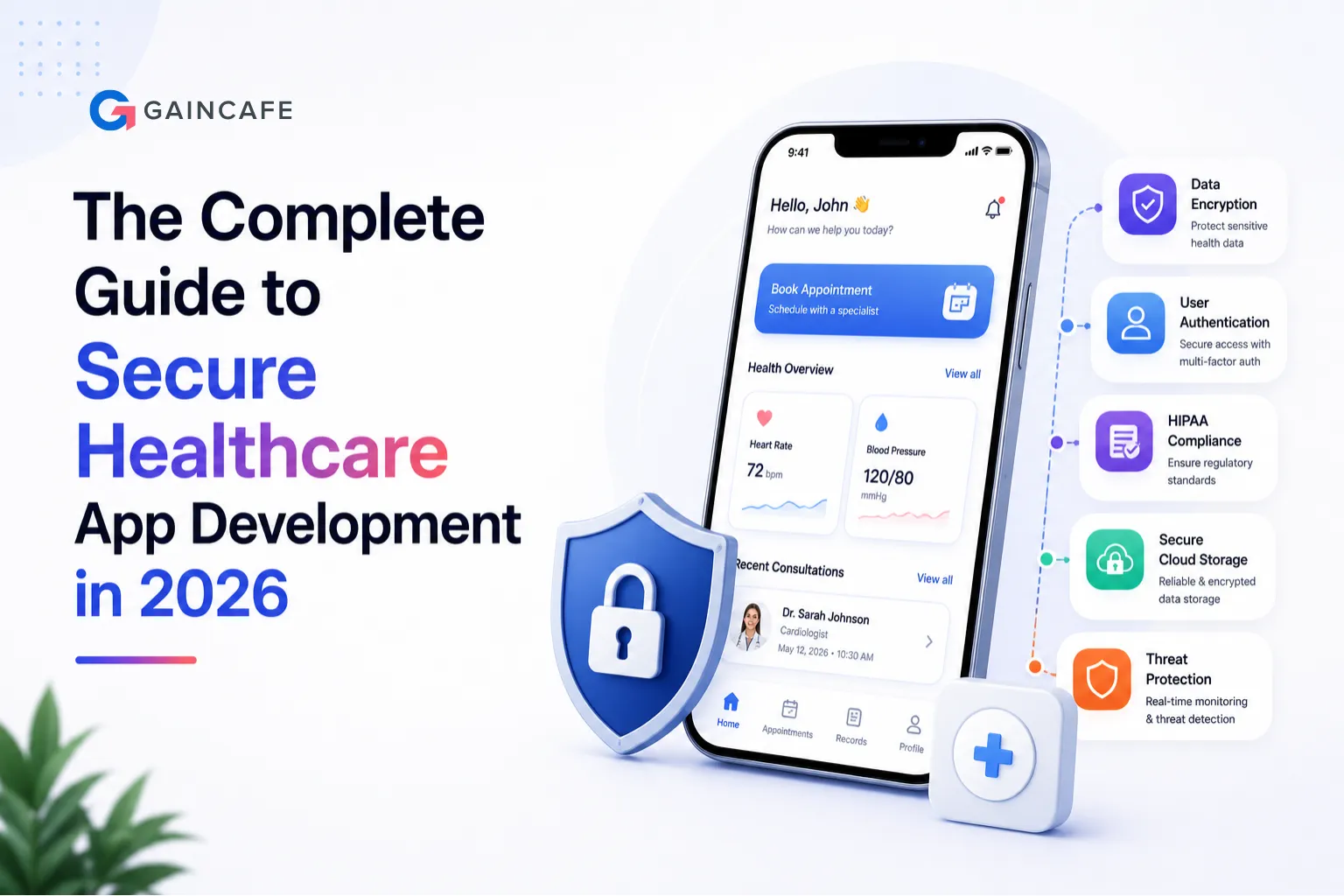
Healthcare data is the most valuable, most targeted, and most regulated category of personal information in the world. In 2026, a single healthcare data breach costs an organization an average of $7.42 million, making it the costliest industry for breaches for the fifteenth consecutive year according to IBM's Cost of a Data Breach Report.
Yet the demand for digital health solutions has never been stronger. Telehealth platforms, remote patient monitoring apps, AI-powered diagnostic tools, and patient engagement portals are reshaping how care is delivered across every continent.
The tension is clear: businesses need to build healthcare apps fast, but security cannot be an afterthought. This guide covers everything decision-makers, product teams, and developers need to know about secure healthcare app development in 2026, from compliance frameworks and architecture choices to cost breakdowns, technology stacks, and future trends.
What Is Secure Healthcare App Development?
Secure healthcare app development is the practice of designing, building, and maintaining mobile and web applications for the healthcare industry using security-first principles, regulatory compliance standards, and privacy-by-design architecture.
It goes far beyond standard mobile or web development. Every design decision, data flow, API integration, authentication mechanism, and third-party dependency must be evaluated across critical layers that directly impact both compliance and patient safety.
- Regulatory compliance: Ensuring adherence to frameworks like HIPAA, GDPR, and regional healthcare laws
- Patient data protection: Safeguarding sensitive health data through encryption, access control, and secure storage
- Auditability: Maintaining detailed logs and traceability for every data interaction
- Clinical safety: Ensuring the app does not introduce risks to patient care or medical decision-making
A healthcare app that skips any of these layers is not simply a compliance risk. It is a direct patient safety risk.
Planning a healthcare app?
Start with a compliance-ready architecture to avoid costly rebuilds.
Why Secure Healthcare App Development Matters More Than Ever
The Threat Landscape Is Accelerating
The urgency around secure healthcare app development is growing rapidly. In a single year, 725 large healthcare breaches were reported in the United States alone, nearly two incidents per day. The average cost of a breach reached $7.42 million, the highest across any industry globally.
While these numbers are global, enforcement risks are highest in regions with strict healthcare data regulations, including the United States, the European Union, the United Kingdom, Australia, and GCC countries building national digital health frameworks.
Nearly half of breached healthcare organizations increase prices to recover losses, with around one-third raising costs by 15% or more. A security failure does not stay technical, it becomes a direct financial burden on patients and payers.
Regulators Are Actively Tightening Enforcement
In 2025 and continuing into 2026, regulators have shifted their approach. The U.S. Department of Health and Human Services (OCR) now focuses on proactive compliance audits instead of reacting only after breaches occur.
Recent enforcement data shows that 76% of penalties were issued due to missing or inadequate risk analysis. This makes the absence of a documented security assessment the most common compliance failure in healthcare app development.
Globally, the European Union's GDPR imposes fines of up to 4% of annual global revenue for violations involving health data. For companies building international products, meeting both HIPAA and GDPR requirements is no longer optional.
AI Is Creating New Security Challenges
The rise of AI is adding a new layer of complexity to secure healthcare app development. The AI healthcare market is growing at nearly 39% annually and is expected to reach $37 billion.
However, AI systems introduce new security risks, including:
- Model inversion attacks exposing sensitive training data
- Data poisoning that corrupts model outputs
- Adversarial inputs designed to manipulate predictions
Any healthcare application integrating AI must now include model security governance as a core part of its architecture, not an afterthought.
Key Benefits of Investing in Secure Healthcare App Development
Healthcare organizations that treat security as a core product feature, not a compliance checkbox, consistently outperform those that treat it as an afterthought. The impact of secure healthcare app development is measurable across revenue, operations, and patient outcomes.
1. Dramatically Lower Breach Costs and Legal Liability
A healthcare data breach is not just an IT incident. It is a financial crisis. The average cost per breach is $7.42 million, covering detection, escalation, lost business, regulatory penalties, and post-breach response.
Organizations that implement AI-driven security and automated monitoring during development reduce this risk significantly. Studies show cost reductions of up to $1.76 million per breach and faster containment times.
Security built into the architecture from day one costs far less than recovering from a breach after launch.
2. Faster Time to Market Without Compliance Rework
One of the biggest advantages of secure healthcare app development is speed at scale.
Teams that integrate HIPAA and GDPR compliance during development avoid delays caused by late-stage audits, redesigns, and vendor rework. Instead of rebuilding systems mid-project, they launch with confidence.
The result is a faster, more predictable go-to-market timeline.
3. Access to Enterprise Healthcare Contracts
Healthcare enterprises do not work with vendors that lack compliance maturity. This is not optional, it is a requirement.
Applications built with HIPAA-compliant architecture, proper BAAs, and certifications like SOC 2 Type II can qualify for enterprise contracts that are otherwise inaccessible.
4. Patient Trust Directly Drives Retention and Adoption
Security failures erode trust instantly. Many healthcare organizations raise prices after breaches, and patients respond by switching providers.
On the other hand, apps that clearly communicate security measures achieve higher onboarding rates and stronger retention.
In digital health, trust directly impacts growth metrics like retention and lifetime value.
5. Regulatory Confidence Across Multiple Markets
Expanding across regions requires compliance with multiple frameworks like HIPAA and GDPR.
A security-first architecture allows your product to scale globally without rebuilding compliance for every new market. This creates a significant competitive advantage for startups and enterprise platforms alike.
6. Reduced Operational Disruption from Cyberattacks
Cyberattacks in healthcare do more than expose data. They disrupt clinical operations, delay care, and trigger investigations.
Secure development practices such as network segmentation, encryption, and strict access control reduce the impact of these attacks.
The goal is not zero incidents. The goal is controlled impact.
7. Stronger Investor and Partner Confidence
Security maturity is now a key factor in investor due diligence for healthcare startups.
Teams that demonstrate compliance readiness, documented risk analysis, and secure architecture signal execution strength and reduce perceived risk.
This also improves partnerships with hospitals and insurance providers, who require compliance validation before integration.
Need HIPAA-compliant development?
We build secure healthcare apps ready for production.
Core Compliance Frameworks for Healthcare App Development
Understanding the regulatory landscape is the foundation of any HIPAA compliant app development company engagement. Choosing the wrong framework scope at the start is one of the most common and costly errors in healthcare projects.
HIPAA
Applies to any application handling Protected Health Information (PHI) for U.S. patients or U.S.-based covered entities. Three rules govern app development: the Privacy Rule (use and disclosure of PHI), the Security Rule (technical, physical, and administrative safeguards for electronic PHI), and the Breach Notification Rule (mandatory notification within 60 days of discovery).
GDPR
Applies to any app processing health data of EU residents, regardless of where the business is registered. Key requirements include lawful basis for processing, data minimization, right to erasure, right to data portability, and data protection by design and by default.
HL7 FHIR
The modern API standard for healthcare data exchange. FHIR-compliant apps connect securely to Electronic Health Record (EHR) systems, insurance databases, and clinical workflows. For any telehealth platform development project, FHIR R4 is now the baseline expectation.
FDA SaMD Guidelines
Apps performing clinical decision support, diagnostics, or treatment recommendations may qualify as Software as a Medical Device and require FDA 510(k) clearance or De Novo classification. Medical device software development services must incorporate clinical validation and regulatory submission planning from the very start of the project.
Compliance Framework Comparison Table
| Framework | Scope | Primary Requirement | Penalty for Violation |
|---|---|---|---|
| HIPAA | U.S. PHI | Technical and administrative safeguards for electronic PHI | Up to $1.9M per violation category per year |
| GDPR | EU health data | Lawful basis, data minimization, privacy by design | Up to 4% of global annual revenue |
| HITRUST CSF | Global | Unified security framework for healthcare | Loss of certification and enterprise contracts |
| SOC 2 Type II | Global B2B | Trust Service Criteria: security, availability, confidentiality | Loss of enterprise procurement eligibility |
| FDA SaMD | U.S. clinical apps | Clinical validation and risk classification | Product recall and market withdrawal |
| ISO 27001 | Global | Information security management system | Certification withdrawal and loss of regulated contracts |
Key Features of a Secure Healthcare App
The following features are non-negotiable in any production-grade healthcare application, whether built as a telehealth platform, patient portal, remote monitoring solution, or custom medical software for startups.
Authentication and Access Control
- Multi-factor authentication (MFA) for all user roles and access levels
- Role-Based Access Control (RBAC): patients, providers, and administrators see only what they are authorized to access
- Single Sign-On (SSO) integration for enterprise hospital and clinic deployments
- Biometric authentication support for mobile apps handling clinical data on device
End-to-End Encryption
All data must be encrypted at rest (AES-256) and in transit (TLS 1.3). This applies to API calls, database storage, file attachments such as lab reports and imaging files, and push notifications. Encryption is a HIPAA Security Rule baseline requirement, not an optional enhancement.
Secure API Architecture and EHR Integration
Secure FHIR APIs now enable real-time EHR connectivity, automated insurance verification, and seamless transitions between health networks. Every API endpoint must be authenticated, rate-limited, versioned, and monitored for anomalous access patterns.
Audit Logging and Activity Monitoring
Every PHI access event must be logged with user ID, timestamp, action type, and data accessed. This is mandated by HIPAA and serves as the primary evidence base in OCR breach investigations. Logs must be tamper-evident and retained for at least six years.
Secure Messaging and Telehealth Modules
Patient-provider communication channels must use end-to-end encryption. Video consultation modules require HIPAA Business Associate Agreements with every third-party provider used, whether Twilio, Daily.co, Vonage, or any other platform.
Data Residency and Backup Controls
Healthcare data must be stored in jurisdictionally appropriate regions with tested backup and recovery procedures. Recovery Time Objective (RTO) and Recovery Point Objective (RPO) must be defined and contractually documented before launch.
Technology Stack for Secure Healthcare App Development
| Layer | Options | Security Considerations |
|---|---|---|
| Frontend (Mobile) | React Native, Flutter, Swift (iOS), Kotlin (Android) | Secure local storage, certificate pinning, jailbreak detection |
| Frontend (Web) | React.js, Next.js, Angular | CSP headers, XSS protection, HTTPS enforcement, no PHI in localStorage |
| Backend | Node.js, Django (Python), Spring Boot, FastAPI | Input validation, rate limiting, dependency scanning, least privilege |
| Database | PostgreSQL, Amazon Aurora, MongoDB (encrypted) | Encryption at rest, field-level PHI encryption, audit logging |
| Cloud Platform | AWS HIPAA-eligible, Azure Health Data Services, GCP Healthcare API | BAA availability, compliance documentation, managed access controls |
| Authentication | Auth0, Okta, AWS Cognito (HIPAA-eligible) | MFA enforcement, token rotation, brute force lockout policies |
| API Standard | FHIR R4, HL7 v2/v3 | Authenticated access only, payload validation, versioned endpoints |
| Real-Time Comms | WebSockets over TLS, Twilio (HIPAA BAA), Daily.co | Encrypted channels, session expiry, recording consent controls |
Step-by-Step: The Secure Healthcare App Development Process
A structured, security-integrated development lifecycle is essential. Skipping phases or reordering steps is where most compliance failures and budget overruns originate.
- Define Compliance Scope and Risk Profile: Before writing a single line of code, map all data flows. Identify what PHI the app will handle, where it will be stored, who will access it, and which regulatory frameworks apply. This documented risk analysis is not only best practice. In 2026, it remains the number-one basis for OCR enforcement penalties.
- Select a Compliant Cloud Architecture: Design security zones, data isolation layers, encryption hierarchies, and access control models before development begins. Confirm cloud BAA availability, data residency region requirements, and disaster recovery architecture at this stage.
- Hire Dedicated Developers With Healthcare Experience: The only way to ensure security is baked in is to bring on engineers with real healthcare project experience. Retrofitting compliance after launch is expensive, slow, and often structurally impossible. Whether you build in-house or engage a specialist firm, always prioritize healthcare domain expertise.
- Implement Security Controls During Development: Apply the OWASP Mobile Security Testing Guide and OWASP API Security Top 10 throughout the development cycle. Integrate Static Application Security Testing (SAST) and Software Composition Analysis (SCA) tools directly into the CI/CD pipeline.
- Conduct Penetration Testing and Security Audits: Penetration testing exposes vulnerabilities before attackers do. All findings must be remediated before production launch. This step is where most teams discover misconfigured access controls, insecure API endpoints, and unencrypted data in transit.
- Clinical Validation (If Applicable): For apps featuring clinical decision support, diagnostics, or therapy recommendations, qualified medical professionals must validate outputs for accuracy and clinical safety before any patient-facing deployment.
- Execute BAAs and Regulatory Approvals: Obtain signed Business Associate Agreements from every vendor handling PHI. FDA SaMD apps require formal regulatory clearance with full documentation before launch.
- Phased Deployment and User Training: Deploy in stages to allow clinical staff and patients to adapt. Prepare comprehensive training materials for every user role. Monitor for unexpected usage patterns in the first 30 days.
- Ongoing Monitoring, Maintenance, and Compliance Audits: Security is not a launch milestone. Schedule quarterly penetration tests, annual risk analyses, and continuous activity log monitoring. Maintain documentation for at least six years under HIPAA requirements.
Healthcare App Development Cost Breakdown (2026)
| App Type | Estimated Cost | Key Cost Drivers |
|---|---|---|
| Basic HIPAA-compliant health tracker | $30,000 - $80,000 | Secure auth, basic EHR sync, compliance documentation |
| Telehealth platform development | $80,000 - $200,000 | HIPAA-compliant video, appointment booking, EHR integration |
| Patient portal with EHR integration | $100,000 - $250,000 | FHIR APIs, multi-role RBAC, audit logging, BAA setup |
| Remote patient monitoring app | $150,000 - $350,000 | IoT/wearable integration, real-time alerting, clinical dashboards |
| Custom medical software for startups (AI-enabled) | $200,000 - $600,000 | AI/ML model security, clinical validation, SaMD scope assessment |
| Full-scale hospital management system | $500,000 - $2M+ | Enterprise architecture, HL7 integrations, multi-site deployment |
Additional security-specific costs to factor into every project budget:
- Annual penetration testing: $10,000 to $40,000
- HIPAA compliance consulting and BAA setup: $5,000 to $25,000
- SOC 2 Type II audit: $30,000 to $100,000
- Ongoing SIEM/SOAR security monitoring: $2,000 to $10,000 per month
Development in the UAE and GCC region frequently delivers 30 to 50% cost advantages over equivalent U.S. or EU rates while maintaining full HIPAA and GDPR compliance equivalence.
Industry Trends Shaping Secure Healthcare App Development in 2026
AI-Powered Security Automation
AI-driven cybersecurity tools reduce breach lifecycles by 108 days on average and save organizations $1.76 million per incident compared to those relying on manual detection. (IBM, 2025 Cost of a Data Breach Report)
AI is simultaneously the most powerful capability and the most dangerous new attack surface in healthcare technology. Any development team building AI features into custom medical software must implement model governance frameworks alongside the standard security controls.
Zero-Trust Architecture Becoming the Baseline
Traditional perimeter-based security is insufficient for multi-cloud, multi-device healthcare environments. Zero-trust frameworks that verify every user, every device, and every request regardless of network location are becoming the standard expectation in enterprise healthcare procurement.
Blockchain for Immutable Health Records
Early-adopter healthcare organizations are using blockchain-based data verification for audit trails and patient-controlled health record sharing. While still maturing, this technology provides immutable logging that eliminates one of the most common healthcare breach scenarios: internal PHI manipulation with no traceable audit record.
IoMT Security as a First-Class Requirement
Applications integrating wearables, continuous glucose monitors, and cardiac sensors must implement per-device authentication, encrypted data pipelines, and standardized patching protocols. IoT remains the most vulnerable attack surface in healthcare environments without standardized security governance.
Privacy-Preserving AI via Federated Learning
Healthcare organizations are adopting federated learning models that train AI on decentralized datasets, keeping patient data on the originating device or server. This enables powerful diagnostic capabilities while fully satisfying GDPR data minimization requirements.
Common Mistakes in Healthcare App Development
Even experienced development teams make costly security errors in healthcare projects. These are the mistakes most commonly identified in post-breach OCR investigations and pre-launch security audits.
- Starting development without a documented risk analysis: Compliance cannot be retrofitted. The risk analysis defines every downstream architectural decision.
- Using non-HIPAA-compliant third-party SDKs: Every analytics SDK, push notification service, and chat integration must have a signed BAA if it touches PHI. This includes marketing and analytics tools that were not originally designed for healthcare.
- Hardcoded credentials and API keys: One of the most common vulnerabilities discovered during penetration tests on healthcare apps. Secrets must be managed through environment variable systems and rotated regularly.
- Over-collecting patient data: Collecting more data than necessary directly violates GDPR's data minimization principle and increases breach exposure surface with no clinical benefit.
- Skipping penetration testing before launch: Many teams skip this under budget pressure. The average cost of a post-breach penetration test finding is orders of magnitude greater than the cost of the test itself.
- Treating compliance as a launch deliverable: HIPAA and GDPR require continuous security management. An annual risk analysis, ongoing monitoring, and documented incident response plans are ongoing operational requirements.
- Ignoring mobile-specific threat vectors: Healthcare apps face threats that web-only security models miss: jailbroken device PHI access, screenshot leakage in app switchers, insecure local storage, and certificate-stripping attacks on public WiFi networks.
Best Practices for Secure Healthcare App Development
- Privacy by design
- Layered, context-aware authentication
- Automated compliance monitoring
- Aggressive dependency management
- Human-factor security training
- Documented incident response before launch
Ready to build securely?
Launch a compliant healthcare product with expert developers.
Ready to Build a Secure Healthcare App?
Building a healthcare app without the right security architecture is not a risk any organization can afford. A single breach at scale can cost more than $7 million, expose sensitive patient data, and permanently damage the trust that healthcare businesses take years to build.
Partnering with a development team that specializes in secure healthcare app development from day one means compliance is built into the architecture, enterprise procurement audits are passed with confidence, and you reach market faster with fewer mid-project corrections.
Whether you need a telehealth platform, a patient engagement app, remote monitoring software, or custom medical software for startups, the right technical partner reduces both your timeline and your regulatory risk exposure simultaneously.
Gaincafe Technologies delivers HIPAA-compliant, GDPR-ready, security-first healthcare applications built for real-world clinical environments. Our Custom Software Development Services cover the full product lifecycle, from architecture and compliance planning through launch, certification, and ongoing maintenance.
We also offer flexible engagement models. If you need specialist healthcare security engineers integrated into your existing team rather than a full project engagement, our Hire Dedicated Developers model lets you bring on vetted, healthcare-experienced engineers on demand.
Contact our team today to discuss your healthcare app project. We will assess your compliance scope, technology requirements, and budget constraints and provide a clear, risk-mapped development roadmap within 48 hours.