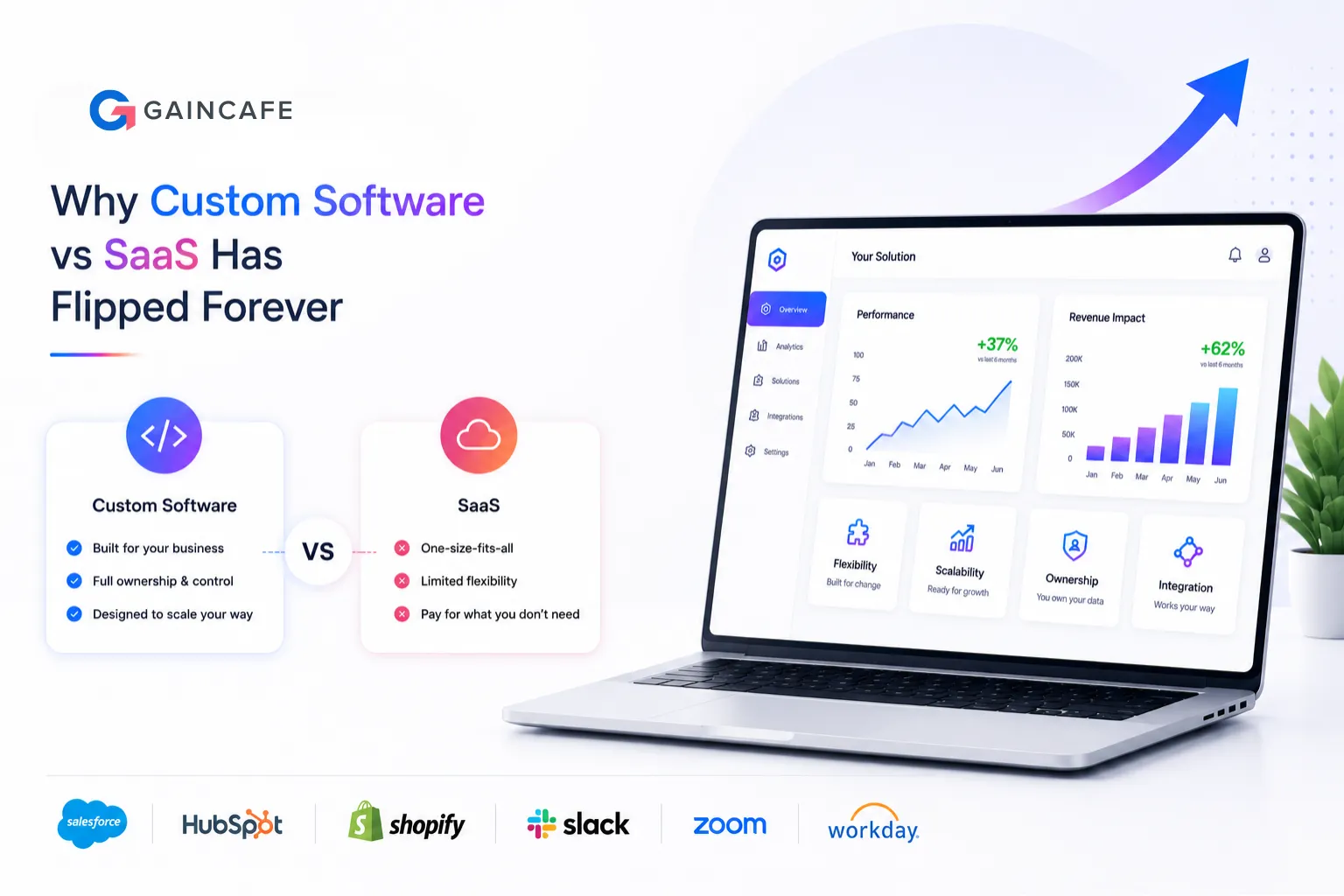
The custom software vs SaaS debate did not just shift in 2026, it inverted entirely. For two decades, buying SaaS was the safe default. Building custom was the expensive exception that only Fortune 500 companies could afford.
Then February 2026 happened. In a single trading session, $300 billion in market value evaporated across software stocks. By mid-March, the iShares Expanded Tech-Software ETF was trading 20% below its 200-day moving average, the widest such gap since the dot-com crash of 2000. Tech media named the moment the SaaSpocalypse.
This article walks through what actually happened, why custom software ownership has never made more economic sense, and the framework every founder and CTO should use to decide their next software investment in 2026.
What Is the SaaSpocalypse and Why Did It Happen in 2026?
Quick answer: The SaaSpocalypse refers to the dramatic 2026 collapse in SaaS company valuations and the structural shift away from off-the-shelf software toward custom, AI-built alternatives. It was triggered by Anthropic's Claude Cowork launch in January 2026, accelerated by autonomous AI agents that bypass traditional SaaS interfaces, and confirmed by over $1 trillion in software market value wiped out within weeks.
The trigger was specific. In late 2025 and early 2026, autonomous coding agents like Claude Code and OpenAI's Frontier Agent demonstrated something fundamental. Software that previously required a $500,000 budget and a team of engineers could now be built for under $20,000 in a fraction of the time.
When that capability went mainstream, the entire economic logic of SaaS started to crack.
The $1 Trillion Wake-Up Call: How SaaS Lost Its Moat Overnight
The numbers are direct. By February 2026, more than $1 trillion in SaaS valuations had been wiped out. Salesforce, Workday, ServiceNow, and Atlassian saw stock declines ranging from 20% to 46%. Intuit alone lost 46% from peak as AI-driven bookkeeping and tax automation made manual data entry software largely redundant.
The performance gap between AI winners like NVIDIA and Palantir versus legacy SaaS reached 95 percentage points in 12 months. Analysts called it a "Bits to Atoms" rotation. For years software was eating the world. In 2026, AI started eating the software.
The Three Forces Behind the Collapse
Three structural forces converged at once:
- AI agents bypass user interfaces: Autonomous AI executes business workflows directly via APIs, making the traditional SaaS UI a redundant middle layer
- Vibe coding commoditises code: Founders prompt-build internal tools in days, eroding the development moat SaaS once charged a premium for
- Build economics flipped: When custom software costs drop from $500K to $20K, the rent-versus-own calculation no longer favours subscription
This is why the build vs buy software 2026 conversation moved from "buy by default" to "build where it matters" almost overnight.
Evaluating whether to build or buy software in 2026?
We help founders and CTOs audit SaaS spend, identify replacement candidates, and design scalable custom software systems.
Book a Build vs Buy Strategy CallCustom Software vs SaaS in 2026: The Economics Have Flipped
Quick answer: In 2026, the total cost of SaaS ownership often runs 2.5x to 4x the headline subscription price once integration, configuration, training, vendor lock-in, and per-seat scaling are counted. Custom software, accelerated by AI tooling, now delivers comparable functionality for $30,000 to $500,000 with full IP ownership and zero recurring vendor fees.
The shift is not theoretical. It is showing up in budget conversations across every mid-market company in 2026.
Why SaaS Made Sense Before 2025
For two decades, SaaS solved a real problem. Building custom software required teams of engineers, 12 to 18 month timelines, and budgets starting at $200,000 for anything serious. Spreading those costs across thousands of customers through a subscription model was rational economics.
Customers got 80% of what they needed at 10% of what it would have cost to build. SaaS vendors extracted recurring premiums for carrying the development burden. Both sides won.
The True Total Cost of SaaS: 2.5x to 4x the Headline Subscription
The headline subscription price is the visible cost. The hidden cost is everything else.
Implementation, integration with existing systems, training, configuration consultants, per-seat scaling as headcount grows, API tier upgrades, and data export fees during migration all stack on top. Industry data from 2026 shows the true total cost of mid-market SaaS ownership runs 2.5x to 4x the published subscription.
A 500-employee company spending $200,000 annually on visible SaaS subscriptions is often paying $500,000 to $800,000 in true total cost once everything is counted. Zylo's 2026 SaaS Management Index also reported AI-native app spending growing 108% year over year, layering even more cost into already bloated stacks.
Custom Software Cost in 2026: From $500K to $20K MVPs
The economics changed because the inputs changed. AI-assisted development tooling, modular cloud-native frameworks, and one-click deployment pipelines compressed timelines that used to take 18 months into 6.
A well-scoped production-grade custom application for a mid-market operator in 2026 costs $150,000 to $400,000 in year one, with roughly $30,000 to $80,000 per year in maintenance after that. Detailed cost ranges are broken down in our MVP Development Cost 2026 guide.
For year two and beyond, custom software has no per-seat subscription, no vendor renewals, and no annual price hikes. The compounding savings cross break-even somewhere between month 18 and month 36 for most mid-market scenarios.
📊 Stat Callout: By February 2026, the iShares Expanded Tech-Software ETF (BATS: IGV) was trading 20% below its 200-day moving average, the widest such gap since the 2000 dot-com crash. Intuit fell 46%, Workday 40%, and Atlassian 35% from their peaks. The carnage was concentrated where AI hit hardest: data entry, seat-based licensing, and standardised workflows that could be replicated by AI agents within days.
The Real Casualties: SaaS Giants That Lost Billions in 2026
Specific companies, specific numbers.
Intuit, Workday, Atlassian: The 35-46% Decline Club
The carnage was concentrated where AI hit hardest. Intuit shares fell 46% from peak as AI-driven bookkeeping rendered manual data entry redundant. Workday dropped 40% as enterprise headcount reductions from AI productivity gains erased seat-based licensing revenue. Atlassian fell 35% after reporting its first-ever systemic decline in enterprise seat counts in early 2026.
These were not speculative early-stage companies. These were established public software giants with billions in revenue and decades of market leadership.
Klarna's Bold Move: Why They Replaced Salesforce CRM With AI
The Klarna case study is now the textbook example. The company publicly replaced its Salesforce CRM deployment with a homegrown AI system, citing better fit for their workflows and substantial cost savings. Other enterprises took notice immediately.
By early 2026, an investor at One Way Ventures told TechCrunch that "the build versus buy decision is shifting toward build in so many cases." Sierra, Bret Taylor's AI startup competing directly with Salesforce in customer service, hit $100 million ARR in under two years by offering AI agents instead of SaaS subscriptions.
What This Means for Mid-Market Companies in India, UAE, and Beyond
The implications extend far beyond US public markets. Mid-market companies in India, the UAE, Australia, and the UK are running the same math. Software budgets are being cut by 30 to 40% as companies replace expensive enterprise SaaS with custom-built alternatives.
The conversation in boardrooms shifted from "which SaaS vendor do we choose" to "what should we build, what should we buy, and what should we replace."
Want to reduce SaaS spend without slowing growth?
We design AI-first custom software stacks that replace bloated SaaS subscriptions with scalable owned systems.
Request a SaaS Stack AuditBuild vs Buy Software in 2026: A Decision Framework for Founders
The build vs buy software 2026 question is no longer binary. The smartest decision in 2026 is rarely "all build" or "all buy." It is "build what matters, buy what is commodity, integrate ruthlessly."
When to Buy SaaS (And When It's Still the Right Call)
SaaS still wins for genuine commodity workflows. Email, accounting, payroll, basic communication tools, identity providers, and payment processing are all categories where the SaaS feature set is mature, the security is battle-tested, and there is zero competitive value in building your own.
If a process is identical across thousands of companies and offers no operational differentiation, paying a subscription is rational. Resist the urge to build everything just because you now can.
When Custom Software Wins: 7 Clear Signals
These are the situations where custom software delivers the strongest ROI:
- Your workflow encodes proprietary business logic that defines your competitive advantage
- Off-the-shelf SaaS forces you to adapt your processes rather than support them
- You operate in a regulated industry requiring strict data sovereignty (healthcare, fintech, legal)
- Your SaaS true total cost has crossed $200,000 per year for a single category
- Vendor lock-in is preventing you from integrating with the systems that actually matter
- Your roadmap is blocked by a SaaS vendor's product priorities
- Your data is your moat and a multi-tenant SaaS architecture is creating exposure risk
If three or more apply, custom software ownership likely wins on a 5-year ROI basis.
The Hybrid Approach: Why Most 2026 Winners Use Both
The strongest 2026 strategy is hybrid. Buy SaaS for identity, billing, and communications where commodity wins. Build a custom domain layer that encodes the business rules unique to you. Expose that custom layer via APIs to internal tools, customer portals, and mobile applications.
This keeps speed on commodity components and control where it actually matters.
| Approach | Best For | Cost Profile | Time to Value | Long-Term Control |
|---|---|---|---|---|
| Buy SaaS | Commodity workflows (email, accounting, payroll) | Low upfront, high recurring | Days to weeks | Low (vendor-dependent) |
| Build Custom | Core differentiation, regulated data, proprietary logic | Medium upfront, low recurring | 6 to 16 weeks | High (full ownership) |
| Hybrid | Most mid-market companies in 2026 | Balanced | Phased over 3 to 6 months | High where it matters |
Why Custom Software Is the Smartest Investment of 2026
Three converging trends make 2026 the inflection point.
Data Sovereignty and IP Ownership in the AI Era
Every piece of operational data running through SaaS in 2026 is potential training data, potential competitive intelligence, and potential regulatory exposure. Multi-tenant SaaS architectures cannot fully isolate your data from vendor systems, vendor analytics, or vendor AI training pipelines.
For UAE companies under the AI Act 2026 framework, healthcare organisations under HIPAA, fintech operators under regional banking regulations, and any business whose data represents proprietary value, custom software development 2026 is the only architecture that preserves true data sovereignty.
Custom Software Builds Competitive Moats SaaS Cannot
A custom system that encodes how your team actually works, how your customers actually buy, and how your operations actually run is a defensible asset. Your competitors cannot subscribe to it. Your AI competitors cannot replicate it from a screenshot.
A SaaS subscription is an operating expense with no residual value. A custom-built application is a depreciable asset that compounds in strategic value as your business grows.
The 5-Year ROI Reality
Run the math over five years.
| Cost Category | Mid-Market SaaS (5-year) | Custom Software (5-year) |
|---|---|---|
| Year 1 cost | $200,000 (subscription) + $300,000 (true TCO add-ons) | $250,000 (build + first-year ops) |
| Year 2-5 annual | $250,000 to $400,000 (with seat growth) | $50,000 to $80,000 (maintenance) |
| 5-year total | $1.5M to $2.1M | $450,000 to $570,000 |
| End-state asset value | $0 (no IP) | Owned codebase + competitive moat |
| Vendor risk | High (renewal hikes, lock-in) | Zero |
Numbers are illustrative for a 500-employee mid-market scenario. Detailed scoping is available through Gaincafe's discovery process.
Planning a custom software investment in 2026?
Get a realistic cost breakdown, architecture roadmap, and ROI projection tailored to your workflows.
Get a Custom Software EstimateHow to Replace SaaS With Custom Software: A Step-by-Step Path
Replace SaaS with custom software is a process, not an event. The path takes 3 to 9 months for most mid-market companies and runs in five clear phases.
Step 1: Audit Your Current SaaS Stack and Spend
The MuleSoft 2025 Connectivity Benchmark found the average enterprise runs 897 SaaS applications with only 29% integrated. Most leaders cannot name half of their stack accurately.
Pull every subscription, every renewal date, every per-seat cost, every integration fee, and every implementation cost from the last 12 months. Categorise by commodity vs differentiating workflow.
Step 2: Identify Replacement Candidates Using the Strategic Importance Score
For each SaaS tool, score on two dimensions, 1 to 5:
- Strategic importance: How central is this workflow to your competitive advantage?
- Workflow uniqueness: How much does your version of this workflow differ from a generic implementation?
Anything scoring 8 or higher combined is a custom build candidate. Anything scoring 5 or lower stays SaaS. The middle band is hybrid territory.
Step 3: Choose Your Build Method
Three primary build methods exist in 2026:
- AI-first vibe coding with Lovable, Bolt, Replit for speed (best for MVPs and internal tools, requires senior engineering oversight before production)
- Hybrid AI-assisted development with Cursor, Claude Code, and senior engineers (best for production-grade business applications)
- Traditional custom development for highly regulated, mission-critical, or large-scale systems
For tool selection guidance, our Top 10 Vibe Coding Tools breakdown covers what each tool actually delivers in 2026.
Step 4: Plan a Phased Migration
Phase migration over 3 to 6 months. Run new custom systems in parallel with existing SaaS. Migrate users in waves. Keep historical data accessible. Set explicit cutover dates with rollback paths.
The fastest way to fail is a "big bang" replacement. The fastest way to succeed is incremental confidence building.
Step 5: Production-Hardening and Ongoing Maintenance
This is the step most teams underestimate. AI-built custom software needs the same production hardening as any other system. Security review, RLS, observability, CI/CD, and load testing are non-negotiable. Our Scale Vibe Coded App guide covers this in depth.
Need help replacing expensive SaaS with custom systems?
We build phased migration roadmaps that reduce risk, protect operations, and preserve your existing workflows.
Plan a SaaS MigrationReal-World Example: How One Mid-Market Company Cut SaaS Spend by 60%
The pattern is consistent across our 2026 client base.
The Problem: 897 Apps, Only 29% Integrated
A mid-market logistics company came to Gaincafe in early 2026. Annual SaaS spend across their stack had crossed $480,000. They were paying for redundant CRM, project management, internal communication, document management, and analytics tools that did not talk to each other.
Their integration team spent more hours connecting tools than running operations. The classic 897-app problem at smaller scale.
The Custom Software Solution Stack They Built
We ran the strategic importance audit. Email, accounting, and payroll stayed SaaS. Their core operations management workflow, their customer portal, and their internal logistics tracking all scored 8 or higher and became custom builds.
Built on Next.js, Supabase, and a custom integration layer over 14 weeks. Total build cost: $185,000.
The 12-Month Outcome
- SaaS spend reduced from $480,000 to $190,000 annually (a 60% cut)
- Integration headcount redeployed to revenue-generating work
- Custom system fully owned, no vendor renewals, no per-seat cost growth
- Break-even on custom investment achieved at month 11
💡 Expert Insight (Senior Software Architect, Gaincafe) "The SaaSpocalypse is not about SaaS dying. It is about SaaS losing its right to charge premium prices for non-differentiating workflows. Companies that audit their stack honestly almost always find 30 to 50% of subscriptions could be replaced or eliminated. That is real money sitting on the table, and 2026 is the first year where the build economics genuinely support acting on it."
Custom Software Development in 2026: What Has Actually Changed
The reason custom is winning in 2026 is not philosophical. It is technical.
AI-Assisted Development Has Compressed 18-Month Builds Into 6
Custom builds that took 18 months in 2023 routinely ship in 6 months in 2026. AI-assisted development handles boilerplate, scaffolding, and repetitive integration work. Senior engineers focus on architecture, security, and business-critical logic.
The cost compression is proportional. A serious production application that cost $400,000 in 2023 typically costs $150,000 to $200,000 in 2026.
The New Tech Stack: Next.js, Supabase, Stripe, AI-Powered Workflows
The most popular 2026 stack for custom applications is Next.js for the frontend and APIs, PostgreSQL via Supabase or Neon for the database, Stripe for payments, Clerk or Auth.js for authentication, and Vercel or Railway for deployment. This stack covers approximately 90% of mid-market application requirements with strong community support and the largest ecosystem of starter kits.
Senior Engineering Oversight: The Critical Layer AI Tools Skip
Here is where the AI shortcut breaks. Veracode's 2025 GenAI Code Security Report found that 45% of AI-generated code samples contain OWASP Top 10 vulnerabilities. Without senior engineering oversight, custom builds inherit the same security risks that took down vibe-coded apps in 2026 breach reports.
This is exactly why Gaincafe pairs every AI-accelerated build with senior Lovable and full-stack engineers who harden the foundation before production.
Building with AI tools but worried about production quality?
Our senior engineers harden AI-generated codebases for security, scalability, and long-term maintainability.
Hire Senior AI EngineersSaaSpocalypse-Proof: Why Gaincafe Builds Custom Software That Lasts
Gaincafe Technologies is built specifically for this moment.
12 Years of Senior Engineering Experience Across 500+ Projects
We have shipped 500+ projects, hold a 5.0 Upwork rating, and serve clients across India, the UAE, Australia, the USA, and the UK. Our team has been building production-grade custom software for over a decade. The shift to AI-assisted development is an acceleration of what we already do, not a replacement.
AI-First Speed Without the AI-First Failure Modes
We use Lovable, Cursor, Bolt, Claude Code, and Replit aggressively for speed. We never ship AI-generated code to production without senior engineering review. That combination is what makes the difference between a 6-week prototype and a 6-week production-ready application.
Full Code Ownership, Zero Vendor Lock-In, Long-Term Maintenance
Every Gaincafe custom build comes with full source code ownership, complete documentation, and ongoing maintenance options. You own the asset. You own the data. You own the roadmap.
Our full Custom Software Development Services page covers scope, engagement models, and example case studies in detail.
💡 Pro Tip (Engineering Lead, Gaincafe) "Founders ask us if AI tools mean cheaper custom software. The honest answer is yes for the build phase and no for the engineering discipline phase. The market is full of agencies offering $30,000 production apps that are actually $30,000 prototypes. The hardening, security review, and architecture work is what separates a real custom build from a pretty demo."
The 2026 Custom Software Investment Calculator
Concrete numbers for budget planning.
What a Custom Build Actually Costs in 2026
| Tier | Use Case | Year 1 Cost | Annual Maintenance |
|---|---|---|---|
| Startup MVP | Validate idea, ship to first 1,000 users | $30,000 to $80,000 | $10,000 to $20,000 |
| Growth-Stage Product | Production-grade, scaling to 10,000+ users | $80,000 to $250,000 | $20,000 to $50,000 |
| Mid-Market Enterprise | Multi-tenant, regulated, integrated | $250,000 to $500,000+ | $50,000 to $100,000 |
| Large Enterprise Platform | Mission-critical, multi-region, complex compliance | $500,000 to $2M+ | $100,000+ |
How to Calculate Break-Even vs Continuing SaaS Subscriptions
Simple formula:
Break-even months = Custom build cost / Monthly SaaS cost being replaced
A $200,000 custom build replacing $30,000 per month in SaaS hits break-even at month 7. After that, every month is pure savings on top of asset ownership.
Red Flags: Signs Your Custom Software Quote Is Too Low
If a quote feels suspiciously cheap, it usually is. Watch for:
- No discovery phase or architecture document before development starts
- No explicit security review or hardening sprint included
- No CI/CD, testing, or observability work in the scope
- No senior engineer named on the project
- "Vibe coding only" with no production engineering layer
A real production-grade custom build for a mid-market operator does not credibly come in under $50,000 in 2026, regardless of AI tooling. Anything below that is a prototype, not a product.
For end-to-end build engagements, our MVP Development Services cover discovery, design, AI-accelerated build, hardening, and maintenance under a single agreement.
Conclusion: The SaaSpocalypse Is a Once-in-a-Decade Opportunity
Most market shocks create losers. The SaaSpocalypse is creating a specific kind of winner.
The custom software vs SaaS conversation in 2026 is not about choosing sides. It is about recognising that the economics that justified blanket SaaS adoption for two decades have fundamentally changed. Companies that audit their stack honestly, identify what genuinely differentiates them, and build custom where it matters are unlocking 30 to 60% cost savings while building durable competitive advantages.
The 2026 winners are not the companies that build everything. They are the companies that build the right things, buy the commodity things, and integrate ruthlessly across both.
If your SaaS spend has crossed $200,000 per year, if vendor lock-in is blocking your roadmap, or if your data sovereignty matters more than your subscription convenience, the audit is the next step. Talk to the Gaincafe team about a strategic build vs buy review and build a SaaSpocalypse-proof software foundation.