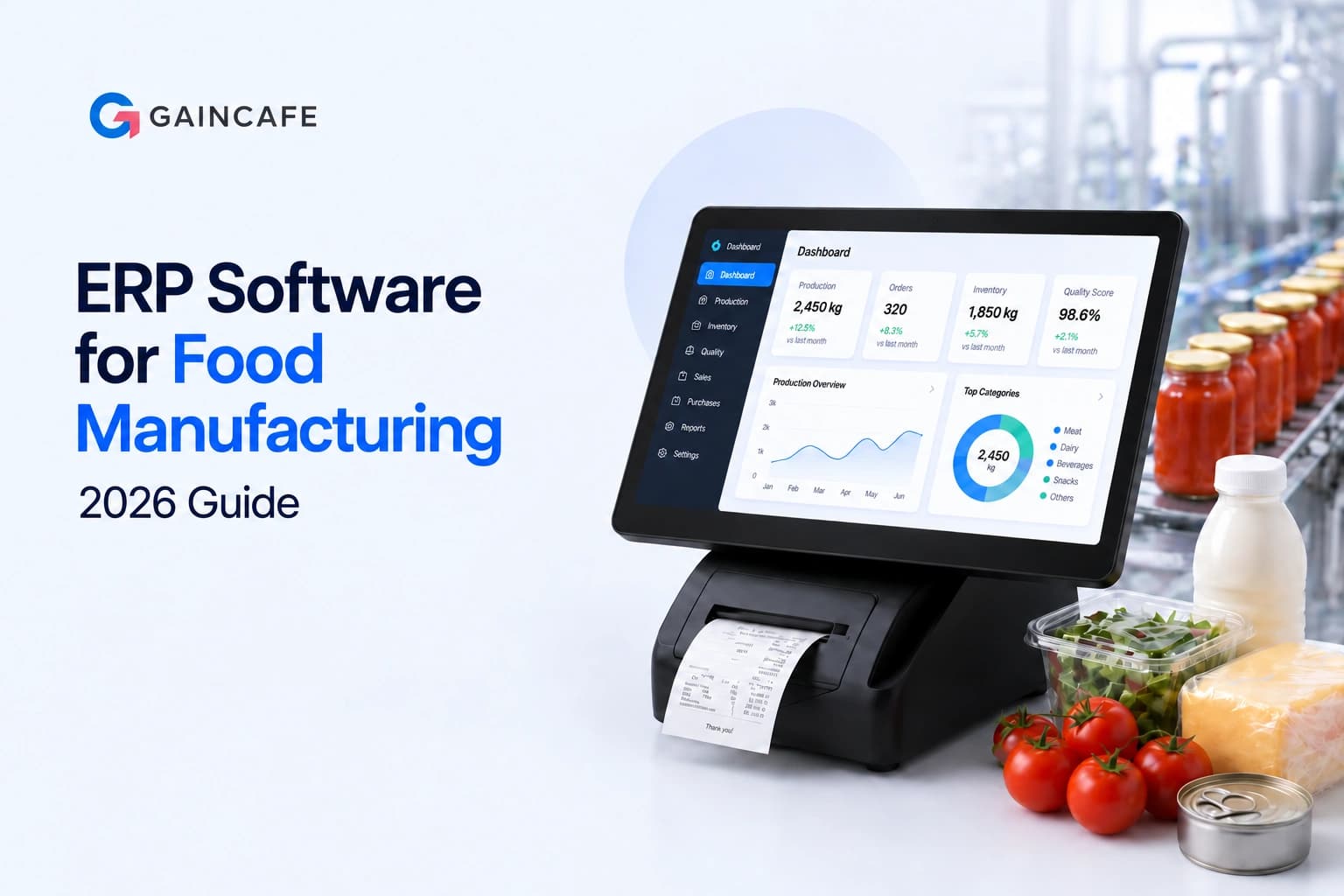
Food manufacturing operates at the intersection of biological reality, regulatory obligation, and razor-thin margins. A batch of cream that expires before your scheduled production run. A supplier ingredient recall that affects 14 finished SKUs already in distribution. A yield variance that has been quietly eroding margin for six months because nobody had the data to see it.
Generic enterprise software does not solve these problems. It was not designed to.
ERP software for food manufacturing is a purpose-built enterprise platform that connects procurement, production, inventory, quality control, compliance documentation, and finance into a single real-time data environment. The defining characteristic is not that it handles these functions. It handles them with the specific logic that food production requires: catch-weight variability, bi-directional lot traceability, formula version control, allergen management, and regulatory audit trails built in as core functionality rather than expensive customisations.
This guide covers what separates a genuine food-grade ERP from a generic platform, which systems lead the market in 2026, what implementation actually costs, and how to evaluate options against your specific operational reality.
The Critical Role of ERP for the Food and Beverage Industry
ERP for food and beverage industry operations solves a specific and costly problem: the disconnect between what is happening on your production floor and what your business systems know about it.
In a disconnected environment, a quality hold on a raw material lot is recorded on a clipboard in the goods-in bay. That information reaches production planning two hours later, by which point a batch has already been scheduled using the held ingredient. The hold reaches the warehouse team the following morning. By then, finished product containing the flagged lot has left the facility. Reconstructing the trace manually takes days. The regulatory clock is already running.
A food-grade ERP eliminates that disconnect. Every transaction from goods receipt to despatch updates the same data environment in real time. A quality hold placed at intake immediately updates inventory, adjusts production scheduling, triggers an alternative supplier purchase order, and creates an audit entry, automatically, without human relay.
The operational cost of staying on spreadsheets and legacy systems is measurable:
- Manual data entry error rates between 1% and 5% compound across every production stage
- Mock recall exercises that regulators expect to be completed within four hours take four days in manual environments
- Yield losses accumulate invisibly because no system connects raw material consumption to finished goods output
- Demand forecasting is intuition-based, leading to excess raw material purchasing and avoidable waste
- Regulatory audits consume weeks of manual documentation assembly that a connected system produces in hours
The food and beverage manufacturers growing fastest in 2026 share a common operational characteristic: their production floors generate real-time data and their systems turn that data into decisions before problems become crises.
Still managing operations on spreadsheets?
See how a food-grade ERP can eliminate manual errors and give you real-time visibility.
Core Features: What Makes a True Food-Grade ERP?
Compliance and Quality Control
A food-grade ERP manages regulatory compliance as an embedded operational function. It does not generate compliance reports at month-end. It creates compliance documentation as a byproduct of normal daily transactions.
Core compliance capabilities:
- HACCP plan management with critical control point monitoring and automated alerts when process parameters fall outside safe ranges
- FSMA documentation generated from operational data rather than assembled manually before an audit
- GFSI certification support through integrated supplier qualification workflows, certificate expiry tracking, and approved vendor management
- Allergen cross-contamination controls that trigger alerts when ingredient substitutions, production sequences, or shared equipment scheduling create allergen risks
- Certificate of Analysis management for incoming materials and outgoing finished goods with automated generation and digital storage
The commercial consequence of embedding compliance in operations rather than managing it as a separate administrative function is that audit preparation time drops from weeks to hours, and the risk of a compliance failure driven by missing or inaccurate documentation is essentially eliminated.
End-to-End Traceability
Bi-directional lot tracking is the technical capability that determines whether a recall is a manageable operational event or a business-threatening crisis.
Bi-directional means the system can trace in both directions simultaneously: from a finished goods lot back to every raw material it contains, and from a raw material lot forward to every finished product it entered and every customer location those products reached.
Why this matters at operational scale:
- A supplier flags a contamination risk on a specific ingredient delivery. Your system identifies all affected finished lots, all warehouse locations holding them, and all despatch records for that product, in minutes
- Mock recall exercises required under FSMA can be completed within the four-hour window that demonstrates genuine compliance readiness rather than the multi-day scrambles that manual systems produce
- Supply chain transparency extends upstream to document ingredient origin and handling history, meeting the chain-of-custody requirements increasingly demanded by major retail customers
Without bi-directional traceability native to your ERP, every recall scenario requires manual reconstruction under time pressure. With it, recall management becomes a system query, not an emergency investigation.
Process Automation
- Food manufacturing ERP automates the operational calculations that consume disproportionate management capacity in manual environments.
- Recipe and formula management handles production scaling automatically, converting master formulas to batch quantities without manual recalculation, maintaining version history on every formula change, and documenting modifications with a complete audit trail. When a regulatory inspector asks which version of a formulation was in production on a specific date, the system answers immediately.
- Yield tracking compares theoretical yield against actual output at every production stage, surfacing variance in real time. A 2% unexplained yield loss on a daily production run is invisible in a spreadsheet environment. In a food-grade ERP, it generates a variance alert within the shift and triggers investigation before the loss compounds.
- Automated inventory replenishment uses actual production consumption rates and supplier lead times to generate purchase orders before stockouts affect production continuity, replacing reactive purchasing with planned procurement.
- Catch-weight management handles the variable-weight reality of fresh meat, produce, and natural products where nominal and actual weights differ. Accurate catch-weight handling ensures that inventory valuation, customer invoicing, and yield calculations reflect actual rather than assumed product weights.
Need these features in your ERP?
We’ll map your requirements to the right ERP system with built-in compliance and traceability.
Comparing the Best ERP Software for Food Manufacturing in 2026
The best ERP software for food manufacturing in 2026 depends on your operation's scale, production category, and regulatory environment. These are the platforms consistently shortlisted by mid-market and enterprise food producers.
1. NetSuite (Oracle) NetSuite is the dominant cloud ERP for mid-market food manufacturers in the AUD 10M to AUD 500M revenue range. Its strengths are financial management depth, multi-site and multi-subsidiary support, and a broad third-party integration ecosystem. Food-specific functionality covers traceability, quality management workflows, and demand planning. Complex food manufacturing scenarios require configuration by a partner with genuine sector experience. Strong choice for manufacturers with significant distribution, finance, and multi-entity complexity.
2. Aptean Food and Beverage ERP Purpose-built exclusively for food and beverage manufacturers. Aptean carries the deepest native food manufacturing functionality of any platform: catch-weight management, formulation and recipe management, bi-directional lot traceability, and regulatory compliance frameworks are core product features rather than paid add-ons. Particularly strong for protein processing, bakery, dairy, and beverage operations. Less suited to operations with complex multi-channel retail distribution requirements.
3. Microsoft Dynamics 365 (Business Central and Finance and Supply Chain) Dynamics 365 offers strong integration with the Microsoft ecosystem, including Teams, Power BI, and Azure infrastructure. Food manufacturing functionality requires either the dedicated industry module or a certified partner extension. The Microsoft interface familiarity reduces end-user training time substantially. Food-specific depth is below Aptean but above generic ERP platforms. Strong choice for manufacturers already heavily invested in Microsoft infrastructure.
4. Plex Manufacturing Platform Plex is a cloud-native manufacturing execution and ERP platform with particular strength in real-time production floor visibility, quality management, and traceability. Its financial management capabilities are less mature than NetSuite or Dynamics 365, making it most effective when paired with a dedicated financial system or deployed in operations where production control is the primary priority over financial reporting complexity.
Not sure which ERP is right for you?
We’ll compare top ERP options based on your exact business needs.
Top Food Manufacturing Software for Small Business Operations
Food manufacturing software for small business operations has fundamentally different requirements from enterprise implementations, and selecting the wrong tier is one of the most common and expensive mistakes smaller manufacturers make.
A 20-person artisan bakery or a regional condiment manufacturer does not need multi-subsidiary consolidation, global compliance frameworks, or advanced demand planning across 40 distribution centres. What they need is a system that eliminates manual spreadsheet processes, delivers regulatory-grade lot traceability, handles recipe scaling without errors, and provides enough inventory visibility to prevent the production stoppages and margin erosion that characterise businesses managing operations by intuition.
What small food manufacturers should prioritise in ERP evaluation:
- Cloud-based SaaS deployment with no server hardware investment and a monthly subscription that scales with actual usage rather than requiring large upfront capital
- Implementation timelines under 12 weeks with configuration-based setup rather than custom development, allowing a small team to reach go-live without disrupting ongoing production
- Lot traceability as a standard feature, not a premium module, because traceability is a regulatory baseline for any food operation regardless of size
- Recipe and formula management that handles both scaling and version control without requiring a technical specialist to operate
- Integration with small business accounting platforms like Xero or QuickBooks rather than requiring complete financial system replacement
- Vendor support from food manufacturing specialists, not generic software helpdesks
Platforms worth evaluating for small food manufacturers: Katana MRP, Cin7 Core (formerly Dear Systems), Fishbowl Food, and the SMB tier of Aptean's platform. Each provides genuine food manufacturing functionality at price points accessible to operations under AUD 5M in annual revenue.
The critical caution for small food manufacturers: a generic small business ERP like basic QuickBooks or a generic inventory system will not handle lot traceability, catch-weight, or allergen management. These are not advanced features. They are operational and regulatory requirements. Select a platform designed for food manufacturing from the ground up, even at the smaller scale.
Running a small food manufacturing business?
Get an affordable ERP setup without overpaying for enterprise features you don’t need.
Decoding the ERP Software for Food Manufacturing Cost: Pricing and ROI
The direct answer on ERP software for food manufacturing cost: Cloud-based food ERP for mid-market operations costs between AUD 2,000 and AUD 12,000 per month in subscription fees depending on platform, user count, and module scope. Implementation adds AUD 30,000 to AUD 250,000 as a one-time investment. For small food manufacturers, SaaS platforms start from AUD 500 to AUD 2,000 per month with implementation of AUD 10,000 to AUD 40,000.
Software Licensing: SaaS vs. Perpetual
SaaS subscription licensing is the standard model for mid-market food manufacturers in 2026. Monthly or annual fees cover the software, cloud hosting, automatic version updates, and base support. No capital expenditure, no server infrastructure, and the system stays current without upgrade projects. The consideration is ongoing cost commitment and dependency on the vendor's platform roadmap.
Perpetual licensing requires a large upfront payment for permanent software ownership plus annual maintenance fees of 18% to 22% of the licence value for continued support and updates. On-premise deployment adds server hardware, IT management overhead, and infrastructure costs. Most new food ERP implementations are SaaS unless specific data sovereignty, disconnected network, or air-gapped facility requirements apply.
Implementation and Integration Fees
Implementation is consistently underestimated in ERP procurement and consistently represents the largest component of total first-year cost.
Key implementation cost components:
- Data migration: Cleaning, structuring, and importing existing product master data, supplier records, customer information, and historical inventory. Expect AUD 15,000 to AUD 50,000 for thorough data migration in a mid-market operation
- System configuration: Mapping your production processes, formula structures, quality workflows, and compliance requirements into the system
- Integration development: Connecting the ERP to accounting platforms, eCommerce systems, 3PL partners, and EDI connections with major retail customers
- Training: Both administrator training for technical users and end-user training across production, warehouse, and office functions
- Go-live support: Dedicated implementation partner presence during the critical first weeks of production operation on the new system
Underinvesting in implementation is the most documented reason food ERP projects fail to deliver expected returns. A well-implemented AUD 80,000 project delivers more operational value than a poorly-implemented AUD 200,000 one.
Hidden Costs
- Annual maintenance and support on perpetual licences runs 18% to 22% of licence value per year. SaaS subscriptions include maintenance but may charge separately for premium support response tiers.
- Version upgrade costs for on-premise systems can reach AUD 20,000 to AUD 80,000 every three to four years when major releases require re-implementation effort.
- User licence growth as your headcount increases adds to monthly SaaS costs in ways that are easy to underestimate during initial procurement.
- Additional module costs for capabilities outside the base platform: advanced demand planning, warehouse management, customer self-service portals, and business intelligence tools are typically priced separately.
The ROI Factor
Food ERP returns come from four measurable operational improvements:
- Yield and waste reduction. Operations with real-time yield tracking consistently identify 2% to 6% improvement opportunities within the first six months. On a AUD 10M revenue operation, recovering 3% in yield is AUD 300,000 in annual margin that was previously undetected loss.
- Labour efficiency gains. Automating production scheduling, purchase order generation, compliance documentation, and quality record keeping typically reduces administrative labour by 30% to 50%.
- Recall cost containment. The average cost of a food product recall to a mid-market manufacturer exceeds AUD 10M when direct and indirect costs are included. Four-hour mock recall capability does not prevent recalls, but it dramatically compresses the window from detection to containment, reducing scope and regulatory exposure.
- Working capital optimization. Accurate demand forecasting and automated replenishment reduce safety stock requirements by 15% to 30%. For a manufacturer carrying AUD 2M in average inventory, that represents AUD 300,000 to AUD 600,000 in freed working capital.
Want an exact ERP cost for your business?
Get a detailed cost breakdown based on your users, modules, and integrations.
Implementation Strategy: How to Choose the Right Food ERP System in 2026
Effective ERP selection begins with your operational bottlenecks, not with a vendor feature comparison.
Start by documenting your most costly operational problems:
- Where does manual effort consume disproportionate management time that should be automated?
- Where do compliance failures and quality escapes originate, and how long does resolution currently take?
- What operational visibility do you lack that is causing recurring production problems?
- What does your regulatory reporting process currently cost in staff time per audit cycle?
Build selection criteria around those specific problems. A platform that solves your three most expensive operational challenges delivers more ROI than a platform with the longest generic feature list.
Require industry-specific demonstrations, not product tours. Ask every vendor to demonstrate scenarios directly relevant to your operation:
- Scale a formula from 100kg to 2,500kg and show the downstream impact on raw material requirements, yield calculations, and batch costing
- Execute a mock recall from a finished goods lot back to a specific raw material supplier delivery, and show the timeline
- Demonstrate how the system handles a quality hold on an ingredient that is mid-way through a production run
- Show allergen management controls responding to an ingredient substitution scenario
Vendors whose systems handle these scenarios fluently are prepared for food manufacturing reality. Vendors who cannot demonstrate them are showing you a general manufacturing platform rather than a food-native solution.
Evaluate the implementation partner as rigorously as the software. The most capable platform delivers poor outcomes when implemented by a partner without genuine food sector experience. Verify case studies in your specific production category: bakery, protein processing, dairy, beverage, and produce operations each have distinct operational patterns that a food-naive implementer will misconfigure.
Avoid costly ERP mistakes
We’ll help you choose the right ERP and implementation partner before you commit.
Conclusion
ERP software for food manufacturing is not a technology investment with a technology return. It is an operational investment with commercial returns that are measurable in yield recovery, labour efficiency, recall cost reduction, and regulatory compliance confidence.
The food manufacturers competing most effectively in 2026 share a common capability: they have eliminated the gap between what happens on their production floor and what their business systems know about it. They can answer a regulator's traceability question in minutes. They detect a yield variance within the shift rather than at month-end. They complete a mock recall in four hours rather than four days.
The ERP platform that gets you there is not the one with the most features. It is the one implemented correctly against your specific production processes, regulatory obligations, and operational bottlenecks by a partner who understands food manufacturing from the floor up.
Whether you are moving off spreadsheets for the first time or replacing a legacy system that has outgrown its capability, the right next step is a demonstration against your actual scenarios, not a generic product overview.
Ready to implement the right ERP system?
Book a free strategy call to evaluate your processes and choose the best ERP for your food business.