Key Takeaways
- Generic CRM platforms consistently fail real estate companies because they are built for generalized sales workflows, not the multi-stakeholder, long-cycle complexity of property transactions.
- Custom real estate CRM software addresses critical operational gaps including multi-agent coordination, lead lifecycle management, commission tracking, and investor reporting that off-the-shelf tools cannot reliably solve.
- Lovable.dev compresses CRM build timelines from six to twelve months down to six to ten weeks, making custom development economically viable for mid-sized brokerages and property management firms.
- AI-accelerated development delivers the greatest value when guided by experienced engineers who can extend, refine, and secure AI-generated code, preserving speed without sacrificing production quality.
- A modern real estate CRM built on Lovable.dev can include automated lead capture, smart follow-up workflows, role-based dashboards, reporting and analytics, and client-facing portals configured to match the firm’s actual operations.
- The cost and timeline advantages shift the economics of custom CRM from enterprise-only to accessible for growing real estate firms at the right stage of scale.
- Gaincafe helps real estate companies move from concept to production-ready CRM through architecture planning, workflow mapping, AI-assisted build, and long-term optimization support.
How Real Estate Companies Can Build Custom CRM Software Using Lovable.dev
Real estate companies are among the most relationship-dependent businesses in any economy. Yet most still manage their most valuable asset, client and property data, through software built for someone else’s workflow. The result is constant friction, missed follow-ups, and revenue lost to operational inefficiency.
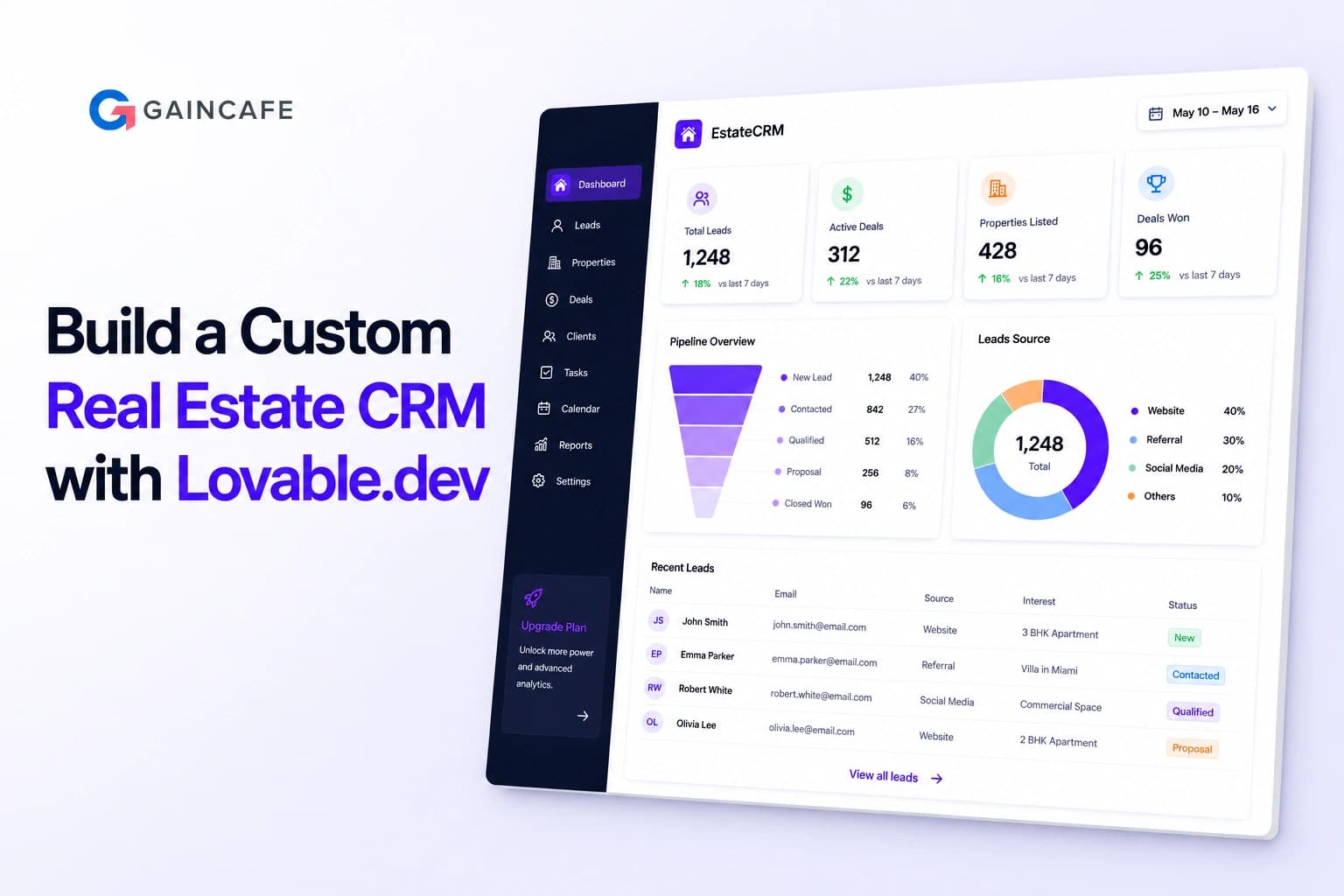
Lovable.dev for Real Estate CRM development represents a meaningful shift in how brokerages and property management firms can approach this problem. Rather than forcing a generic platform to fit a complex, commission-driven, multi-agent environment, organizations can now build purpose-built CRM software in a fraction of the traditional time and cost, using AI-accelerated full-stack development.
This is not about cutting corners on software quality. It is about eliminating the inefficiency of building from scratch while still retaining full control over features, workflows, and data architecture. For real estate companies serious about operational scalability, custom CRM development has moved from aspirational to achievable.
Want a CRM that matches your brokerage workflow?
Share your lead sources, deal stages, commission rules, and reporting needs. We’ll map your workflow and recommend the fastest path to a production-ready CRM using Lovable.dev.
Why Off-the-Shelf Real Estate CRMs Fall Short
The CRM market is saturated with platforms that promise real estate functionality. In practice, most of these tools are adapted versions of generic sales software with property fields bolted on. The gap between what they offer and what a modern brokerage actually needs is significant.
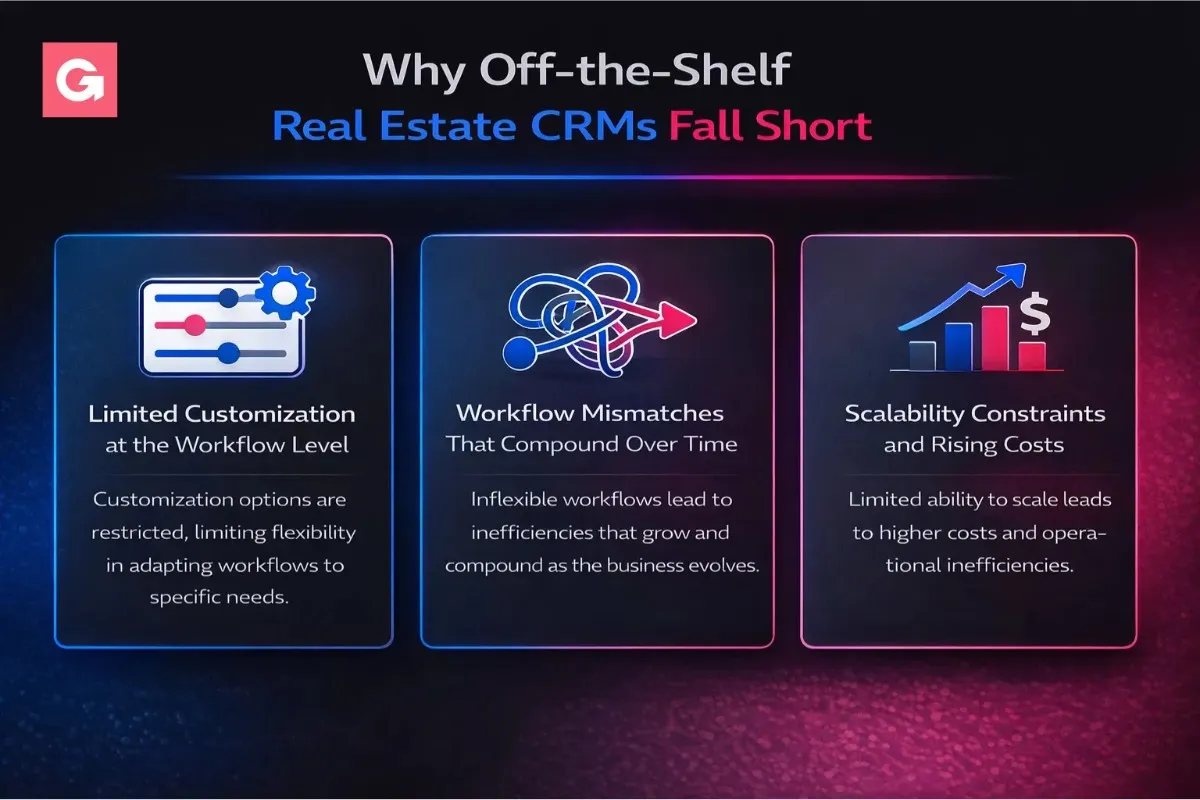
Limited Customization at the Workflow Level
Most commercial CRMs allow surface-level customization, custom fields, renamed stages, branded emails. What they cannot do is restructure the underlying logic of how a deal, a lead, or a property moves through your business. A boutique commercial brokerage operates nothing like a residential franchise, yet both are expected to work within the same pipeline architecture.
When your software does not reflect your workflow, your team adapts their behavior to the software rather than the other way around. Over time, this produces workarounds, shadow systems, and data inconsistency across the organization.
Workflow Mismatches That Compound Over Time
Real estate transactions involve layered stakeholders, buyers, sellers, landlords, tenants, investors, and lenders, often simultaneously. Off-the-shelf CRMs rarely accommodate this complexity without significant customization that must be re-engineered every time the vendor pushes a major update.
Property management firms face a particularly acute version of this problem. Maintenance tracking, lease renewal workflows, and owner reporting are not native capabilities in most general-purpose CRMs. The ones that offer them often do so through third-party integrations that introduce reliability and data integrity risk.
Scalability Constraints and Rising Costs
Vendor pricing models often punish growth. Per-seat licensing, feature-gated tiers, and API call limits mean that as a brokerage scales, adding agents, markets, or transaction volume, software costs rise disproportionately. At the same time, the platform’s architecture imposes a ceiling on how much the system can grow with the business.
By the time a firm realizes its CRM is holding it back, it has already built years of data and process dependency around a platform it cannot easily exit.
Why Real Estate Companies Need Custom CRM Software
The case for custom real estate CRM software is not simply about preference. It is about the operational requirements of a high-volume, relationship-driven industry where deal timelines are long, stakeholders are numerous, and revenue depends on precise coordination.
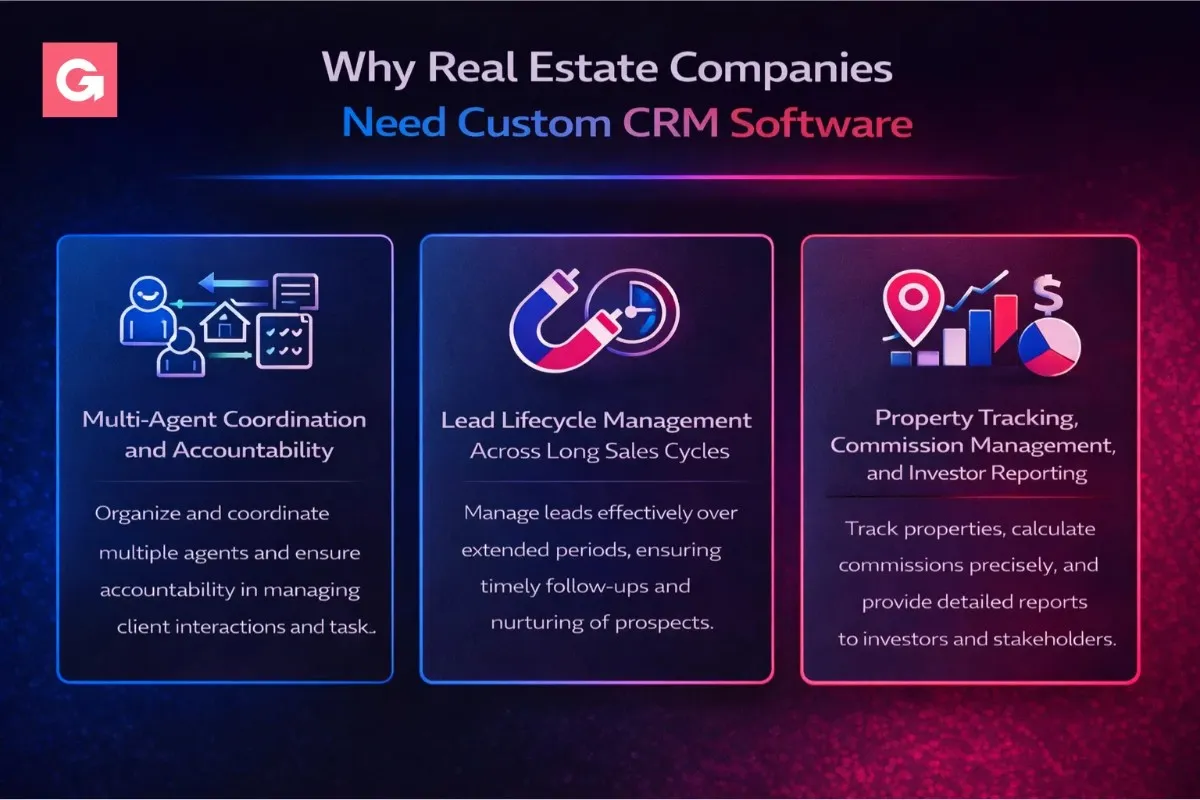
Multi-Agent Coordination and Accountability
In any brokerage with multiple agents or teams, visibility and accountability are constant challenges. A custom CRM can be architected to give team leads clear oversight of pipeline activity, lead distribution, and follow-up status, without requiring manual reporting from individual agents.
Role-based access, automated alerts, and performance dashboards can all be configured to match the actual management structure of the organization, not a generic sales hierarchy. Firms that invest in AI automation at this layer tend to see measurable reductions in administrative overhead within the first quarter of deployment.
Lead Lifecycle Management Across Long Sales Cycles
Real estate leads often take months or years to convert. A standard CRM built around 30 to 90-day sales cycles will not serve a firm where a prospective buyer may remain in the pipeline for two years before transacting.
Custom lead lifecycle management allows firms to define nurture cadences, re-engagement triggers, and segment criteria that reflect how their clients actually move toward a decision. This produces meaningfully better conversion rates without increasing lead acquisition spend.
Property Tracking, Commission Management, and Investor Reporting
These three capabilities represent the greatest functional gap between generic CRMs and what real estate companies actually need.
Property tracking dashboards that connect listing status, showing history, and offer activity to client records require deep integration between sales workflow and property data. Commission management, including splits, referrals, and disbursement tracking, is a compliance and financial function that few commercial CRMs handle adequately. Investor-facing reporting, particularly for firms managing multi-asset portfolios, requires structured data outputs that most CRM platforms cannot generate natively.
A custom-built system addresses all three in a single, unified data environment.
What Is Lovable.dev and How It Accelerates CRM Development
Lovable.dev is an AI-powered application development platform that enables the generation of full-stack web applications through a combination of AI-driven code generation and structured engineering workflows. It is not a no-code tool and it is not a simple prototype generator. It is a development accelerator designed to produce production-grade applications at significantly reduced timelines and cost.
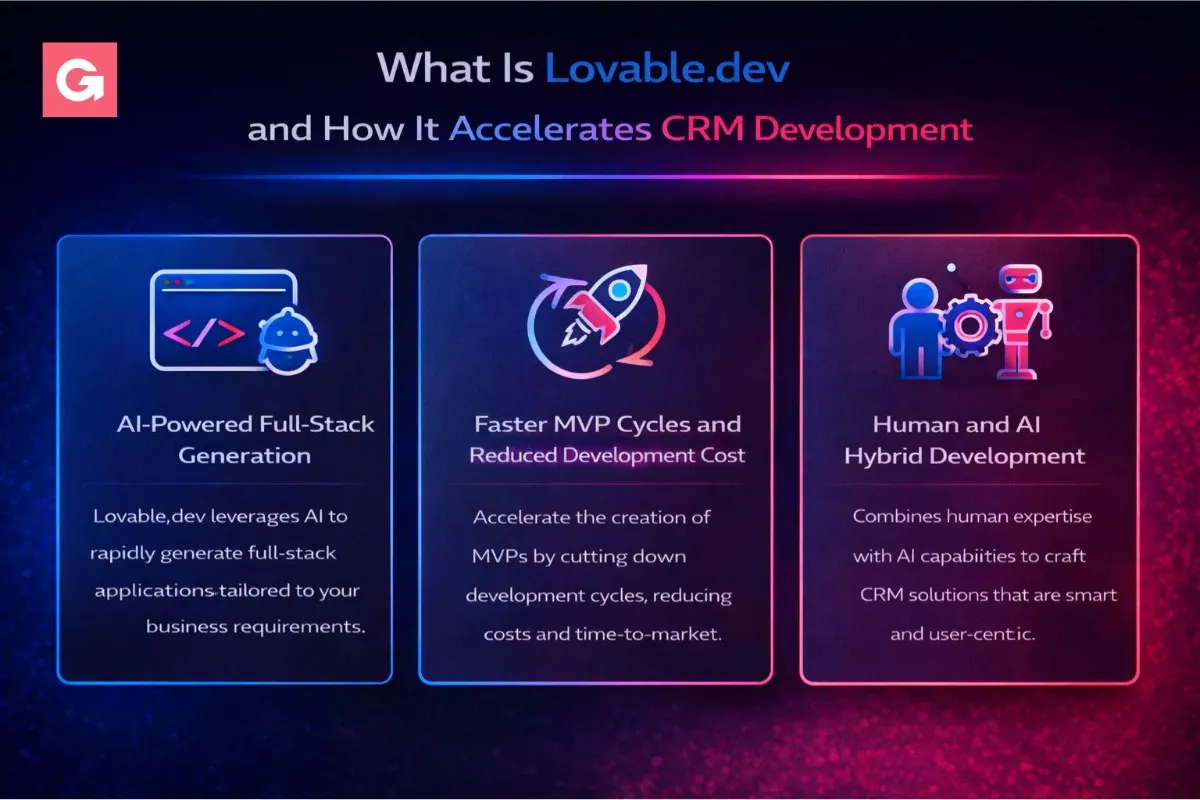
AI-Powered Full-Stack Generation
The platform can generate frontend interfaces, backend logic, database schema, and API integrations from structured prompts and specifications. For a real estate CRM, this means that the foundational architecture, lead intake forms, contact records, pipeline stages, property databases, can be scaffolded rapidly, leaving engineering resources available for the complex, business-specific logic that differentiates one firm’s system from another.
Faster MVP Cycles and Reduced Development Cost
Traditional CRM development for a mid-sized brokerage can require six to twelve months of engineering time and significant capital investment before any functional system is in production. Lovable-based development compresses this dramatically.
MVP timelines of six to ten weeks are achievable for well-scoped systems. This allows real estate companies to validate the core system with actual users before committing to full-scale feature development. The result is less wasted investment and faster time to operational value.
Human and AI Hybrid Development
Lovable.dev is most effective when used by experienced engineers who understand how to structure inputs, evaluate AI-generated output, and intervene where business logic requires precision that automated generation cannot reliably produce. This is the implementation approach that separates a stable, scalable production system from a fragile prototype. Working with a certified Lovable expert ensures that AI-generated code is properly reviewed, extended, and deployed with production standards from day one.
Key Features of a Modern Real Estate CRM Built with Lovable.dev
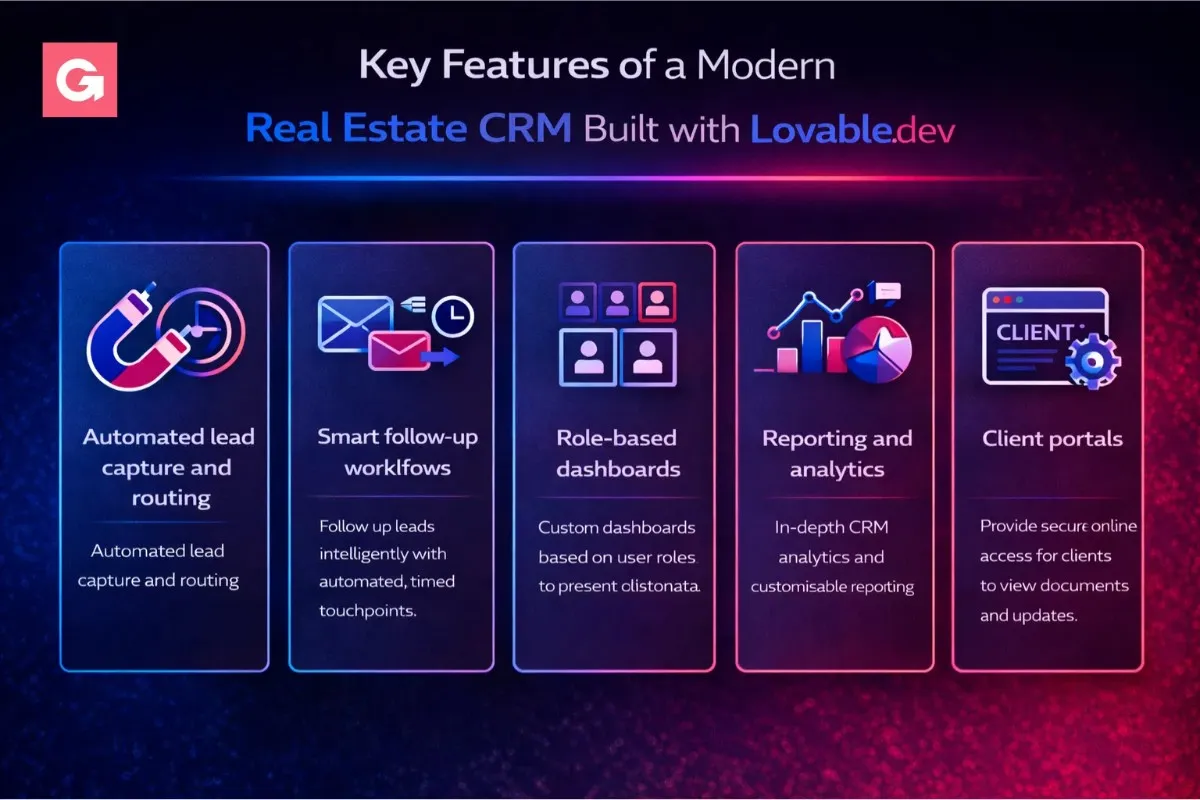
A well-built real estate CRM is not defined by the number of features it offers. It is defined by how accurately those features reflect the firm’s actual operations. The following capabilities represent the functional foundation of a modern system.
- Automated lead capture and routing from website forms, listing portals, and inbound communication channels, with rules-based assignment to agents based on geography, property type, or availability.
- Smart follow-up workflows that trigger communication sequences based on lead behavior, timeline signals, or pipeline stage, reducing manual oversight while maintaining consistent engagement.
- Role-based dashboards that surface the right data to the right stakeholders, deal-level detail for agents, team performance metrics for managers, and portfolio-level summaries for principals and investors.
- Reporting and analytics covering pipeline velocity, lead source performance, agent productivity, and transaction volume, with export capabilities for investor reporting and internal review.
- Client portals that give buyers, sellers, or tenants a structured view of their transaction status, document requirements, and communication history, reducing inbound inquiry volume and improving client experience.
The design of these portals directly affects client perception of professionalism; firms that invest in thoughtful web application design alongside CRM functionality report stronger client retention and referral rates.
Traditional Development vs. AI-Accelerated Development
The decision to pursue custom CRM software has historically been constrained by development economics. AI-accelerated development changes the calculus.
| Factor | Traditional Development | Lovable-Based Development |
|---|---|---|
| MVP Timeline | 6–12 months | 6–10 weeks |
| Initial Build Cost | High | Significantly Reduced |
| Team Requirement | Full engineering team | Smaller, senior-led team |
| Iteration Speed | Slow, expensive | Rapid and cost-efficient |
| Customization Ceiling | Unlimited but costly | Unlimited with expert guidance |
| Risk of Scope Creep | High | Managed through structured AI workflows |
The cost reduction is not the primary value proposition. The primary value is that iteration becomes affordable. When changes are less expensive to implement, firms can refine their systems based on real operational data rather than upfront assumptions, which produces materially better software over time.
How Gaincafe Helps Real Estate Companies Build Custom CRM Software Using Lovable.dev
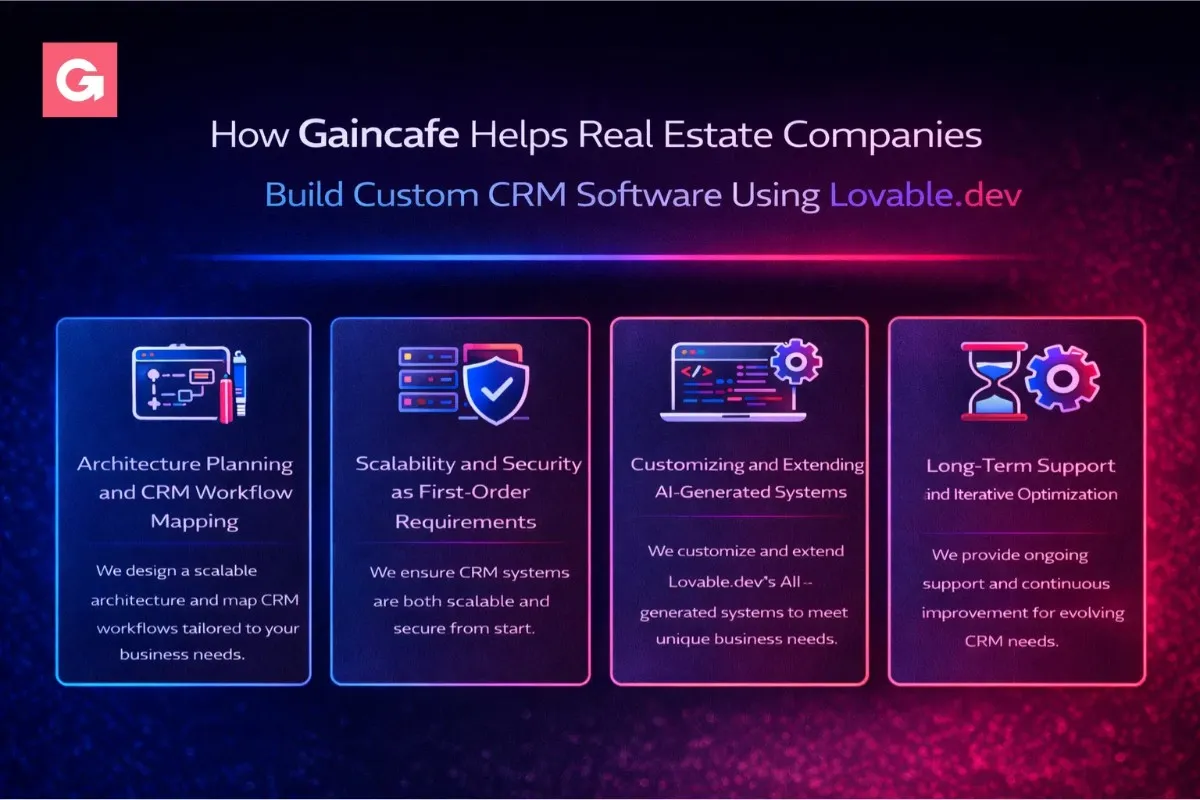
Building a real estate CRM with Lovable.dev requires more than prompt engineering and generated code. It requires a disciplined implementation process that accounts for business workflow complexity, data architecture, security requirements, and the operational realities of real estate organizations.
Architecture Planning and CRM Workflow Mapping
Before any development begins, Gaincafe conducts a structured discovery process with each client to map existing workflows, identify the boundaries of what the CRM needs to manage, and define the data relationships that will underpin the system.
This step determines how lead records connect to property records, how commission calculations flow from transaction close to disbursement, and how reporting data is structured to serve both internal management and investor-facing outputs. Getting this architecture right at the outset prevents the expensive rebuilds that result from AI-generated systems built on poorly defined foundations.
Scalability and Security as First-Order Requirements
Real estate CRMs handle sensitive personal and financial data. Any system operating in this space must be architected with appropriate data access controls, audit logging, and compliance considerations from the beginning, not retrofitted after the fact.
Gaincafe applies security and scalability requirements to the initial system design, ensuring that a CRM that functions well for a 15-agent brokerage today can accommodate 150 agents, multiple markets, and expanded feature sets without requiring a full rebuild.
Customizing and Extending AI-Generated Systems
AI-generated code provides an accelerated foundation, not a finished product. Gaincafe’s engineering team reviews, refines, and extends AI-generated output to implement the business-specific logic that automated generation cannot reliably produce, commission split calculations, regulatory compliance requirements, integration with MLS data feeds, and custom reporting outputs.
This hybrid approach is at the core of how Gaincafe operates as an AI automation company, preserving the speed advantage of AI-accelerated development while ensuring that the final system meets the production standards a real estate firm requires.
Long-Term Support and Iterative Optimization
A custom CRM is not a one-time delivery. As a firm’s operations evolve, new markets, new transaction types, new regulatory requirements, the system needs to evolve with it. Gaincafe provides ongoing development support and system optimization, treating the CRM as a long-term operational asset rather than a discrete project.
When Should a Real Estate Company Consider Lovable-Based Development?
Not every firm is at the right stage to invest in custom CRM development. The organizations that benefit most typically share a few common characteristics.
They have outgrown their current CRM and are managing significant operational friction through manual processes or third-party integrations. They have a clear sense of what their ideal workflow looks like but cannot find a commercial platform that supports it. They are preparing for growth, in agent headcount, geographic markets, or transaction volume, and need a system that can scale with that growth rather than constrain it. Or they operate in a specialized segment, commercial real estate, property development, multi-family asset management, where generic CRM platforms consistently fall short.
For firms in early growth stages evaluating their first custom-built system, a structured MVP development engagement offers a lower-risk entry point, a working, validated core system before committing to full-scale development investment.
If any of these conditions apply, a Lovable-based custom development engagement is worth evaluating seriously.
Ready to validate a CRM MVP in 6–10 weeks?
We’ll scope an MVP that matches your operations, build it with Lovable.dev + senior engineering review, and ship a production-ready foundation you can iterate on without vendor constraints.
Conclusion
Generic CRM software was built for average use cases. Real estate companies, particularly those managing growth, complexity, or specialization, are rarely average. The operational requirements of a modern brokerage or property management firm demand software that reflects how the business actually works, not how a software vendor assumed it might.
Lovable.dev makes custom CRM development accessible for the first time at a cost and timeline that mid-sized firms can realistically consider. But the platform’s value is fully realized only when it is implemented by a team that understands both the technical architecture and the business domain.
Gaincafe works with real estate companies and brokerages to design, build, and scale custom CRM systems using AI-accelerated development. Whether your firm needs a dedicated Lovable expert to lead implementation or a full-scope engagement from architecture through deployment, we are equipped to help you define the scope, build the right system, and support it as your business grows.
How long does it take to build a custom real estate CRM with Lovable.dev?
A custom real estate CRM built using Lovable.dev typically reaches MVP stage in six to ten weeks for a well-scoped system.
This compares to six to twelve months for traditional custom development. The time reduction comes from AI-accelerated scaffolding of core architecture, contact records, lead pipelines, dashboards, and database structure, which allows engineering resources to focus on business-specific logic rather than foundational build work.
Factors that affect timeline:
- Number and complexity of third-party integrations (MLS feeds, payment processors, email platforms)
- Depth of custom business logic (commission calculations, regulatory compliance workflows)
- Number of user roles and dashboard configurations required
- Whether the engagement begins with a structured discovery and architecture phase
Working with an experienced Lovable implementation partner keeps timelines on track by reducing scope ambiguity and preventing mid-build architectural changes.
How much does it cost to build a custom real estate CRM using Lovable.dev?
AI-accelerated development using Lovable.dev costs significantly less than traditional custom CRM development because it reduces engineering hours required for foundational build work, requires a smaller core team, and supports faster iteration without proportional cost increases.
The exact investment depends on:
- Scope of features included in the initial build
- Number and complexity of integrations required
- Security and compliance architecture requirements
- Ongoing support and optimization scope post-launch
A useful framing is to compare the cost of custom development against the compounding cost of per-seat licensing, integration workarounds, and lost operational efficiency from using a platform that does not fit the business. For most mid-sized brokerages, a custom CRM reaches cost parity with commercial platforms within 18 to 24 months, and continues to deliver value without licensing cost increases as the firm scales.
For firms evaluating entry-level investment, an MVP-first development approach builds and validates a core system before committing to full-scale feature development.
What is the difference between building a CRM with Lovable.dev versus using a no-code platform?
The fundamental difference is architectural ceiling and long-term flexibility.
No-code platforms allow non-technical users to configure pre-built components within a constrained environment. They are fast to set up and require no engineering expertise, but they impose hard limits on what the system can do. Custom integrations, complex business logic, and scalability beyond the platform’s design parameters are either impossible or prohibitively expensive to implement.
Lovable.dev generates actual production code, frontend, backend, and database, which means the resulting system has no architectural ceiling. It can be extended with custom logic, integrated with any third-party service, optimized for performance, and scaled without platform-imposed constraints.
The trade-off is that Lovable.dev requires engineering expertise to implement correctly. AI-generated code must be reviewed, extended, and validated by experienced developers, particularly for the business-specific logic, security configuration, and integration architecture that a real estate CRM requires.
For a real estate company with complex operational requirements, Lovable.dev-based development delivers the flexibility of custom software at a materially lower cost and timeline than building from scratch.
How does Gaincafe implement real estate CRM projects using Lovable.dev?
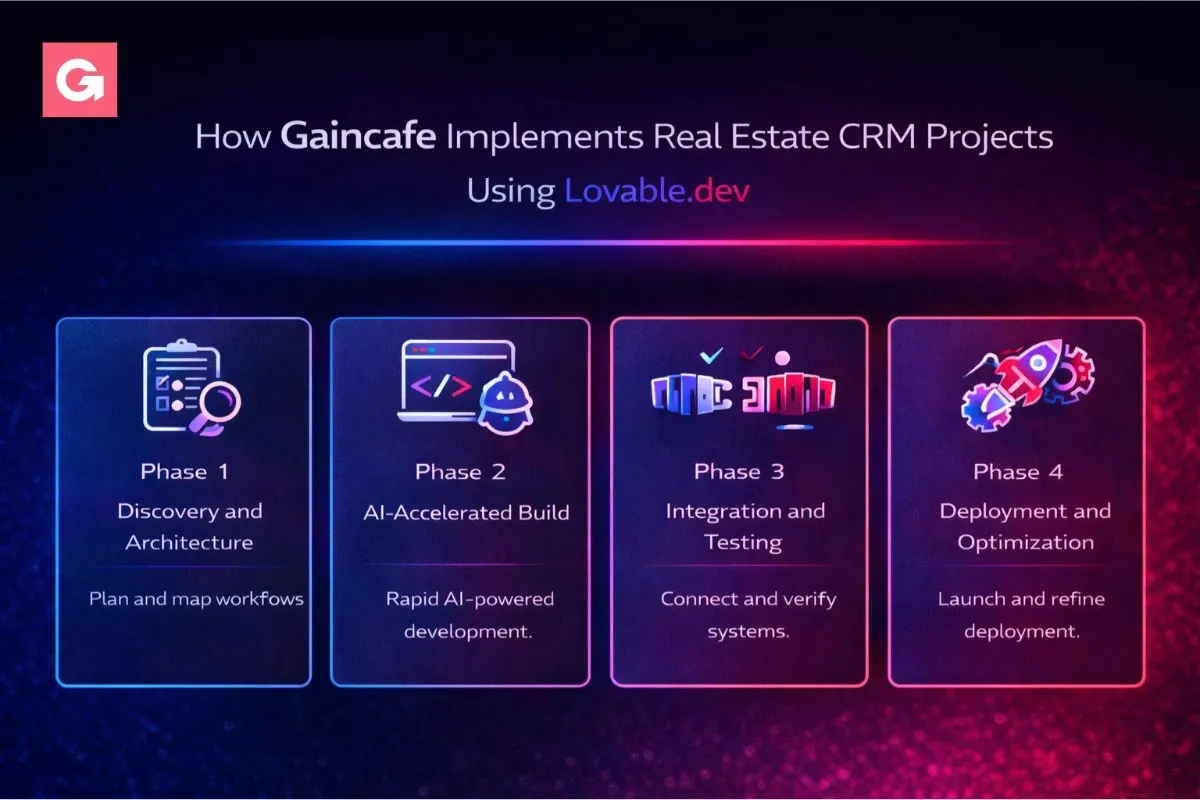
Gaincafe follows a structured implementation process for every real estate CRM engagement:
Phase 1, Discovery and Architecture Gaincafe conducts a structured discovery process to map existing workflows, define data relationships, identify integration requirements, and establish the security and scalability architecture for the system. This phase determines how every component of the CRM connects, from lead intake to commission disbursement, before development begins.
Phase 2, AI-Accelerated Build Core system architecture is scaffolded using Lovable.dev, with Gaincafe’s senior engineering team reviewing and extending AI-generated output. Business-specific logic, commission calculations, compliance requirements, custom reporting, is implemented by engineers, not generated automatically.
Phase 3, Integration and Testing Third-party integrations, MLS data feeds, email platforms, payment processors, document management tools, are built and validated. The full system is tested against real-world operational scenarios before any production deployment.
Phase 4, Deployment and Optimization The system is deployed with appropriate security configuration, user onboarding support, and documentation. Gaincafe provides ongoing development support as the firm’s operational requirements evolve.