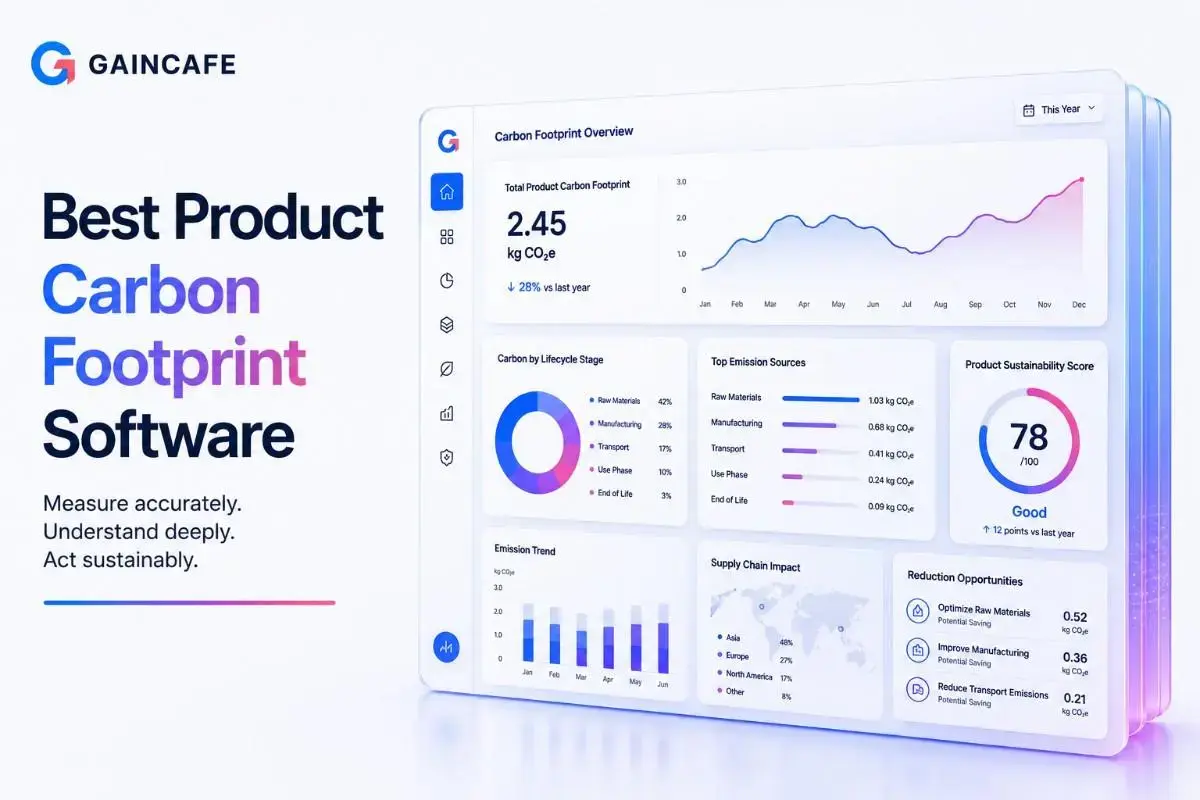
Product carbon footprint software has moved from a sustainability nice-to-have to a board-level requirement in 2026. Regulators now ask for product-level emissions data, retailers demand it from suppliers, and investors read it before they commit capital. Companies that once tracked emissions in spreadsheets find that approach too slow and too risky for audit-ready reporting.
This guide reviews the ten best product carbon footprint software platforms this year, explains how to choose the right one, and shows when a custom build makes more financial sense than any off-the-shelf tool.
The numbers explain the rush. Fortune Business Insights valued the carbon accounting software market at around 22.5 billion dollars in 2025 and projects close to 27.5 billion dollars in 2026. The Business Research Company reports a similar path at roughly 22 to 23 percent annual growth. That growth pushes more carbon footprint software into the market every quarter, which makes the choice harder, not easier.
What Is Product Carbon Footprint Software?
Product carbon footprint software measures the total greenhouse gas emissions tied to a single product across its full life cycle. It covers raw material extraction, manufacturing, transport, use, and disposal, an approach often called cradle to grave. The result is a verifiable emissions figure for each product, expressed in kilograms of CO2 equivalent. This differs from a company-wide number, because it isolates the footprint of one item rather than the whole organisation.
Most platforms work by combining your activity data (materials, energy, logistics) with emission factor databases. The software then applies recognised standards such as ISO 14067 or the GHG Protocol Product Standard to calculate results. Good carbon footprint calculations software also highlights the hotspots, meaning the stages or materials that contribute the most emissions. That insight is what turns a compliance report into a reduction strategy.
Product Carbon Footprint Software vs Carbon Accounting and LCA Software
Buyers often confuse three categories, and the difference matters before you spend. Corporate carbon footprint software measures organisation-wide emissions across Scope 1, 2, and 3, which suits company-level disclosure. Product carbon footprint software zooms into one product, which suits labelling, supplier requests, and border tariffs. Life cycle assessment (LCA) software goes broadest of all, modelling many environmental impacts beyond carbon, such as water and land use.
There is overlap, and several vendors now offer carbon footprint management software that blends these views in one platform. A carbon footprint management software suite can track corporate totals while still producing product-level numbers on demand. If your main pressure is product labels or import tariffs, prioritise product-level depth. If you report at the entity level, corporate carbon footprint software will serve you better.
Why Product Carbon Footprint Software Is Business-Critical in 2026
Two regulations changed the urgency this year. The EU Carbon Border Adjustment Mechanism (CBAM) entered its definitive phase on 1 January 2026, shifting from quarterly reporting to an annual declaration, with the first verified annual report due by 30 September 2027. Importers of goods such as steel, aluminium, cement, and fertilisers now carry a carbon price at the border, with a penalty of 100 euros per excess tonne for non-surrender of certificates. Accurate product-level data is now a direct cost driver, not just paperwork, and that is why demand for carbon footprint software keeps climbing.
The second shift is the Corporate Sustainability Reporting Directive (CSRD). After the EU Parliament approved the Omnibus I package in December 2025, CSRD now applies to larger companies with 1,000 or more employees and 450 million euros or more in turnover. These companies must report Scope 3 emissions, which depend heavily on product and supplier data. For thousands of exporters and suppliers worldwide, product carbon footprint software is the practical way to answer these requests on time.
Top 10 Best Product Carbon Footprint Software in 2026
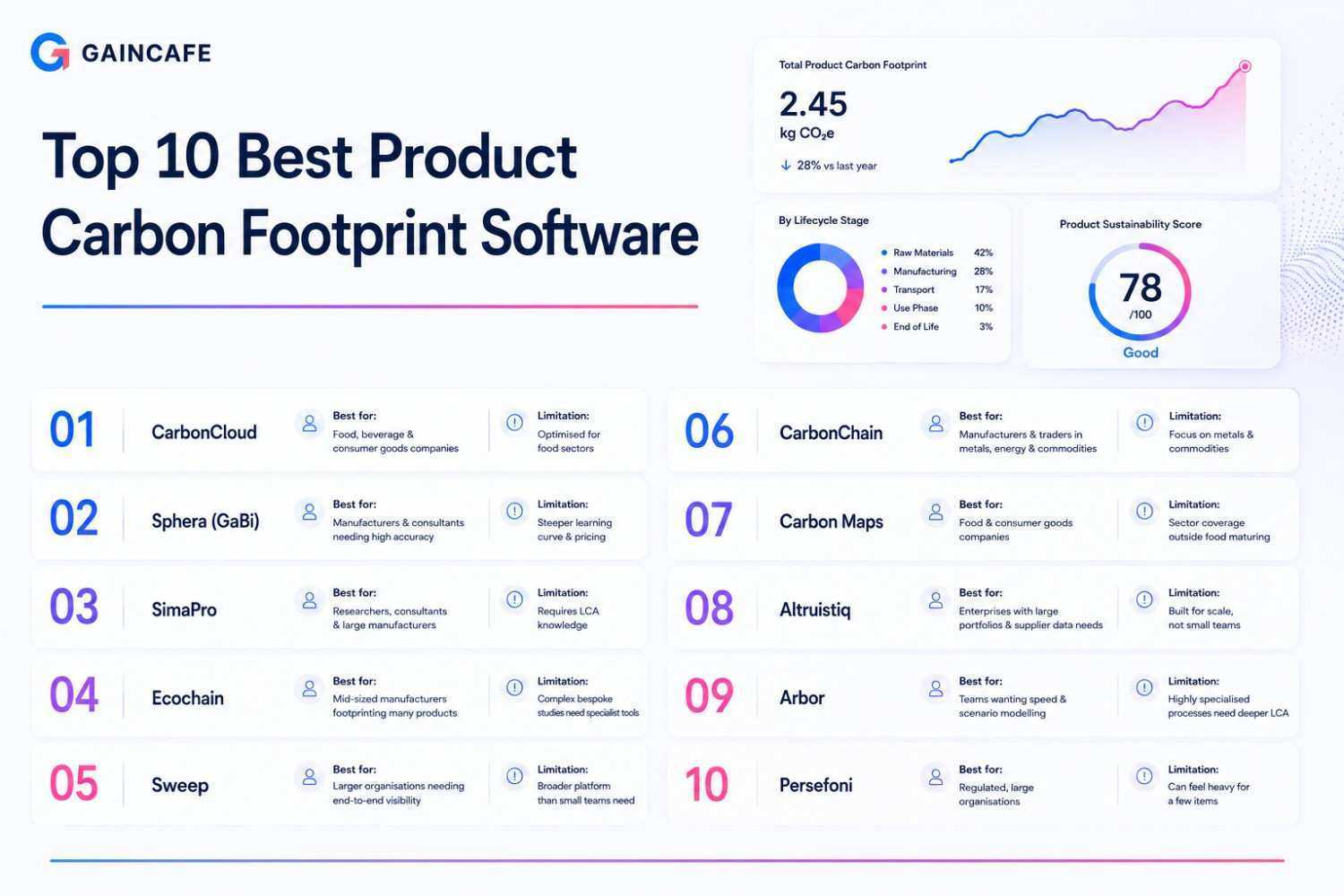
The platforms below are the strongest product carbon footprint software options this year, chosen for accuracy, compliance coverage, and integration depth. Each entry notes who it suits best and one limitation to weigh.
1. CarbonCloud
CarbonCloud automates product carbon footprint calculations using a proprietary database of more than 10,000 pre-modelled items. It is built for food, beverage, and consumer goods companies that need fast, ISO 14067-compliant results. Its strength is speed, since teams can generate footprints without deep LCA expertise. The limitation is that it is optimised for food sectors and fits non-food products less neatly.
2. Sphera (GaBi)
Sphera, through its GaBi product line, is one of the most established life cycle assessment suites for detailed product footprint modelling. It suits manufacturers and consultants who need granular, defensible data across complex supply chains. Premium databases make it a benchmark for accuracy. The trade-off is a steeper learning curve and enterprise-level pricing.
3. SimaPro
SimaPro is a professional-grade LCA tool that uses curated databases like ecoinvent for high-fidelity life cycle data. Researchers, consultants, and large manufacturers rely on it for audit-ready precision. Teams choose it when defensibility matters more than speed. It expects real LCA knowledge, so it is less friendly to first-time users.
4. Ecochain
Ecochain is a cloud platform built for rapid product footprinting from cradle to gate. It works well for mid-sized manufacturers that want to footprint many products without hiring a full LCA team. Automation and a clean workflow are its selling points. Very complex bespoke studies may still need a specialist tool.
5. Sweep
Sweep is a carbon management platform with automated product-level tracking and supplier engagement features. It suits larger organisations that want corporate and product views together. Strong data collaboration tools help capture primary supplier data. Smaller teams may find the platform broader than they need.
6. CarbonChain
CarbonChain specialises in product carbon footprints for commodity supply chains such as steel, aluminium, and energy, with a focus on EU CBAM and CSRD compliance. It is a natural fit for manufacturers and traders facing border tariffs. Its supplier data network supports accurate Scope 3 figures. The focus on metals and commodities makes it narrower for other sectors.
7. Carbon Maps
Carbon Maps automates product footprint calculations following ISO 14067 and the GHG Protocol, and provides a clear summary of total product emissions. It targets food and consumer goods firms that field frequent retailer and supplier requests. Reporting clarity is a strong point. Sector coverage outside food is still maturing.
8. Altruistiq
Altruistiq measures corporate emissions at scale and can calculate thousands of product carbon footprints each month, backed by access to over 180,000 secondary emission factors. It suits enterprises with large portfolios and heavy supplier data needs. Granular, site-level modelling is a clear strength. The enterprise positioning means it is built for scale rather than small teams.
9. Arbor
Arbor is an automated carbon accounting platform whose standout claim is ISO 14067-compliant product carbon footprints in as little as 10 minutes. It works for teams that want speed plus scenario modelling for lower-carbon design. Audit-ready output aligned to the GHG Protocol and PEFCR helps with compliance. Highly specialised industrial processes may still need deeper LCA tooling.
10. Persefoni
Persefoni is an enterprise carbon management and accounting platform trusted for disclosure-grade reporting. It suits regulated, larger organisations that need corporate and product-level views with strong governance. Its compliance and audit features are mature. For a small product team focused on only a few items, it can feel heavy.
How to Choose the Right Product Carbon Footprint Software
Choosing product carbon footprint software starts with the standards you must meet, not the feature list. Confirm the tool supports ISO 14067, the GHG Protocol Product Standard, and any framework tied to your market, such as CBAM or PEF. A platform that cannot produce verification-ready output will cost you later. Strong carbon footprint calculations software should also show its working, so auditors can trace every number.
Next, weigh data quality and integration. The best results come from primary supplier data, so check whether the tool can collect it and connect to your ERP, PIM, or procurement systems. Pricing models vary widely, from per-product fees to enterprise contracts, so map cost to your portfolio size. Some carbon cost estimating software also forecasts CBAM certificate exposure, which helps finance teams plan ahead.
Finally, test usability and support against the team that will actually run it. A powerful tool that no one can operate produces no value. Ask about onboarding, audit support, and how often emission factors are updated. This checklist often reveals that no single product fits perfectly, which leads many companies to the build versus buy question.
When Off-the-Shelf Product Carbon Footprint Software Falls Short
Off-the-shelf tools are excellent for standard needs, but they have real limits at scale. Per-product or per-seat pricing can climb quickly when you footprint thousands of items across many sites. Industry-specific processes, unusual materials, or custom allocation rules often do not fit a generic template. When the tool dictates your workflow instead of the reverse, accuracy and adoption both suffer.
Data ownership is the other pressure point. Grand View Research notes that organisations with strict data protection needs, such as those in financial services, healthcare, and government, increasingly prefer on-premises carbon software to keep full control of sensitive data. Understanding the custom software vs SaaS economics in 2026 helps explain why deep integration with proprietary ERP systems, internal databases, and supplier portals is so hard to achieve with a closed platform. A capable carbon cost estimating software module built into your own stack can model border exposure exactly the way your finance team needs. These are the moments when carbon footprint software development becomes the smarter path.
Carbon Footprint Software Development: What a Custom Build Means
Carbon footprint software development means building a tool around your exact products, data sources, and compliance needs. Instead of forcing your process into a vendor template, the software models your real bill of materials, your supplier network, and your reporting formats.
Modern teams scaffold the interface and core flows quickly with AI-powered development , then engineers harden the calculation logic, security, and integrations. The output is a platform you own outright, with no per-product fee as your catalogue grows.
A custom build also lets you place AI where it adds value, such as estimating missing Scope 3 factors or matching supplier data to the right emission factors. It can connect directly to ERP, IoT meters, and procurement systems for live data instead of manual entry. For many firms this is best to start with a focused MVP that footprints one product line, then expands. Ownership of the code and the data is the core reason regulated companies choose carbon footprint software development over a subscription.
Carbon Footprint Software Development Cost in 2026
The most common question is simple: what is the carbon footprint software development cost in 2026? Industry data this year puts typical custom software at 30,000 to 100,000 dollars for small to mid-sized projects, and 50,000 to 200,000 dollars or more for complex builds with AI, integrations, and custom workflows. A focused PCF tool usually lands in the lower-to-middle band, while a full enterprise platform with supplier portals and audit modules sits higher.
Three factors move the carbon footprint software development cost the most: the number of integrations, the depth of the emission factor logic, and the level of compliance and audit features. AI-assisted development has changed the maths, with 2026 reports noting that delivery time and cost can fall by two to three times, so a build that once took ten months and over 100,000 dollars can now ship in around three months for far less. The right scope keeps the budget controlled without cutting accuracy.
It helps to think in total cost of ownership, not just the sticker price. 2026 analyses estimate enterprise SaaS total cost at 2.5 to 4 times the headline figure once seats, tiers, and add-ons stack up. Build versus buy break-even commonly lands between year two and year three, after which an owned platform mostly needs maintenance while subscriptions keep compounding. For a large product catalogue under regulatory pressure, that long-term picture often favours a custom build.
Build vs Buy: A Quick Decision Framework
Use a short test to decide. Buy off-the-shelf product carbon footprint software when your needs are standard, your portfolio is modest, and speed to first report matters most. Build custom when product-level differentiation, data sovereignty, or per-product cost at scale becomes the deciding factor.
Many companies run a hybrid model, and it works well. The same build, buy, or hybrid decision applies here: use a proven tool for quick wins while building a custom layer for the workflows that competitors cannot copy. The decision is rarely permanent, so revisit it as your catalogue and regulatory exposure grow. The goal is the right tool for the problem in front of you, not loyalty to one model.
Why Choose Gaincafe for Carbon Footprint Software Development
Gaincafe builds custom carbon and sustainability software with an AI-first method and senior engineering oversight. The team scaffolds quickly with tools like Lovable, Cursor, and Replit, then hardens authentication, security, performance, and integrations so the product is ready for real users. This approach delivers working software in weeks rather than months, which suits founders and enterprise teams facing tight compliance deadlines. You get a platform you own, not another subscription.
The team has shipped production systems with custom backends, real-time data, and third-party integrations across regulated and data-sensitive use cases. For a product carbon footprint software build, that means clean ERP and supplier integrations, audit-ready calculation logic, and AI placed only where it reduces manual work. Engagements can start as a focused MVP and scale into a full platform as needs grow. If you are weighing the build, talk to our engineering team for a scoped estimate that fits your business instead of the other way round.
Conclusion
The right product carbon footprint software gives you accurate, audit-ready emissions data at the product level, which is now a business requirement rather than an option. Off-the-shelf tools cover standard needs well, and the ten platforms above are strong starting points. When per-product cost, data ownership, or deep integration becomes the deciding factor, carbon footprint software development gives you a platform you own and control. Match the choice to your portfolio size, your regulatory exposure, and your long-term cost picture, and the decision becomes clear.