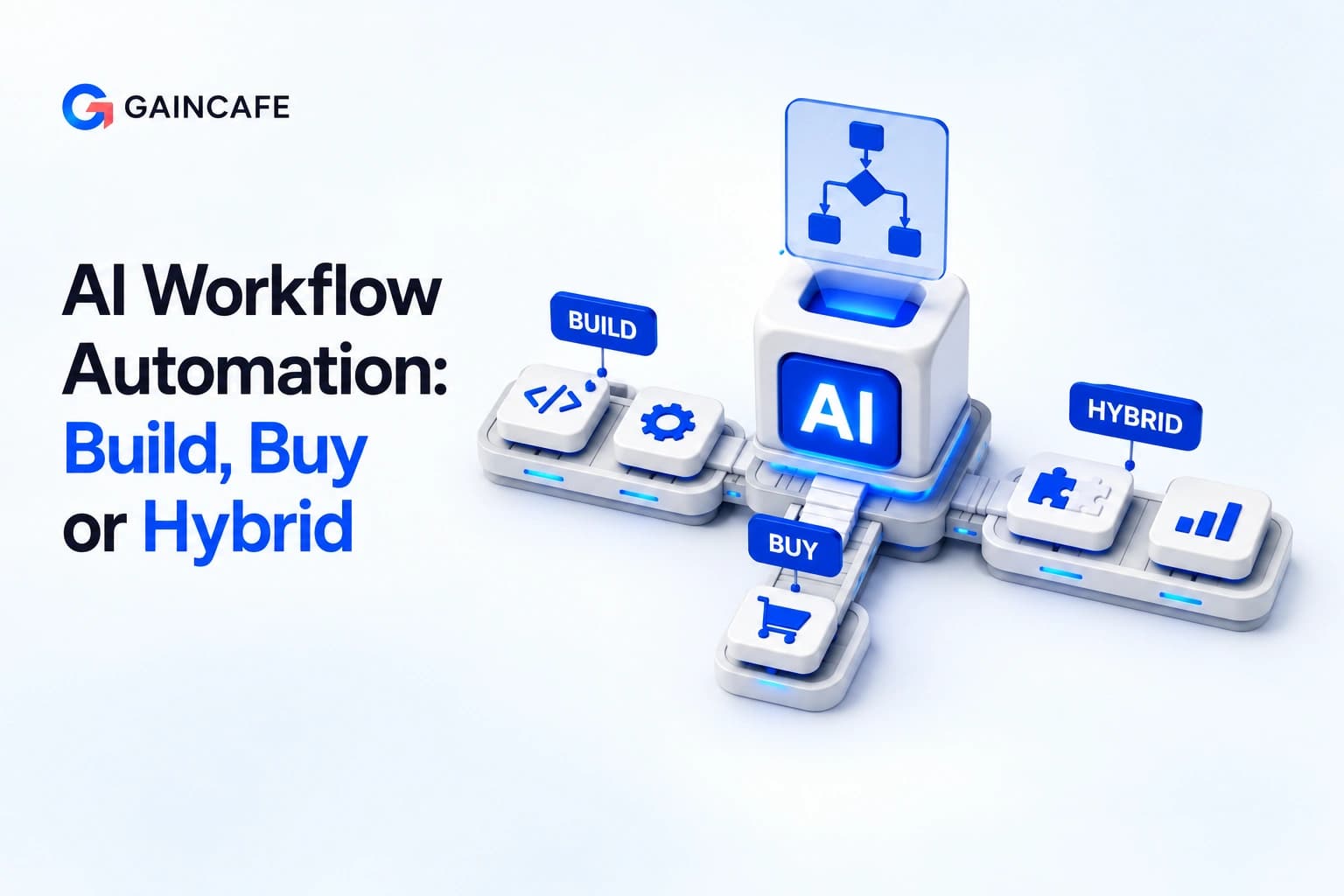
With increasing adoption of artificial intelligence by firms, one of the critical questions organisations need to answer when adopting AI technology is whether they will develop their own AI workflow automation, purchase it off-the-shelf or use a hybrid strategy. AI technology has moved beyond basic automation and is now key to operational optimisation, decision-making, cost savings, and enhanced customer experience. The choice made regarding this issue could have ramifications for ROI and business agility, among others.
There cannot be a generic response to whether to build, buy, or use a combination of both strategies when implementing AI workflow automation software. In building such automation tools, customisation is assured, but on the other hand, this would take more time, resources, and money. Enterprises are now going for hybrid solutions in order to exploit the strengths of both strategies in achieving their goals.
Understanding AI Workflow Automation and Why Strategy Matters
AI workflow automation involves optimisation, automation, and enhancement of business processes while ensuring minimal involvement of human beings. Unlike conventional automation, which works on the basis of pre-set rules, AI technology is capable of analysing data, recognising trends, making decisions, and continuously improving its performance.
This technology is revolutionising the way organisations optimise their mundane activities and improve their efficiency in areas such as customer service, document processing, finance, logistics, and human resources, among others. It is worth noting that about 90% of organisations currently utilise AI technology.
With the widespread adoption of AI, choosing the best automation strategy has become as important as AI itself. Organisations adopt AI to deliver better customer experience, make decisions and save money, with successful AI workflow automation adoption resulting in increased productivity by 40%. These achievements require proper planning of the process that would correspond to business needs, fit into the current infrastructure and allow for growth in the future. The key to success is to see AI workflow automation as a strategic move that changes workflows and encourages innovation.
Business Impact of Implementation Decisions
- ROI: The most efficient strategy ensures that the process is accomplished faster and bears fruit in the form of real value added to the company, as well as optimises the use of resources in order to maximise returns on AI investment.
- Scalability: A scalable design of AI will enable further automation within a company without having to develop new systems or re-engineer the company's structure.
- Security/Governance Compliance: Enterprises that have to comply with various data security and governance requirements will need to factor this into their consideration of AI products to avoid compliance issues.
- Integration: For an AI automation project to be successful, integration into the corporate environment in terms of applications, databases, ERP systems, among others, is critical.
- Total Cost of Ownership: Besides the initial cost for putting the product in place, there are other things to juggle, like maintenance and training, and they kind of matter too.
Risks of Choosing the Wrong Approach
- Going Past Budget: When the implementation plan is poor, and the complexity of overall roll-out is underestimated, costs tend to climb, timelines slip, and the ROI comes late.
- Implementation Issues for AI Technologies: There might be employee resistance to change in cases when the AI workflow automation software is complicated and implemented incorrectly.
- Technical Problem: Implementation of a solution in order to quickly solve problems without considering future necessities can create high costs related to technical limitations, thus limiting scalability.
- Limitations Related to Scalability: Rigid AI technology cannot always cope with changing business conditions.
Choosing the Right AI Workflow Automation Option: Build, Buy or Hybrid
A) Option 1: Build
The “build” approach involves designing, developing, implementing, and utilising an artificial intelligence-based automated system tailored to the business's needs.
Advantages:
- Complete Customisation
- Improved Data Control
- Flexible Integrations
Challenges:
High cost, long development time, need for skilled professionals.
Best Fit For: Large enterprises, regulated industries, complex workflows.
B) Option 2: Buy
The “buy” approach includes adopting commercially available software solutions (SaaS) that offer ready-made automation capabilities.
Advantages:
- Faster Deployment
- Lower Initial Costs
- Vendor Support
- Proven Functionality
Challenges:
Limited customisation, dependency on vendors.
Best Fit For: SMEs, quick implementation needs.
C) Option 3: Hybrid
The hybrid approach combines commercial platforms with custom-built AI systems.
Benefits:
- Faster Time-to-Value
- Cost Optimisation
- Improved Flexibility
- Better Scalability
Challenges:
Integration complexity, governance issues.
Best Fit For: Medium to large enterprises.
Final Takeaway
Choosing between build, buy, or hybrid depends on business goals. A hybrid approach often provides the best balance between flexibility and efficiency. Businesses that align AI strategies with objectives gain competitive advantage.