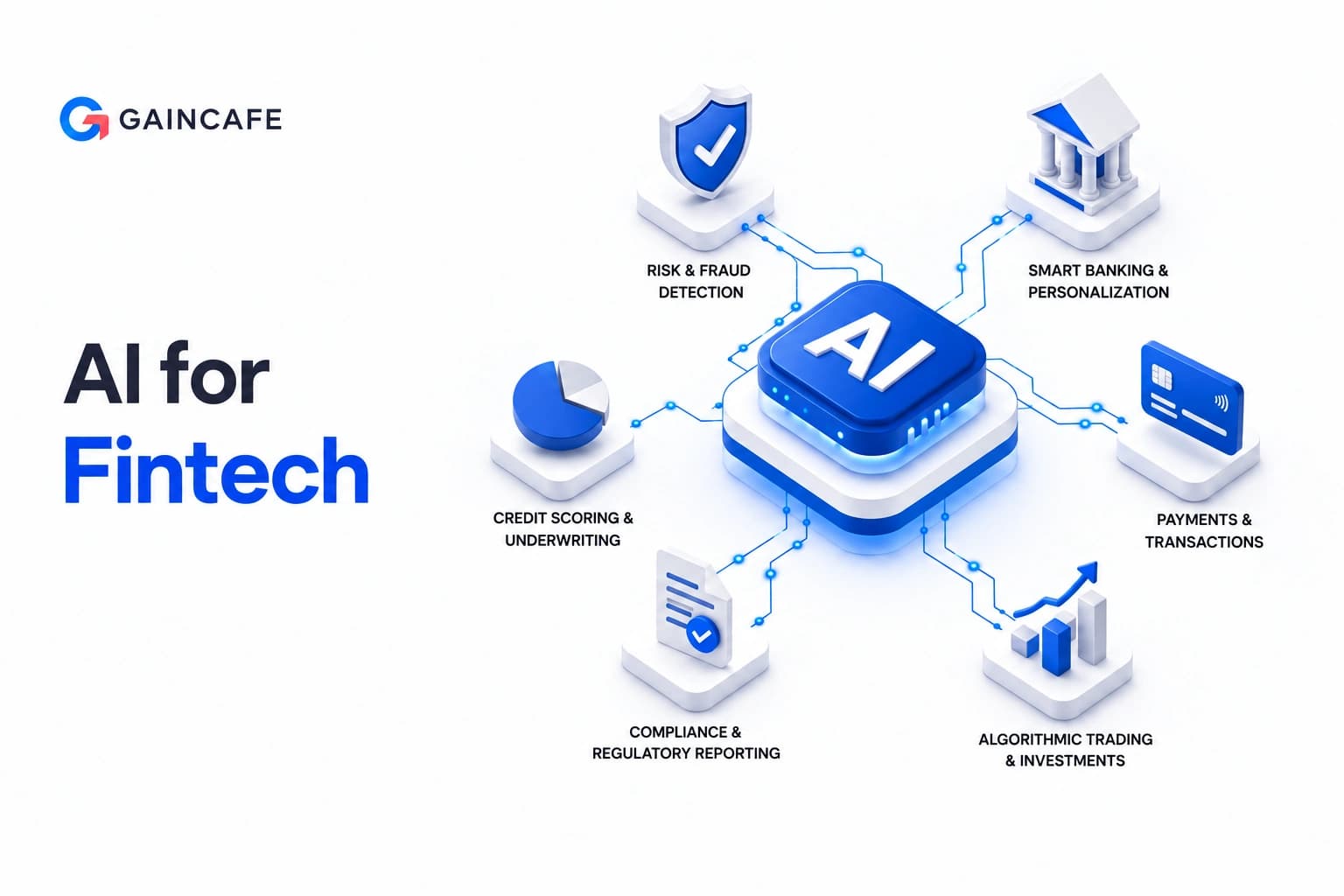
The fintech industry is entering a new phase of transformation in 2026, with Artificial Intelligence (AI) becoming the core driver of efficiency, innovation and customer-centric services. From automating routine operations to allowing real-time financial insights, AI for fintech helps to streamline procedures, deliver customised experiences at scale and reduce costs. As digital financial services continue to expand, AI adoption isn’t just a competitive benefit but is becoming a business necessity.
Advancements in machine learning, predictive analytics, generative AI and intelligent automation are reshaping how financial institutions manage risk, detect fraud, evaluate creditworthiness and engage customers. With growing demand for smarter and secure financial solutions, companies are using AI for fintech across functions to enhance decision-making and unlock new growth opportunities. In this blog, we will explore the top 8 use cases of AI driving fintech adoption in 2026 and their impact on the future of financial services.
Understanding AI for Fintech: Why Organisations are Increasingly Adopting AI in 2026?
AI has become a strategic priority for fintech companies in 2026 as the industry faces growing demand for faster services, improved customer experiences, better operational efficiency and stronger security. Financial institutions are now using AI-based technologies such as natural language processing (NLP), machine learning, generative AI, and predictive analytics to automate complex processes, make informed business decisions, and reduce costs. As digital financial services continue to expand, AI for fintech companies remains a competitive advantage in an increasingly data-driven marketplace.
The rapid growth of digital transactions and customer data is another factor driving AI adoption . According to industry experts, the International AI for fintech market is expected to top $60 billion by 2030, growing at over 20% annually. Plus, AI helps cut costs big time; it can easily knock down those ops expenses by 20-30%. Moreover, AI outperforms older methods in detecting fraud. Companies adore AI; it hikes up profits and amps up risk management.
Today, customers crave personalised service and speedy responses, transforming the fintech scene big time. Around 70% of financial companies are investing in AI for fintech just to meet these demands. They use AI for chatbots, virtual assistants, and tailored advice. This lets firms offer slick, instant services on a large scale.
AI For Fintech: Top 8 Use Cases To Consider Before Adopting AI In Finance Operations in 2026
1. AI in Fraud Detection and Prevention
Fraud detection has changed due to AI's ability to analyse transaction data across multiple financial platforms in real time. AI for fintech systems help to identify unusual behaviour and prevent fraud and suspicious activities before they create any losses.
AI is making strides in identifying fraudulent activity in the financial technology (FinTech) space. This includes reducing false positives and enhancing the precision with which it can identify potential risks associated with certain transaction types (e.g., instant payments and cross-border transactions).
Key Benefits:
The ability to detect and prevent fraudulent conduct in real time, with fewer false positives and human investigations of possible fraudulent transactions; the flexibility to react to developing fraud patterns; and greater regulatory compliance through automated alerting.
2. AI-Driven Credit Scoring and Lending
Traditional credit assessment methods depend on limited financial information, often excluding people with sparse or no credit history. AI for fintech enhances credit scoring by looking at alternative data, such as spending habits, transaction histories, income patterns, and repayment trends. AI helps lenders make better and more equitable lending decisions.
Fintech lending has almost completely transformed banks and other financial institutions by 2026, enabling them to speed up loan approval and reduce underwriting time while maintaining strong risk management.
Key Benefits:
It offers deep borrower risk analysis with various financial signals, speeds up loan approvals, and expands opportunities for underserved folks. Also, it improves decision quality through predictive analysis and increases lending accuracy while lowering default risk.
3. Conversational AI for Seamless Customer Experience
Conversational AI is a key trend of AI for fintech, driving customer engagement as financial institutions modernise digital channels and banking apps. AI assistants in apps and websites offer users immediate assistance with repetitive financial tasks using NLP and Machine Learning.
They leverage user data and provide customised answers based on the user's profile or the context of their question. This reduces operational costs and increases customer satisfaction.
Key Benefits:
Automation solutions reduce costs and handle tedious tasks. It offers round-the-clock chatbot support for help anytime. These systems give personalised responses based on user info or requests. Plus, it integrates easily with the banking and fintech systems.
4. AI-Driven Predictive Analytics for Investment Strategies
AI-based predictive analytics is becoming important for fintech firms to streamline investment and portfolio-related strategies. By processing real-time and historical data, AI for fintech systems assist institutions in anticipating market movements and identifying opportunities faster.
These models consistently learn and adapt, which allows firms to evaluate risk, streamline asset allocation and align investment decisions with the emerging revenue models. The result is faster, informed decision-making in volatile markets.
Key Benefits:
Predicting market trends can really boost investment returns. It also beefs up portfolio management with AI risk analytics, helping to identify opportunities while reducing risk. Real-time data lets you make quicker decisions, too.
5. Anti-Money Laundering (AML) and Compliance Monitoring
Financial institutions face regulatory pressure to detect and prevent money laundering activities. AI for fintech boosts anti-money laundering by analysing large transaction datasets, spotting anomalous patterns, and detecting potential financial crimes.
In 2026, AI for fintech helps firms automate things like transaction monitoring, risk assessment, and knowing your customer stuff. This means they catch more bad stuff accurately, lower costs, and ease the workload.
Key Benefits:
AI handles monitoring and compliance way better, spotting sneaky transactions, adapting to new rules seamlessly, and reducing the need for employees to constantly handle all the routine tasks.
6. AI-Powered Blockchain for Secure Transactions
AI enhances the safety and operational efficiency of blockchain networks. Blockchain transactions are stable and fully transparent, with an immutable history. AI detects anomalies by learning patterns, allowing it to immediately identify when something is not right.
AI for fintech systems tracks blockchain activity across data sources to detect irregular behaviour, reduce fraud risk and accelerate transaction validation. This integration is valuable for real-time payments and decentralised financial platforms.
Key Benefits:
FinTech speeds up transactions and settles them more quickly. It makes financial platforms handle more volume. Real-time fraud detection and smarter monitoring also step up security.
7. Risk Management and Predictive Analytics
Risk management for financial service institutions is crucial to their survival in an ever-changing economic landscape. Financial technology companies research and predict risks by analysing customer behaviour, business operations, and global economic trends. In 2026, AI-driven predictive analytics will enable financial technology to manage risks before they occur. This strengthens the business, improves its strategic planning, and ensures proper compliance with all the rules.
Key Benefits:
AI for fintech helps catch risks before they become big problems, keeping the business stable and strong. Also, it makes risk assessments better and provides real-time data for accurate forecasting.
8. AI for Personalisation in Financial Products
AI-based personalisation is becoming a competitive differentiator for fintech companies striving to increase customer loyalty and engagement. By evaluating data such as spending behaviour, savings patterns, and credit history, AI for fintech systems customize financial products for individual users.
Embedded AI agents personalise customer journeys - from product recommendations to pricing and timing, leading to more relevant offerings, higher retention rates and stronger relationships.
Key Benefits:
Enables personalised financial products for lots of customers at once. Finds strong upsell and cross-sell opportunities, boosts conversion rates with smart suggestions, and keeps customers more engaged.
4 Crucial Challenges Every Fintech Company Must Solve by 2026
1. Data Privacy: Protecting Client Data, Maintaining Trust
Fintech companies end up with mountains of sensitive data, like payment details and financial records. Once AI gets involved, it makes safeguarding harder, especially against cyberattacks. And if something goes wrong, such as a breach, a fintech organisation could incur massive financial losses, face harsh penalties, and take a real hit to its reputation.
At the same time, AI for fintech can help strengthen security in a practical way too, for example, by spotting fraud immediately, improving encryption, and identifying strange patterns. Automation AI solutions for the fintech world, such as cybersecurity monitoring, real-time fraud prevention, automated threat response, plus behavioural analytics that look for what doesn’t fit.
2. AI Model Bias and Transparency
AI relies on past data to make decisions, and if that data's biased, AI for fintech could inadvertently create unfair situations - be it in loan approvals or customer screenings. This hurts customer trust and damages a company's reputation.
To tackle this, they're investing in explainable AI and bias detection tools. This makes AI more transparent, showing how suggestions are made and ensuring fairness. Key AI solutions consist of bias detection tools, explainable systems, regular performance tests, and transparent decision models.
3. Regulatory Compliance Complexities
Financial institutions have to deal with guidelines that keep changing, for anti-money laundering, the know-your-customer checks, financial reporting, and data protection. It drains so many resources.
But AI steps in to streamline things. It can automate tasks such as monitoring, risk assessment, and report generation. AI for fintech helps by spotting and highlighting fishy transactions and churning out needed reports. This lets firms concentrate on other stuff.
Key AI use cases automate KYC and AML checks, manage regulatory reporting tasks, and run real-time transaction surveillance plus risk management tools, to help teams move faster.
4. Customer Retention and Personalisation Challenges
Rising customer expectations push digital banks and fintechs to be more competitive. To keep and engage users, firms really do need to provide more personalised experiences.
In practice, firms leverage AI for fintech to inspect user behaviour, preferences, and transaction histories, then translate all that into action. That means better-tailored suggestions, sharper financial insights, and also offers that feel more relevant. These custom services tend to improve customer satisfaction and commitment over time.
Key AI approaches include personalised financial recommendations, predictive churn analysis, intelligent product recommendation engines, and AI-driven customer segmentation.
Final Takeaway
AI is no longer a future consideration for financial institutions; it has now become a critical driver of innovation and growth. In 2026, AI for fintech is getting better at spotting fraud, managing risk, and giving people more personal banking experiences, while also automating compliance stuff. But as competition heats up, and customer expectations keep shifting, fintech firms really have to use AI in a smart way, not just “because it’s new.” With that approach, they can tighten security, reduce expenses, discover fresh earning avenues and even speed up day-to-day service To stay ahead, you have to invest in the right AI for fintech system and build a good foundation for whatever comes next. The finance world never sits still, so adaptability becomes kind of non-negotiable. Looking to step up your fintech with AI? Connect with the Gaincafe Technologies team for safe services that amp up efficiency, foster innovation, and help your business grow.